Category: readings

  • 12 Haiku Resolutions for the New Year

    12 Haiku Resolutions for the New Year

    Note: This essay was originally intended to run in the January issue of the Haiku Society of America newsletter. However, it got preempted by an obituary for an HSA member. Given that this piece won’t be timely in February, I figured I might as well share it here, so it doesn’t just linger on my hard drive. (Because if I save it for 2025, I will probably forget that it exists.)

    As someone who takes on a shocking number of projects, you probably aren’t surprised that I love the reflection and goal-setting aspect of the new year. I’m also wary of absolutes like, “You should write every day.” As we go through the different seasons of life, our relationship to our poetry evolves. I wanted to start out 2024 with a list of practices you can use to support your haiku practice. Whether you’re a new practitioner, or more seasoned and looking for fresh inspiration, I hope some of these ideas resonate with you.

    1. Sign up for a time-bound daily writing challenge such as National Haiku Writing Month (https://www.nahaiwrimo.com/) or Poetry Postcard Fest (https://cascadiapoeticslab.org/poetrypostcards/). Daily writing is a fantastic discipline, and committing to a one-month period can make it seem like a more manageable task. (Note that Poetry Postcard Fest is not specific to haiku/senryu, but the postcard format is a perfect fit!)

    2. If you feel extra ambitious about daily writing, try the Buson Challenge: 10 haiku a day for 100 days. (I confess I have attempted this challenge at least four times and haven’t yet succeeded.) You can listen to Mike Rehling talk about the challenge here: 3 Michael Rehling.  

    3. Make a calendar of submission deadlines for the coming year. Most publications have their deadlines established already, and you can set up recurring deadlines easily using Google Calendar or iCal. Don’t forget to turn on email or push notifications so you always get a reminder! (I like to set notifications for both the opening date and closing date.)

    4. If you don’t have a system yet for tracking your haiku submissions, this is the year to set one up! Most of us (myself included) have accidentally submitted something that’s out for consideration elsewhere. A solid submission system helps! There are many services out there, such as Duotrope, that help you track your submissions (usually for a fee). However, you can use a spreadsheet or Word document as well. I’ve been using a color-coded Excel spreadsheet for three years, and it works great!

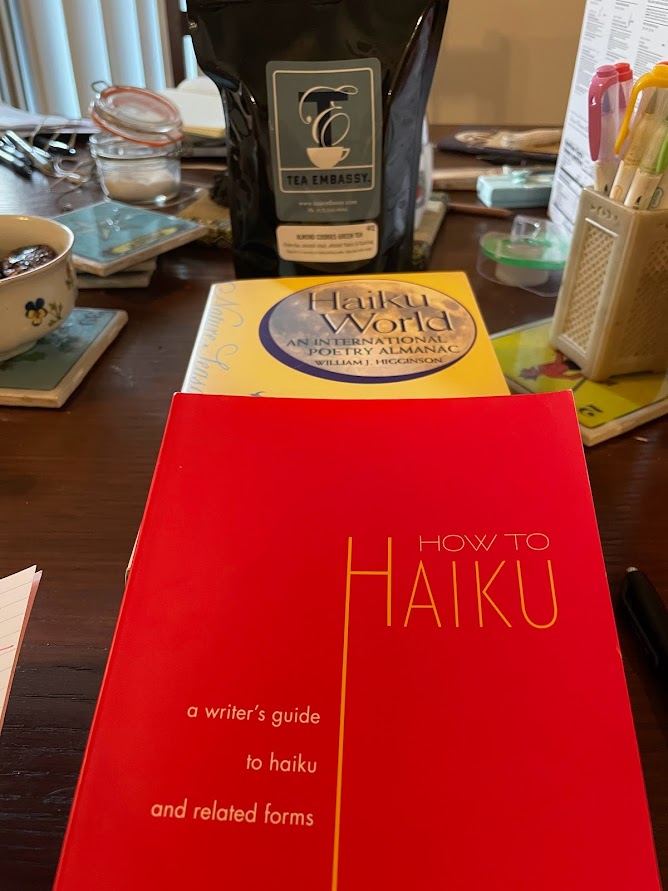
    5. Work with a saijiki (a compendium of kigo), picking one word a day to start as a jumping-off point. My favorite is William J. Higginson’s Haiku World: An International Poetry Almanac. However, it’s out of print and copies can be expensive. I am also a fan of Jane Reichhold’s A Dictionary of Haiku, available as a free PDF from the Haiku Foundation

    6. Commit to a revision streak. Often, we get focused on generating new work and don’t devote as much time to revision. Consider taking a few weeks off from writing new poems (unless you get struck with divine inspiration, of course!) and focus on daily revision of existing work. 

    7. Spend a chunk of time every day observing your environment: sunrise and sunset, traffic patterns (they can be seasonal!), the emergence of plants, the clothes that people wear. Start to develop your own personal saijiki related to the area where you live. 

    8. We often overlook the sense of smell in our writing. Try spending a week writing down every scent you encounter as you go about daily life. Use your scent list as a springboard for your haiku, senryu, and other forms.

    9. Join forces with a haiku friend or a small group and write some renku, rengay, or split sequences. If you don’t have a writing buddy in your area, you can write via email, online chat, text message, or Zoom.

    10. Participate in a ginkgo (haiku walk). If you don’t have a group in your area to walk with, you can have a solitary ginkgo. (Or maybe start a ginkgo group in your area!) You can learn more about ginkgo practice in the article “Haiku as a Nature Connection Practice” from seasonwords.com.

    11. Make a small chapbook as a birthday or holiday gift for a loved one, especially if you have a number of haiku/senryu written about them and experiences you have shared.

    12. Take a poetic risk this year: submit to a journal or contest that feels out of reach, self-publish a collection, give a public reading, or start a podcast. Maybe launch a print-on-demand store of postcards featuring your haiga. Whatever is calling to you but seems scary, give it a shot. 

    Which of these ideas will you try this year? Let me know! And be sure to check back in to tell me about your experience.

  • Join Us on a Virtual Poetry Road Trip!

    Register for the event via Eventbrite!

    Even with pandemic restrictions loosening, I’m still inclined to take precautions regarding large events. Most of the poets I know are still hosting readings online, and I’m not about to be the first one to push the status quo. But now that the spring semester is over, I’m getting that usual burst of creative energy, and I wanted to host an event. It’s definitely been a while.

    I also wanted to collaborate with Zoe Fay-Stindt again. We edited the 2020 Texas Poetry Calendar together, and since then she’s spent time in Europe, and then returned to the USA to pursue her MFA at Iowa State University. When the idea for a virtual poetry road trip between Texas and Iowa popped into my head, I immediately messaged her, and then, it was on!

    The Virtual Poetry Road Trip takes place on Friday, May 21st from 6:00-7:30 pm CST. This event is by donation, and you can still join even if you can’t contribute financially. We’re asking all attendees to register via Eventbrite. If you are unable to make a donation and have trouble registering, please contact me directly! We will work it out!

    If you want to know more about our featured poets, read on! Otherwise, head over to our Eventbrite page to attend. And bring your own road trip snacks! (I’ll have two kinds of potato chips.)

    Featured Poets
    Cindy Huyser’s (TX) poems have received Best of the Net and Pushcart Prize nominations, and appear in many journals and anthologies. Her chapbook, Burning Number Five: Power Plant Poems, was co-winner of the 2014 Blue Horse Press Poetry Chapbook Contest, and her first full-length collection, Cartography, is forthcoming from 3: A Taos Press. She has edited or co-edited a number of anthologies, including Bearing the Mask: Southwestern Persona Poems (Dos Gatos Press, 2016) and several editions of the Texas Poetry Calendar. Cindy has been a juried performer for the Houston Poetry Fest, Houston’s Public Poetry series, and the Scissortail Creative Writing Festival, and lives in Austin, Texas, where she hosts the monthly BookWoman 2nd Thursday Poetry Reading and Open Mic series.

    Ken Hada (OK) lives in rural Pottawatomie County in Oklahoma. He has published eight volumes of poetry, including his latest, Sunlight & Cedar (VACPoetry, 2020). Ken’s poems have been featured on The Writer’s Almanac, and his work has been awarded by The Western Writers of America, The National Western Heritage Museum, SCMLA and The Oklahoma Center for the Book. Information available at kenhada.org.

    Dottie Joslyn (MO) is a writer and poet living in Southwest Missouri. She is a retired Certified Applied Poetry Facilitator in the field of Poetry Therapy, Certified Journal Facilitator, and Journal to the Self® Instructor. Her poems have appeared in: American Tanka, Buffalo Bones, Poetry from the Trail Ridge Writers, Wellness & Writing Connections Newsletter, Beginning Again: Creative Responses to Poetry of Presence, and Gyroscope Review. She also has a poetry book, Just Show Up, published in late 2018. Her website, http://www.joslynpoems.com has more information and includes an interactive blog.

    Jennifer L. Knox’s (IA) sixth book of poems, Crushing It, was published by Copper Canyon Press in 2020. Publisher’s Weekly’s review called Crushing It, “Darkly inventive…This is a careful, thoughtful book about the complexities of identity and the difficulty of words.” Knox’s poems have been published in The New Yorker, The American Poetry Review, Granta, McSweeney’s,five times in the Best American Poetry series, and the 2022 Pushcart Prize: Best of the Small Presses anthology. Her nonfiction writing has appeared in The New York Times and The Washington Post. She received an Iowa Arts Council Fellowship for her crowdsourced poetry project, Iowa Bird of Mouth. Over 750 people from around the world contributed to the project; the code is open source and free to use in noncommercial projects.

  • The Best of It: The Poetry of Donuts Edition

    A delightful donut and coffee
    1. Postcards from the August Poetry Postcards Festival have already started to arrive! They bring me such joy.
    2. The blueberry donuts from Wheatsville.
    3. Getting to participate in the Wednesday Night Poetry virtual open mic.
    4. My grading queue is clear (for now).
    5. Natalie Goldberg hopped into our workshop practice period today. Wonderful to get to be in her (virtual) presence!

  • A Year in Readings

    Being bawdy at Austin Writers Roulette in February 2015
    Being bawdy at Austin Writers Roulette in February 2015

    At last year’s Poetry at Round Top festival, which was also the weekend of my 30th birthday, I gave myself a challenge: to do at least one reading a month before I turned 31. I was going to read in public at least once a month, either at an open mic or as a feature. It didn’t matter if it was one poem or several. I was just going to get up and get out there. That meant 12 performances of one kind or another in my 30th year.

    At the Georgetown Poetry Festival
    At the Georgetown Poetry Festival

    As it turns out, doing one reading every single month was quite challenging, and some months I didn’t read at all… But I not only met my goal, I surpassed it! In November, for example, I was too busy training for my black belt test to schedule anything. And while there are poetry readings and open mics just about every week in Austin, some months, I couldn’t get anything that meshed with my work schedule. But there were other months full of abundance. December was particularly active; I read four times!

    I ended up reading 16 times. 13 of those times were in Austin, one was in Georgetown, one was in Fort Worth, and one in Waco. This year my schedule was just too heavy for me to get to San Antonio or Houston again. I can’t believe I haven’t read in either of those cities in over a year!

    Now that this challenge has been met, I plan to keep it up. Reading 12 times in a year was tough at times, but overall doable. Now I’m just trying to figure out what the literary challenge will be for Year 31!

  • January Retrospective

    2015 started off with some great opportunities for writing, reading, and sharing work.

    AWR January 2015
    The Austin Writers Roulette group

    First, I again had the honor of being a featured poet at the monthly Austin Writers Roulette show. The January theme was “Redemption,” and host Teresa Roberson once again rocked a thematic outfit. I performed three short, silly poems about feeling guilty for irrational things. We had a wide range of poems and stories, some honest and haunting. There were so many brave authors sharing vulnerable but inspiring work.

    ITWOW
    Having fun in Waco

    Despite living only about 90 minutes from Waco, the only time I’ve spent there has been driving through it. But Waco poet Jenuine Poetess, founder of In The Words of Womyn, invited me up for ITWOW’s birthday celebration/daylong writing retreat. I arrived in time for the afternoon potluck where there was amazing food. After two workshops that brought forth some incredible work from all participants, I got to hang out, eat delicious Vietnamese food, and then participate in a reading/open mic, as well as a silent auction. I made some excellent new friends, and found out that Waco has its charms.