Julie creates the New to Haikucolumn for The Haiku Foundation, and also serves as the THF secretary. Her first collection, Grasping the Fading Light: A Journey through PTSD, won the 2021 International Women’s Haiku Contest. Julie is also a freelance writer, environmental scientist, and a mother.
You mentioned on Instagram that After Curfew was inspired by Rowan Beckett’s Hot Girl Haiku. Can you say more about that inspiration, and how it helped you write and shape your collection?
Rowan held an online launch party on Facebook for their book, Hot Girl Haiku, in May 2022. My friend, haiku poet Susan Burch, reminded me to attend. I’d never been to an online launch party. It was fun! Rowan had posts and videos set up on a schedule. One of the prompts was to write our own “hot girl haiku.” It brought me back to that time in early adolescence and young adulthood when I wanted so much to be a “hot girl” but I was more of a “geeky girl.” I wrote this in the comments:
face-first in a stranger’s lap— tequila shots
Joshua Gage, of Cuttlefish Books, wrote back that he’d like to hear more of that story. I said there wasn’t much to tell — I didn’t think I had too many “hot girl” moments. But it got me thinking, which led to writing the collection.
On a related note, I read online that you wrote most of After Curfew in one sitting. Do you usually write in big spurts? How was creating this collection similar to or different from your usual process?
I rarely write in big spurts! This was very different than my usual plodding along. I just felt inspired. It was like Rowan gave me permission to write about my past.
What was your editing process like? Did you have to cut any haiku? Was there a point where you found yourself needing to add some to supplement the original poems?
I wrote the poems quickly at first, jotting them down as they came to me. When it came time to order them, I wanted to tell a cohesive story: of first love, of loss, of moving on. When I realized that I really did have a collection, I wrote a few poems to fill gaps in the narrative, and I dropped a few that didn’t fit. Originally, I had a few tanka in there too.
In English-language haiku, poets are often instructed to focus on composing from the present moment. After Curfew is written in the present tense, but concerns the past. Did you make a conscious decision to keep the poems in the present tense? Or did that emerge organically during the writing process?
I think the present tense brings an immediacy to haiku — writing in past tense puts some distance between the reader and the poem. I’d like to say something profound about how I wanted the reader to share in my awkward moments, but the truth is, I was reliving my memories as I wrote them.
What was it like to relive those awkward teenage years in such an immediate and compressed way? Did that awkwardness feel fresh, or has distance lessened it?
Oh my goodness, reliving those years still feels awkward! But I can laugh alongside the discomfort now. I’ve read this collection aloud to friends and most laugh and nod along. We’ve all been there, but when you are living those years, it’s so tough.
Cuttlefish Books has been posting some of my haiku from the book on Instagram. I was really struck by the response to this one:
strangers at the bar trying to remember my fake name
To me, that was a funny memory of getting called out for using a fake name. But when I saw a hashtag about the patriarchy, I realized that’s true as well. I was using a fake name to keep myself safe. That experience was just so normalized for me that I never saw it that way. It adds a whole new dimension to the poem, and to the collection. Rowan wrote an Afterward for me that touches on this.
What level of vulnerability was required to not only write these haiku, but publish them in a collection? Is it similar to, or different than, the levels of vulnerability required in other areas of your work?
I’ve said that my first print collection, Grasping the Fading Light: A Journey through PTSD, was equally embarrassing, but for different reasons. This collection is much easier for me to see in print. I’m not sure I will ever publish anything that makes me feel as vulnerable as my trauma collection does.
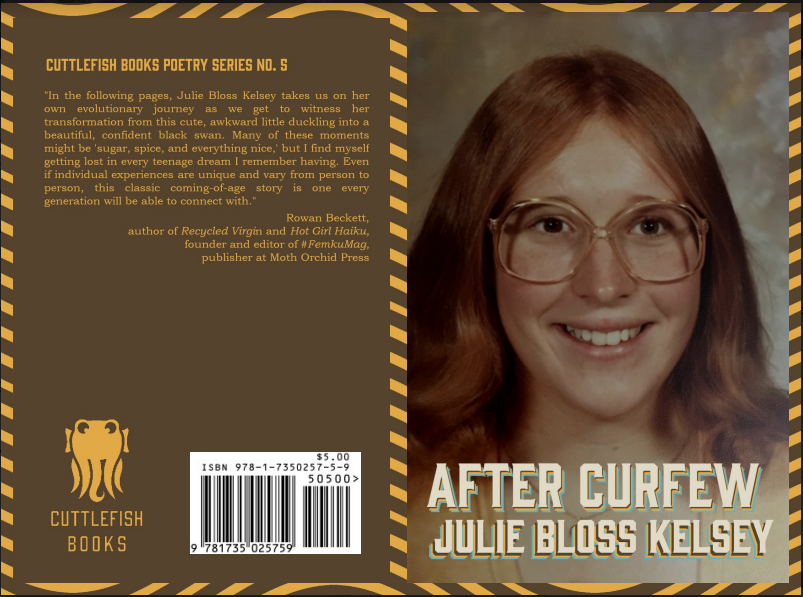
I love that you used your 8th grade class photo as the cover image. What was the thought process that went into your cover design decisions?
My best friend posted that picture of me on Facebook for my birthday one year! I saved it and reposted it to my Facebook wall in December of last year. Joshua Gage, of Cuttlefish Books, noticed it and asked if we could use it for the cover.
Is there anything else I haven’t asked that you’d like to say about After Curfew, or about haiku in general?
Reading over my answers, I realized that Facebook played a huge role in this book coming into existence! Social media, for all of its ills, can be a great tool for poets. I cut my teeth writing haiku on Twitter.
Writing haiku can be isolating. Most of us don’t interact with other haiku poets in person in our daily lives. Helping new haiku poets find connection is a primary goal of my haiku column, New to Haiku, at The Haiku Foundation.
Although Lenard and I only had the chance to meet briefly at HNA, I have long admired the depth, breadth, and skill of his haiku. His attention not just to the details of the present, but also to the stories of the past, reflects a sense of artistic discipline that’s worth emulating. In celebration of his forthcoming chapbook, A Million Shadows at Noon, I wanted to feature him here to learn more about his process with this new collection. Read on for the full interview.
Cuttlefish Books is currently in the preorder period for the summer 2023 chapbook series. You can reserve your copy of Lenard’s book, A Million Shadows at Noon, or buy the whole bundle of three!
AW: What is the thematic focus of A Million Shadows at Noon? What compelled you to create this chapbook?
The thematic focus of A Million Shadows at Noon is brotherhood, family, love and unity. I was compelled to create this project, because I drew inspiration from such a significant historical event. It was so powerful to see so many Black men come together and march for important issues. By now, I hope you know that I am referring to the Million Man March, which will celebrate its thirtieth anniversary in 2025. I wanted to do something innovative with the haiku form or a haiku sequence, an extensive of my poetic risks with my book, Desert Storm. Perhaps, I need to write one more book-length poem, employing the haiku form. To that end, maybe there is a trilogy in the making. Let’s see what happens with my future work.
AW:What are the particular challenges of writing a haiku sequence? On the flip side, what is it about writing sequences that you find inspiring?
The challenges of writing a haiku sequence are varied. Firstly, I had to ensure that all of the haiku resonate as individual poems. Secondly, I had to ensure that I was writing the same poem again and again, if you will, or similar poems. Thirdly, I had to ensure that all of the haiku linked some kind of way. Fourthly, I had to ensure that the poems worked in chronological order. At least, that is the way I saw the sequence developing. Fifthly, I had to ensure that the natural world played a major role in the sequence. Sixthly, I had to ensure that I infused rhythm or musical elements throughout A Million Shadows at Noon. Seventhly, I had to ensure that I employed strong verbs in the haiku sequence. Eighthly, I had to ensure that the contrasts were effective throughout the sequence. Ninthly, I had to ensure that the symbolism worked well. Tenthly, I had to ensure that the poems told a story. Tenthly, I had to ensure that the haiku sequence was original. Eleventhly, I had to ensure that the poems did not reveal everything. Twelfthly, I had to ensure that I employed vivid imagery. Of course, there are other elements and characteristics that I strove to employ in the sequence.
AW:How do you perceive the difference between a structured haiku sequence versus a less structured collection of haiku addressing common themes?
The difference between a structured haiku sequence and a less structured collection of haiku addressing common themes is that the structured haiku sequence unfolds like a novel. It must work as a whole work, reeling in readers and closing with a surprise ending. The sequence should address the five who, what, where, when and why. The less structured collection of haiku does its own thing.
AW:Was this chapbook one you worked on over a period of months or years? Or did it come to you fairly quickly?
A Million Shadows at Noon came to me quite quickly. I think I wrote the poems over a weekend. Of course, I worked on ordering the poem. I am sure I tweaked some of them. Many of the poems originally work, because I felt like I was in a writing zone.
AW:What was your editing process like? If you decided to cut poems, how did you make that choice?
My editing process was to cut out or delete any poems that I was might be weak or did not work with the sequence. I also take a close look at the musical elements and how the poems might do something new.
AW:In the English-language haiku world, we are often taught that haiku should come from a moment in daily life. The emphasis on the haiku moment is often overemphasized, even though both the classical and contemporary editions are filled with counterexamples. I imagine that when working on a narrative sequence, many of these haiku did not come from a specific moment. To what extent was your direct experience relevant to this collection? How did history, or the lives of other people, factor into your writing?
History certainly plays a role. Interviews play a role. What I see plays a role. For my book, Desert Storm, all of those factors played a role. With Desert Storm, photographs also played a role, though interviews mostly worked. Of course, I am a Veteran. To that end, I have had training, too.
AW:What went into the design process for the cover art? How did you use color and shadow to reinforce the thematic focus of the poetry?
The publisher did an excellent job with the design process for the cover art. I thoroughly like the colors red, black and green and what they symbolize. In the 1960s and 1970s, those colors were very important in the Black community. I do not go into what each color symbolizes. Maybe my readers, students and scholars will be inspired to do research. I hope so.
AW:Is there anything I haven’t asked that you would like to say about this book?
I hope the book will garner reviews and trigger discussions of it. I also hope the book sells well. In addition, I hope the book will be taught in classrooms and considered for book clubs and libraries.
More from Lenard D. Moore Listen to Lenard’s interview as part of Grace Cavalieri’s The Poet and the Poem series: link to mp3.
Listen to “Gardening with Poet Lenard Moore” on the 27 Views podcast: episode link.
Read Crystal Simone Smith’s “Mentoring a New Generation of African American Haiku Writers: In Conversation with Lenard D. Moore”: Project MUSE link.
Lenard is the featured guest poet in Upstate Dim Sum Fall 2022. Read more here: issue link.
Read the news article about Lenard’s 1996 collection Forever Home:read here.
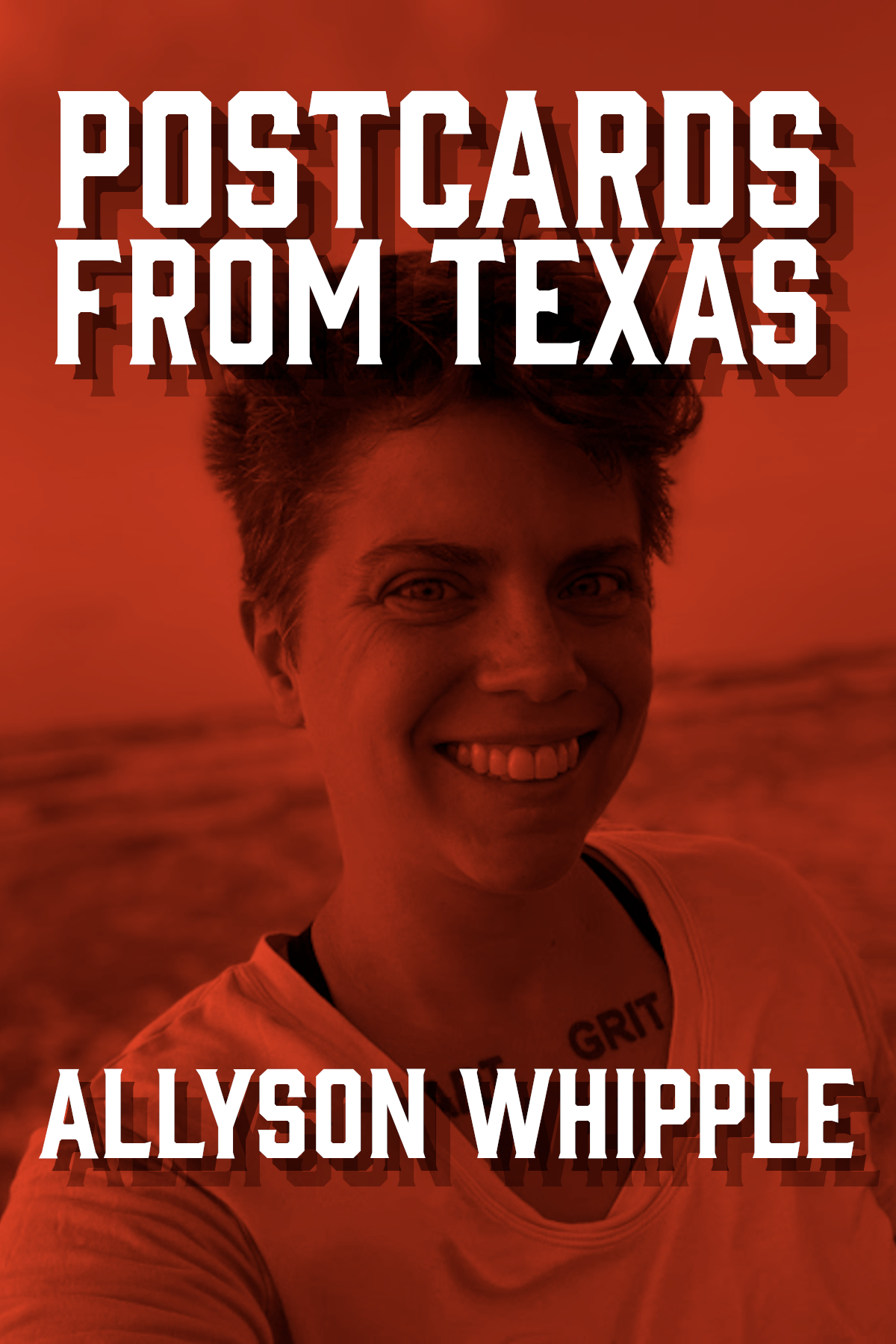
I’m thrilled to announce the forthcoming publication of my third poetry chapbook, Postcards from Texas, now available for preorder from Cuttlefish Books. This chapbook is my first that is devoted exclusively to haiku, and represents the shift in my creative focus since 2020. You can find the preorder link here: https://cuttlefishbooks.wixsite.com/home/2023-summer-book-launch.
The haiku in Postcards from Texas were mostly written in the second half of 2021 and the first half of 2022, the last 12 months I spent living in Austin. A few are older, going as far back as 2018. They were composed on hikes and camping trips, as well as dog walks around the city and picnics in local parks. My haiku address the changing political and physical landscape of a place I lived in, and deeply loved, for 15 years.
I’ve now lived in Missouri for just over a year. I adore the city of St. Louis, I finally found a job I could enjoy, and there are gorgeous landscapes throughout the state. The past year has also been one of grief for a place I still adore with all my heart, a place I thought I’d live until I died. Putting this chapbook together this past spring was a way to find some resolution of those emotions surrounding my move.
Postcards from Texas contains another form of grief as well. In 2015, I reconnected with my maternal grandfather for the first time in 20 years. (The reasons for that separation are complicated, and I have become wary of making family history public.) John and I are avid hikers, and I began sending my grandfather postcards from our hikes and camping trips all over Texas. He loved seeing the places we went. Four and a half years after my grandfather came back into my life, the universe took him from me again. He didn’t die of COVID, but I believe that he was a secondary casualty of the havoc the virus created around the world. There is no way to know fore sure, but I believe that if COVID hadn’t cause so many other problems, he’d still be here. I still feel sad that we didn’t get more time, and heartbroken that COVID protocols kept me from seeing him or even attending his funeral.
Postcards from Texas is dedicated to my maternal grandfather, as well as all the other people I lost my last few years in Texas (all but one of them died before COVID). Putting this book together was a way to continue writing postcards could no longer go to their intended recipient. It’s not just a farewell to a place I loved; it’s a reckoning of the loss that I feel should never have happened when it did.
Not only am I excited to be publishing a book, but I’m thrilled to be in the company of Lenard D. Moore and Julie Bloss Kelsey, the other two Cuttlefish authors included in the summer catalog. While you can preorder my book individually, I encourage you to get the bundle of all three authors. Lenard D. Moore is someone I consider a contemporary haiku master, with an incredible attention to detail. Julie Bloss Kelsey presents a compelling and humorous look at adolescence and the transition into adulthood, all in the short haiku form.
(Note: As of this writing, the preorder site is having some issues on mobile browsers. It’s easier to order from the desktop version of the site. If you are trying to order from a mobile browser and running into issues, email me or send me a DM on Instagram, and I’ll help you out.)
While the details are still in progress, I’m excited to announce that I plan to release two new chapbooks in 2023! One will be a self-published collection of free verse, and the other will be my first haiku collection published by Cuttlefish Books, a small press out of my hometown of Cleveland, Ohio. Both chapbooks are devoted to my last few years in Texas, and as I move through the processes for each, I feel more and more each day like I am really closing that chapter in my life.
As I plan for two new releases, and therefore lots of new copies, I want to make some space in my office for the new words coming through. So, for the month of February, you can get my first two chapbooks for just $8.00 each . . . and that price includes shipping!
While I’m definitely not a minimalist, Marie Kondo’s work has always spoken to me. I’ve also always just loved the way it feels to clear out the past to make more space for the present. Even something as simple as zeroing out my inbox leaves me feeling energized and inspired. My first two chapbooks will always be dear to me. I still believe in those poems, and I will always keep copies. Yet this June will be 10 years since the publication of We’re Smaller Than We Think We Are, and seven years since the publication of Come Into the World Like That. So much has changed in that time. Those books represent very different places in my life’s journey. I will always love them; I will always be proud of them. It’s also time to make more room on my shelf for this next phase of my poetic journey.
This sale will only last until February 28th, or until I sell out. So if you’ve always been eyeing a copy of either of these, grab one now!
Laura Van Prooyen’s new collection, Frances of the Wider Field
I met Laura Van Prooyen at Poetry at Round Top when she was promoting Our House Was on Fire. I still remember seeing her cast in the warm stage lights of the Round Top concert hall, reading these poems about uncertainty, illness, and motherhood. Her new collection, Frances of the Wider Field, was released in March. While I was sad that we couldn’t celebrate her new release in person at Round Top this year, I did enjoy the online workshop I took with her in the online version of the festival. I’m excited to share this interview that we conducted via email over the past few months, while dealing with the Texas freeze, teaching duties, family responsibilities, and the work that goes into a book launch. That we wrote our questions and responses amidst the hustle and bustle of daily life reflects something that I admire about Laura’s poetry: our other work, our obligations, do not take us away from poetry. They are the stuff of which poetry is made.
[AW] My favorite lines in “Against Nostalgia” are “What defines me is constancy of place, / and my urge against it.” Like you, I’m from the Midwest, and have made a life in Texas. I find that the longer I am away from Ohio, the more the tension of being a native of one place but choosing to live in another comes through with more intensity in my poems. Has being of a particular place but then making your life in another place influenced your poetry in a particular way?
[LVP] Thanks for this question. It is hard to be away from home, but when I visit my parents it is also hard. So, yes, that inherent paradox informs my poems. I grew up in a house my grandfather literally built. I never met him, but I have a picture of him with a crew digging the basement. My grandmother lived next door to us, and my great-grandmother next to her. My mom has never moved in her life. She’s still there now, at 81 years old and with dementia. Our roots are deep. I opted for sun, warmth, and new experiences, a choice I don’t regret but wrestle with all the same. I feel torn a lot, wishing to be in multiple locations at once. That tension fuels a lot of the poems in Frances of the Wider Field.
As I read through Frances of the Wider Field, I think of my own grandmothers, one who died suddenly 30 years ago, and one who died 17 years ago from Parkinson’s. I often feel that I never really got to know them, and that is its own kind of grief. I see your poems as a way to stay in conversation with people you cannot converse with anymore, at least not in the way you once did. Do you feel there is something special about poetry as a genre that allows for these conversations to happen?
I hadn’t really thought about it like this before, but yes. Poetry allows for all kinds of unexpected turns as opposed to, say, a mode that has some expectation of linearity. It seems to me that poems are not only a way to stay in conversation with people we can no longer access, but that writing into the unknown allows us to converse with mysteries. The Frances poems originated with that energy, of being open to conversations with people I never met, with places that existed before me, with lineage, with ghosts, with concepts of god. The energy was at first an impulse to write toward a very specific absence, but the poems turned into presence–Frances began permeating the landscape, the dailiness of past, present and maybe even future. I’m interested in the continuum of time and memory and how we move long through different planes of experience, sometimes all at once.
Speaking of lineage, I love the ways in which that theme shows up in this collection. One of my fascinations is with the idea of a writer’s lineage, and the ways in which creative lineage can be expansive. We have our family lineage, and we also have the poets/writers we read over and over. We have the teachers that have taught us about craft, or form, or topics that had nothing to do with writing, but nonetheless had a profound influence. Anne Sexton and Natalie Goldberg are part of my creative lineage; so are the Austin poets who have been both mentors and friends over the past 13 years. Finally, that list includes my 9th grade geography teacher (who taught kindness as much as she taught geography), my aunt, and my grandmothers. How do you trace your own creative lineage? What are the different threads or spokes that have come together to help make you the poet that you are today?
One pivotal moment in my life was my first semester at the university. I was a first generation college student. My first semester I took a seminar called “Creating Selves.” I have no idea if we had choices for these seminars, but somehow I lucked into this class taught by a professor who had us read Rainer Maria Rilke’s Letters to a Young Poet, Maxine Hong Kingston’s The Woman Warrior, Dag Hammarskjöld’s Markings, and Helen Hanff’s 84 Charing Cross Road. She required that we keep a journal, a mix of personal insights mixed with responses to the texts. I have been keeping a journal since that class, since I was 18 years old. I still have my marked up copy of Letters to a Young Poet, and I’m actually still in touch with that professor. She came to my virtual book release just last week. I hold close poems from Louise Gluck, Larry Levis, Brigit Pegeen Kelly, Vievee Francis, John Donne, Adelia Prado and Olena Kalytiak Davis among many others, too. I’m also a fan of Lynda Barry. I wanted to be a visual artist before I ever thought about being a writer. I suppose there’s still time.
I love the way you depict work in these poems, specifically, the work Frances performs. “Avenue F” is the most striking example: the work of wringing and hanging laundry, of polishing the baby’s shoes. In “Lilacs Full of Bees,” Frances has cleaned gutters, polished the car, and soaked her feet after a long day. I’d love to hear more about your approach to depicting those daily tasks. Did you have a specific approach to incorporating them? I think some poets are hesitant to bring dailiness into their poems because they worry it comes across as boring. How did you incorporate Frances’ daily, domestic work in a way that made the poems come alive?
It’s wonderful to hear that for you the poems came alive. Dailiness is life. I’m interested in specificity, and if I had a particular approach, I suppose it was to write toward the specifics. I also had to make choices. I had ideas and things popping up, like polishing the car and cleaning the white walled tires with a toothbrush. Not every daily task made the final cut. When I really get into revision, I read my work aloud. What stays is what sounds right. As in, sonically. I ask myself (consciously or intuitively) how the sounds of words play off each other, how can the poem create a sonic landscape that works in relation to the details.
Finally, is there anything you never get asked about your work that you’ve always wanted to talk about?
I love your final question, but I cannot think of anything in particular that I’ve never been asked. I love talking about the creative process and hearing from other makers what they do, what they’re reading, what art they’ve seen or music they’d listened to. I like to talk to people who are curious, because staying curious feels right to me. Learning new things. Being open. That’s part of the work.
Laura Van Prooyen
Thanks to Laura for participating in this interview. I hope you enjoyed learning more about this engaging collection. You can buy Frances of the Wider Field from Laura’s website (the most direct way to help a poet get paid!), Lily Poetry Review Books, Bookshop.org, major book retailers, or your local independent bookstore.
I never can remember the first time I met someone who became a close friend. I know that I met Elizabeth Kropf at AIPF, and I’ve known her close to a decade, if not more. There have been periods when we’ve spent a lot of time together, and periods where work, school, and family meant we went a long time without talking. The death of our friend Wade Martin earlier this year provided a sad yet vital opportunity to reconnect. One of the first things she told me was that her first chapbook, what mothers withhold, had been accepted for publication. It’s now in preorder until November 6th, and I’m thrilled for her. To celebrate, I thought it would be fun to interview Elizabeth about her upcoming publication. This interview is inspired by the style of Divedapper.
[Allyson Whipple] I’ve always wanted to discuss the role that faith plays in relation to your poetry. I remember being shocked the first time you told me you were a practicing Christian, because back then I knew many people whose actions gave Christianity a bad name. While you don’t seem to write much overtly religious poetry, at the same time, I find that our spiritual practices often end up infused in our work. Does your spiritual life connect with your creative life, and if so, what’s your relationship to poetry and faith?
[Elizabeth Kropf] I take your shock as a compliment. The graduate program I attended was Perelandra College, which is the name of a C.S. Lewis novel. The philosophy of the college is that Christians should be good writers because we have access to the Holy Spirit. Ken Kuhlken’s book Writing and the Spirit expanded on this idea. I took a course called “The Bible as Story,” which was about looking at Scripture as a story. I wrote my first published poem in that class, so I think responding to Scripture is powerful for me. There is one poem in “What Mothers Withhold” that is based off a verse in Exodus. Poetry is a way to wrestle with God and is an act of worship. My spiritual journey has been influenced by the writings of Sarah Bessey and Rachel Held Evans, and I highly recommend their writing to anyone struggling with faith. What I hope to accomplish in my poetry is to share my story without excluding anyone. I don’t want someone without a Christian background to feel alienated, and I don’t want someone who is not a mother to not have any way to connect to my work.
[AW] One of the things that fascinates me about spiritual practice is the ways in which form lies at the heart of worship. We can find form in the instructions for Islamic prayer, in Communion rituals, and in meditation practice. I’m curious as to whether the formal aspects of Christian practice connect in some way to your love of the sestina form.
[EK] I hadn’t thought about that connection. I didn’t grow up with a lot of rituals, but they are valuable to me now. I didn’t grow up celebrating Lent, but it is something I practice as an adult. Something fascinating about Lent is that you can just fast from certain things, such a sugar, or add a practice during Lent. That would be a wonderful exercise as a poet- to fast from something commonly used, or to add something for a period of time. For me, I could abstain from writing in first person, or add an image from nature in each poem.
I recently started practicing TaeKwonDo, which has form. My instructor said that no one would use form during a fight, but it is about practicing the movement and creating muscle memory. Form can be considered an exercise to make us stronger writers. I recommend The Poetry Dictionary by John Drury because it defines many forms and other poetry terms.
What I love about form is that it prevents poets from just bleeding into the page. The sestina is my favorite because it creates a theme with the repeated words, but it is subtle enough that the reader doesn’t anticipate the next line. Ezra Pound said the sestina is “a thin sheet of flame folding and infolding upon itself.”
[AW ] I have always enjoyed list poems and how-to poems. Even though I’ve made the choice to not have children, the poem “how not to get pregnant” is one of my favorites because of the way it plays with the how-to form, since ultimately the desired goal doesn’t materialize, at least for a long time. I also think this poem speaks to something universal, whether you’re trying to have children or not: that is, putting all of your energy and attention into something, and despite doing everything right, it never comes to fruition. I can feel the sorrow and frustration that led to this poem, and yet despite those emotions, this poem also has moments of humor. The image of trying to remember your temperature until you find a pen and the imperative, “Don’t argue when you are ovulating” are funny, not because they are not serious, but because when we are in pursuit of our soul’s deepest desire, sometimes the things we put ourselves through are a little comical. Now that you’ve had some distance from the initial struggle that led to this poem, do you find humor in it? Has your relationship changed to the poem at all?
[EK] I’m glad you connected poem, and I remember that you write this kind of poem as well. I probably copied the concept from you! I have a few “how to” poems, and two of them are about attending funerals. A list or how-to poem can give some distance to be able to approach intense topics without just bleeding onto the page. I recommend any poet try that as a way to write about something they are struggling to articulate. It would make a fantastic anthology.
I’m glad that the humor in the poem came through, as I was going for a lighter approach. The process is quite absurd. There are literally apps to track ovulation symptoms. My relationship to the poem has changed because we were fortunate enough to have another child. As I am looking at what is the final version of the manuscript (I have been sending the manuscript out for years), I see how it ties into the theme in other poems of my struggle to accept when things are different than I planned or expected. My delivery with my oldest was very difficult for that reason, and I wrote so many poems just to process it.
[AW] I’m thinking now about how I saw Vievee Francis speak on a panel at Poetry at Round Top, and she talked about how the process of creating her poems and books was not necessarily therapeutic. The writing did help her process and make sense of the life she’d lived growing up Black in rural Texas, and yet they didn’t necessarily provide closure. Natalie Goldberg has said that writing practice isn’t therapy. It’s clear that poetry has been part of your healing process. I’m wondering if it gave you the closure you were expecting, or whether the work only got you so far.
[EK] Poetry absolutely has given me closure. There is something beautiful about crystalizing an experience and saying, hey, I would have liked for this to turn out differently. Part of my healing also was sharing the poems with others. There are tragedies that there cannot be closure for, and in those instances at least acknowledging pain is powerful. I wrote a poem about the mass shooting in my hometown of Thousand Oaks, California and I don’t have closure about that.
Poems about a lack of closure can also be powerful. I remember a poem from Round Top about a woman whose adult daughter died, and she had a metaphor about how she would be okay and then pain would come back like a piece of glass in her foot. I think the poem was called “Smithereens.”
Since having my youngest daughter I have worked with a life coach, and I realize now that I could have had closure much sooner with some things. I was creating more suffering for myself because I was struggling with the idea that what happened should not have happened. With my first daughter, I very much did not want an epidural, but was induced and ended up getting one. The epidural was incredibly painful and didn’t work. If I had been able to let go of my anger over that, I would have had closure on that aspect of the birth much sooner. I recommend the website https://thework.com/ for more about challenging our thoughts. That itself would be an amazing workshop, to challenge our thoughts about something we don’t have closure on.
[AW]On the Commonplace podcast, poet Rachel Zucker has often talked about her attempts to write an essay about the poetics of motherhood, and ultimately finding she could not write the essay she intended. It wasn’t because motherhood and poetry were incompatible, but because she found that the nature of motherhood was not something that could be neatly tied up into poetics. What are your thoughts? Do you think it’s possible to have a poetics of motherhood, or does motherhood defy that kind of categorization? How do motherhood and poetics connect for you, if at all?
[EK] My strongest poems are about motherhood. However, there are things I have not been able to write about yet. I have very few poems about my youngest, even though she is delightful and exuberant. It is hard to write about certain things without being smarmy. I also try to have a “turn” in a poem, which I learned from Cindy Huyser. I don’t remember who she said stated it, but she believes every poem should have a turn. There are things I want to write about but I haven’t figure out how to do it well.
Motherhood has brought the most intense experiences I have had. For me, poetry is a way to tell a story and connect to the reader. You don’t have to experience their story to relate to the emotion. I’m reading David Meischen’s poetry book Anyone’s Son, and it is incredibly moving. I like the concept of a poetics of motherhood as a verb. How do we mother? How are we mothered? Can we mother the reader?
[AW] That leads me back to Rachel Zucker’s work, because she also has spoken and written in defense of sentimentality. In the essay “Terribly Sentimental,” she writes: “I have less and less patience with poems that don’t in some way engage human emotion. Poems in which I do not feel the presence of a feeling (as well as thinking) human being. This preference is, I think gendered. I hear my students talk about their fear of sentiment (they seem as afraid of sentiment as of sentimentality or do they just not distinguish between the two?) and I can’t figure out where this is coming from. I used to be afraid of writing poetry of witness, a sort of AA poetry, but now I think I prefer that to the mechanistic poetry that wants to be person-less. Is this about age? Gender again?” Is smarminess different from sentimentality? I think “Chocolate Chip Cookies with Madeleine L’Engle” and “heel-click” are poems that are sentimental without being smarmy. What is your relationship to sentimentality, and what kind of potential do you think there is in being willing to engage with it?
[EK] I really connected with this essay, and it drew attention to many of the ideas I have about what I was not prepared for with birth specifically. I do have some sentimental poems, and I selected the poems you referred to in order to balance out the intense themes in the other poems. “Chocolate chip cookies with Madeline L’Engle” is one of the most recent, if not the most recent, poem in the collection. Even though it is not as personal as the other poems, it still draws on the theme of wanting to protect others, which might be seen as sentimentality.
There is value in engaging with sentimentality, and I always will. My previous answer was more from a place of examining what I feel I am able to succeed in accomplishing. I am more drawn to poems that have a human connection, as talked about in Zucker’s piece. I’m not drawn to poems about nature. I recognize the skill in their writing, but it’s not what I’m drawn to read. I enjoy being outside, but I have almost no poems about nature.
[AW] Is there anything you never get asked about your work that you’ve always wanted to talkabout?
[EK] I wanted to talk about the cover art for my book. Tamryn Spruill is an amazing artist. When I found out I got to select the cover art for my book, I asked her to create something. She asked what I had in mind and I said “I have no idea.” She read my manuscript then created this sculpture. She asked me what color my anxiety was and I said orange. The thread around the woman is orange, and the belly is covered with images from the book. I am grateful she created such an exquisite sculpture.
Note: Preorder your copy of what mothers withhold by November 6th. Poets depend on preorders more than ever. If you know someone who you think would resonate with this book, preorder a copy for them as well! This chapbook is scheduled to ship on January 4th, 2021.
Five Oaks Press has just released We’re Smaller Than We Think We Are.
It’s hard to believe that a year ago, I was still struggling to get a failing project into the world. I didn’t imagine this book would happen. But I was also in the midst of a second round of the Tupelo Press 30/30 Project, and something was happening. I was writing a lot of cathartic poems. About my past. About my failed marriage.
I had spent a long time trying to get over it. Get over everything. And now it seemed I finally was.
Not all of the 30/30 poems made it into this chapbook. Most were culled; many didn’t fit thematically. But I added a few older poems and wrote a few new ones as well. By July, I had a manuscript. And after lots of revision and lots of rejection, I found out that Five Oaks Press had named it a finalist and was offering me a contract.
Going from manuscript to publication in less than a year feels like a miracle. I’m very lucky that things all came together. I’m in love with this book, and the relationship I have with Five Oaks.
April might be National Poetry Month, but May is an auspicious one for me, at least with my own work.
You can purchase the book on Amazon. Or, to order a signed copy, send $15 via PayPal to literaryaustin@gmail.com. The price includes shipping, and I’ll be happy to inscribe it however you want!
BookWoman is the cornerstone of my literary career so far. I worked there in 2009 and 2010, and through the store I met Debra Winegarten and thus became a member of the Austin Writergrrls. Helping with the store’s open mic, I met lots of local poets, and gradually found a place in the local poetry community. While working on Sundays, I met Abe Louise Young, who became my mentor. I learned about Gemini Ink and Poetry at Round Top. I bought writing manuals and honed my craft. BookWoman is part and parcel of the writer I am today.
To that end, I’ve decided to turn my pre-sale period into a chance to give back to the store that has given so much to me. My book is available for pre-order until the 27th, and for every copy I sell in pre-order, I’ll give $1 to the store. (This applies if you’ve bought a book before I made this announcement. Congratulations! You’ve pre-emptively donated $1 to BookWoman!
You’re not only supporting poetry; you’re now supporting a bookstore as well. There are only 11 feminist bookstores left in North America. So pre-order now and support BookWoman, small businesses, and feminsm!
That’s right! My pre-order period ends on February 27th. That means you have just a few weeks left to get on the discount-shipping bandwagon.
Want to know more? Check out poems from the collection here, here, and here. Like what you see? There’s more of that where that came from. So head over to the Finishing Line Press site and pre-order your copy today!