Rather than do a typical haiku commentary post, this week, I wanted to reflect on the ways in which my commitment to haiku practice over the past few months has impacted my perception of the seasons as I experience them. It’s been seven months since I launched this project, and while my haiku practice and saijiki study go beyond the scope of food, the framework of this blog and podcast is where I come to work out my ongoing understanding of kigo.
I’ve written elsewhere on the blog (my intro post is just one example) about how my direct experience of the seasons doesn’t always line up with what the Gregorian calendar says. This was in part influenced by geography (Cleveland has long winters, Austin has even longer summers), but also a sense that dividing the seasons according to equinoxes and solstices didn’t truly account for the way the climate felt.
One of the reasons I was intrigued by the haiku (lunar) calendar was because the seasons all began roughly six weeks earlier than I was accustomed to; the equinoxes and solstices were in the middle of the seasons, rather than the initiation point for each season. As I’ve delved into this seasonal exploration, I stumbled across Naturalist Weekly, a blog which, among other things, talks about the 72 micro-seasons. While I think micro-seasons vary from climate to climate, I think they are a fascinating framework for how to study and experience one’s own surroundings, and I’m brainstorming with ways to work with micro-seasons in 2023.
This year’s study of saijiki and kigo has shown me a great deal of how I experience the seasons. The biggest takeaway for me is that the way I perceive the changes in time relates to fluctuations in daylight. On some level, I’ve known this for a while. My last few years in Cleveland, I struggled a great deal with seasonal depression. Living in Austin, I didn’t struggle quite as much because it wasn’t as cold, but I also noticed I felt demoralized by the lack of daylight. Both ends of daylight savings time make me feel jetlagged, and when it ends in the fall, that abrupt plunge into early darkness is really rough on me.
Slightly under-dressed for a Thanksgiving visit to Cuyahoga Valley National Park.
In December 2019, I also observed that while the Gregorian late autumn (ranging from mid-October to the winter solstice) is particularly tough for me, I start thriving again fairly early in January. While many people I know struggle through the cold, snowy first quarter of the year, my mood and motivation are consistently on the upswing. Maybe it’s because I love what New Year’s symbolizes (even though my celebrations are a lot more toned down than they used to be), and that gives me a mental boost. But I think there’s something more, and it’s that even though the days are still short and the nights are still long, it’s already getting brighter. And my body is well-aware of the gradually increasing days.
In the haiku calendar, winter starts more or less on November 5th. The lunar New Year generally takes place in early February, with actual celebration periods varying based on the specific traditions of Asian countries. The New Year period gives way to spring during a time that is still solidly winter based on the Gregorian calendar.
A January day in Real de Catorce, Mexico. Even 9,000 feet up, it was fairly warm in the daylight.
As I wrote back in that initial blog post, I was flummoxed by how spring could start in February, when everything is still snowy and dormant. Yet the first blossoms of the calendar year aren’t that far off. But what I think is more significant is that the days are getting incrementally longer.
Based on the haiku calendar, the December solstice is the middle of winter, and is the official turning point, sending us down the path to spring. So while a few months ago, I was flummoxed by February being considered a spring month, when I think about the increase in available daylight, it makes total sense.
Even if it’s a struggle for me to classify November as winter instead of autumn, ultimately, the seasonal label doesn’t matter as much. What’s important to me is the insight of how the changes in daylight affect my body, mind, and spirit. And I don’t know if I would have come to that conclusion if I hadn’t embarked on this process in my poetry.
(But . . . can we do away with DST already? Or keep it. I don’t care. Let’s just pick one and stop switching the clocks twice a year, okay?)
Thanks to Lorraine for the contribution of three coffees! I’ve now covered 28% of my web hosting costs for the year. I’ll be releasing the October bonus recipe next week, so if you want to make a contribution, now’s your chance!
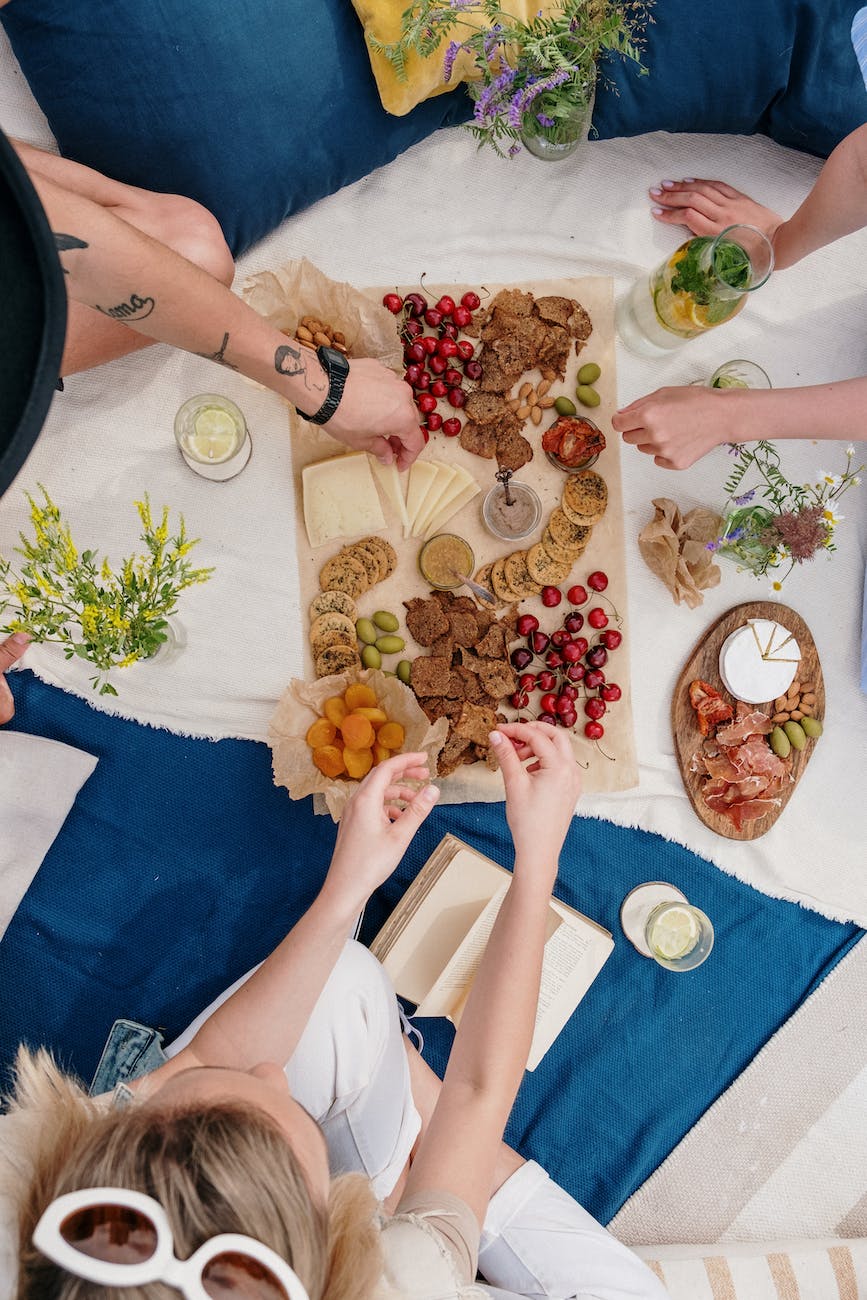
The turn of autumn has me thinking about people gathering together to eat. Maybe it’s because I finally cooked a serious meal (French onion soup) in our new home. Maybe it’s because John’s birthday is just around the corner. Maybe it’s because I’m experiencing my first real autumn in over a decade, and the feelings of coziness it inspires. Either way, I decided to explore haiku in my collection that in some way reflect eating together. Oddly enough, only one of those haiku has a seasonal referent, and it’s summer! The rest best fit in the all-year category. But as always, these posts reflect my collection of food haiku and senryu at a particular moment in time; if I revisit this topic in a year, the seasonal distribution might look entirely different.
All Year
outside the food bank a ragman shares his crust with a sparrow
Kim Goldberg has written an exceptionally tender haiku. Here is a man with next to nothing, yet still has it in his heart to share what little he does have with a small sparrow. While I’d initially intended for this post to focus on haiku about people eating together, I added this poem to the database early in this project, and I kept coming back to it as I was deciding what to write about this week. Per Higginson’s Haiku World, “sparrow” is an all-year term, and I don’t see any other seasonal referent, making it an all-year poem.
This poem can be read a few different ways. First, the quarrel could be caused by the presence of a shell in the omelet. Second, the couple could have been quarreling, and the person who made the omelet leaves the shell in as a bit of passive-aggressive revenge. In a third interpretation, the person making the omelet is so flustered by the argument that they let the shell slip in unnoticed. Although there is no seasonal referent, this is nonetheless a poem that opens itself up to the imagination, which is one of my favorite things about a well-wrought haiku.
re-opening . . . the server remembers my standing order
Barry Levine, Prune Juice #35
There is something about being a regular at a restaurant that feels special. Yes, the restaurant is part of your routine, but it’s that sense of consistency, the knowledge that the servers see dozens (if not hundreds) of people a day, and yet they still know who you are, and what you like to order. (Cue the Cheers theme song . . .) Barry Levine heightens that feeling by writing this poem in the COVID era. The restaurant has probably been closed for at least three months, maybe six, maybe even a whole year. Yet the server is still there, and that person still remembers. Because re-openings were different everywhere, there’s no seasonal referent in this poem, but that doesn’t make it any less heartwarming.
tea tree swamp weary workers pause to boil their billy
Louise Hopewell, Echnidna Tracks #9
I placed this poem in the all-year category, though I admit that my lack of knowledge about the southern hemisphere might be interfering with my understanding of the poem. This haiku required some research on my end. To “boil their billy” means to make tea. Here, we see laborers taking a pause to rest and enjoy some tea. Tea-drinkers tend to drink it all year, workers tend to work year-round, and thus I placed this poem all year. However, if I’m incorrect, please let me know in the comments!
shared coffee all the stories we don’t tell
Lori Kiefer, Haikuniverse, October 5th, 2022
Just as devoted tea-drinkers can enjoy hot tea year-round, coffee drinkers usually take their beverage hot, even in the middle of summer. The avoidance of painful topics and/or the keeping of secrets also isn’t limited to a particular season. Lori Kiefer’s senryu does a beautiful job of showing a sense of distance even in physical proximity.
wind from the sea— I clean the green beans with my mother
Pasquale Asprea, Haikuniverse, June 26th, 2022
The act of shelling or cleaning beans can be a fun social activity. While it wasn’t something that happened in my family, I’ve cleaned a big garden haul with friends, many of whom shared fond memories of doing so in childhood. The green beans place this haiku in the summer. If you’re familiar with fresh sea air, it’s easy to feel the breeze, smell the salt, and feel the connection that comes from cleaning, preparing, or preserving food with a loved one.
I hope that as the weather gets colder and the days get shorter, you have plenty of opportunity to share good meals with people you care about.
(PS – A shout out to the wonderful folks a Kampai who know my favorite items on the menu.)
Join the Conversation I’m seeking guests for December! If you’d like to be on the podcast, visit https://culinarysaijiki.com/join-the-conversation/ and fill out the form. My life is a little hectic right now, so if I don’t follow up in a timely manner, send me a reminder.
Support the Project You can make a one-time or recurring donation to the Culinary Saijiki at https://www.buymeacoffee.com/culinarysaijiki. You also can help by sharing this episode with people you think will love it!
Theme Music “J’attendrai” by Django Reinhardt, performing at Cleveland Music Hall, 1939. This recording is in the public domain. Hear the whole song at https://clevelandhistorical.org/files/show/6045.
First, thank you to the anonymous person who bought me three coffees this month! I appreciate your support of the project, and especially for covering this year’s website costs. I’m now 13% of the way toward my goal.
This week, I got inspired to explore the connection between region and food in haiku. When I wrote primarily free verse, I loved writing about the landscapes of Texas, and I also enjoy exploring the ways in which landscape connects to food. I decided to start with the Southwest in part because that is one of two regions (the other being the Midwest) where I have lived the longest, and have detailed understanding of regional food. I’d also been rereading Lifting the Seasons: Southwestern Haiku & Haiga, and had added a number of the haiku to my Culinary Saijiki database. I decided to use it as my initial source text in my exploration of Southwestern food haiku. (There are a number of other good anthologies out there, but I didn’t have access to them this week . . . but that just means I’ll have to return to this topic again!)
As it turns out, I ran into a number of challenges with this post! I thought I was going to have any easy time talking about Southwestern food in haiku, but in fact, this was the most difficult entry I’ve done so far, which is all the more reason I’ll want to return to this topic.
1. The southwest is not a clearly delineated space. Arizona and New Mexico are the only definitive Southwest states, but parts of Texas, Oklahoma, Utah, Colorado, Nevada, and Oklahoma also get included. However, there isn’t a definitive map that delineates which portions of each state get included. For example, San Antonio is closer to Louisiana than it is to New Mexico, but the city seems more a part of the Southwest than the South. There’s a great deal of culturally and geographically liminal space that’s difficult to account for.
2. Southwestern food is not a clearly delineatedcategory. While some foods, like nopales and tamales, are clearly Southwestern, I found myself struggling with many of the crops. For example, Texas has its own types of melon and peaches, but the places where those crops are grown appear in that liminal space. In addition, changes in farming practices over the years mean that produce I didn’t initially think belonged in the Southwest does grow there. I ended up pouring a great deal of research into produce to place poems accurately!
3. Disagreeing with some of the placements of these poems.Lifting the Seasons editors Scott Wiggerman and Constance Campbell worked hard to place the poems in this anthology, and I consider Scott one of my poetry mentors. So I didn’t feel great when I came upon a poem in a certain season and found myself disagreeing with its placement. I made notes in my saijiki database about why I disagreed, and tagged the poem with both seasons. I’ve also chosen to make note of my disagreements in this post, because I don’t want to mislead people who might have already read the collection and wonder why I deviated from the original placement. Ultimately, I hope these disagreements come across as respectful. There is always debate within the haiku community; not all saijiki align with each other. Disagreement is part of the process.
4. No autumn food kigo I hadn’t already used. I prefer to not use the same haiku in multiple blog posts. When going through my database, I’d already used the best examples of Southwestern autumn food elsewhere on the blog, so I don’t have any autumn entries this week.
For more information on Lifting the Seasons: Southwestern Haiku & Haiga, visit the Dos Gatos Press website: http://dosgatospress.org/.
Spring
prickly pear salad nopales skinned and shredded— thornless spring
Katherine Durham Oldmixon, Lifting the Sky: Southwestern Haiku and Haiga, ed. Scott Wiggerman and Constance Campbell. Dos Gatos Press, 2013.
Nopales are the pads of a nopal, commonly referred to as a prickly pear. There are over 100 species of nopal in Mexico and the southwestern United States, and are a common cooking ingredient. However, the tiny spines must be removed first, and while experienced cooks can probably complete the process efficiently, many of us home cooks prefer to buy our nopales pre-skinned from Mexican grocery stores.While nopales can be in season for much of the year, spring is when they first peak. When other crops have just been planted, and the abundance of summer produce is a way off, nopales are a way to enjoy something fresh.
A nopal in Austin, Texas
across asphalt truck tires scatter grit and white pear blossoms
Sandra D. Lynn, Lifting the Sky: Southwestern Haiku and Haiga, ed. Scott Wiggerman and Constance Campbell. Dos Gatos Press, 2013.
Fruits were one of the primary challenges for me in putting together this entry. I hadn’t revisited this anthology in a number of years. I was surprised to find two haiku about pears in a book focused on the American Southwest! However, after doing some digging, I discovered that Southern California is a peach-growing region, and while the official states of the Southwest are Arizona and New Mexico, Southern California is also frequently included. I think that this haiku points to one of the challenges that practitioners and editors come across: geographical boundaries are not as well-defined as we might like. In addition, due to the ways in which humans have traveled, colonized, and globalized, a European fruit will thrive in a place not originally its home, complicating our understanding of what an appropriate kigo might be.
the pear tree’s hesitant buds— February
Sally Clark, Lifting the Sky: Southwestern Haiku and Haiga, ed. Scott Wiggerman and Constance Campbell. Dos Gatos Press, 2013.
Sally Clark’s haiku also presented me with a familiar challenge that I have not yet figured out how to reconcile: what it means to be a haiku practitioner writing in the age of the Gregorian calendar. Her haiku appears in the winter section of the anthology, which certainly makes sense for editors working in the United States. However, February is considered spring in the haiku calendar, and the image of actual buds on the tree further reinforces the spring image. Because of the presence of buds, rather than bare branches, I chose to place this haiku in the spring section.
Summer
what’s left of the moon— a slice—ripe cantaloupe— set on a chilled glass plate
Robert A. Ayers, Lifting the Sky: Southwestern Haiku and Haiga, ed. Scott Wiggerman and Constance Campbell. Dos Gatos Press, 2013.
This is the first haiku where I found myself disagreeing with the editors regarding placement. In Lifting the Sky, this haiku appears in the Winter section. However, cantaloupe is at its peak in summer, so for the purposes of this project, I have placed there. Various melons are popular in summer dishes, and make excellent agua frescas (refreshing fruit drinks) during the hottest months.
below the peach tree flipping pages in a book hummingbird flutter
Ellaraine Lockie, Lifting the Sky: Southwestern Haiku and Haiga, ed. Scott Wiggerman and Constance Campbell. Dos Gatos Press, 2013.
I spent a few hours mulling over Ellaraine Lockie’s haiku, and what season I felt it best represented. In Lifting the Sky, this haiku appears in the Spring section. Since we don’t know what state the peach tree is in, I understand the editors’ decision. However, depending on what saijiki you are using, hummingbirds are listed as either a spring or summer kigo. In my lived experience, hummingbirds tend to be more visible in the summer. In addition, unless a poet mentions blossoms or a bare tree, I picture it covered with fruit, which in that case, would make summer more appropriate.
Chris Ellery, Lifting the Sky: Southwestern Haiku and Haiga, ed. Scott Wiggerman and Constance Campbell. Dos Gatos Press, 2013.
While I debated a bit as to whether or not to keep this haiku in the winter category, as it appears in lifting the sky, a careful bit of research led me to agree that it was a winter poem. While in much of the United States, the first frost is likely to happen in autumn, in most of the Southwest, the first frost is not likely to happen until winter.
winter sunlight our neighbors bring us homemade tamales
Lynn Edge, Lifting the Sky: Southwestern Haiku and Haiga, ed. Scott Wiggerman and Constance Campbell. Dos Gatos Press, 2013.
When I lived in Texas, I knew Christmas was getting close, because people who made tamales would start taking pre-orders. Even grocery stores would do big tamale sales at Christmas! While tamales aren’t inherently a winter food (more on that below), they’re certainly a hallmark of the holiday season in the Southwest. While a Southwestern reader might not need the phrase “winter sunlight” to place the season, someone who has lived their whole life in Canada might not be aware of how tamales connect to the seasons, so I think Lynn made a good choice setting the poem explicitly in winter. Working on this project reminded me the extent to which much of haiku relies on shared cultural knowledge, and how we can’t expect every reader to have the same understanding of the world. I also don’t think that’s a bad thing. We can’t spend our whole lives limiting our writing to what we think people will understand. If haiku is the poetry of the moment, we have to write from our experience, without worrying whether or not a reader from the other side of the world will get it.
Mama’s gifts filled, wrapped, tied with care— tamales
Christine Wenk-Harrison, Lifting the Sky: Southwestern Haiku and Haiga, ed. Scott Wiggerman and Constance Campbell. Dos Gatos Press, 2013.
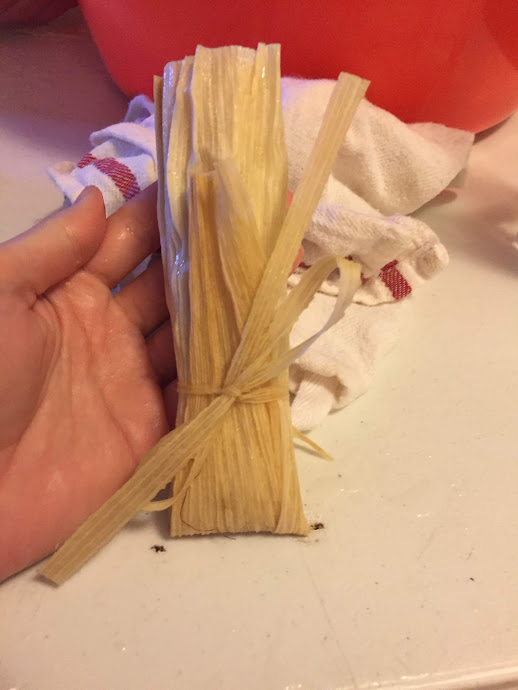
Tamales don’t have to just be a winter food. However, the labor-intensive process means that if you’re going to make them at home, they’re a special-occasion food . . . and a dish best made as a group. The last Christmas before COVID, John and I hosted a tamale-making party, and it remains one of my happiest holiday memories. I’m still sad I never had one more opportunity to host a Christmas tamale gathering in Texas. I associate tamales with winter holidays more than any other, and they are a gift that can last for months. With the filling wrapped in corn husks, they can be frozen and easily re-steamed (or microwaved) for a delicious meal in those last days of winter and earliest days of spring, when the holidays are long gone but things feel a little bleak.
The fruits of our labor, Christmas 2019
Cheshire cat grin between bare pecan branches— the waxing moon
Sandra Cobb, Lifting the Sky: Southwestern Haiku and Haiga, ed. Scott Wiggerman and Constance Campbell. Dos Gatos Press, 2013.
Note: In Lifting the Sky, this haiku appears in the Spring section. However, I interpret bare branches as a winter kigo, and thus have placed it as such.
Although I encountered a number of challenges while working on this post, I feel inspired to keep going with the regional theme. However, I can’t possibly be an expert on all geography-specific foods, even in my own country! If you’re interested in putting together a guest post similar to what I’ve done here, please contact me. I’ll also put up a post with formal guidelines sometime in the next week or so.
In my May 10th post, I noted that I have observed three broad categories of food words in haiku:
Food words that are a definite seasonal referent;
Food words that are not a part of any specific season;
Food words that become seasonal with an additional modifying word
In the May 10th post, I also wrote about the first category. In the May 24th post, I focused on the second category. Today, I’m wrapping up the series by discussing the third category.
As of this writing, I’ve collected 140 haiku and senryu related to food. Based on my initial collections, category #3 represents the smallest proportion of haiku I’ve collected thus far.
Winter
Ginger cookies fresh from the oven. One of my favorites!
So far, winter contains the highest proportion of foods that become seasonal through a modifying word. My hypothesis is that because in the northern hemisphere, winter is the holiday season, a time when we’re often making special foods (such as Christmas cookies) that otherwise might fit all year. A chocolate chip or peanut butter cookie might show up in spring or fall (and even summer if you’re willing to turn on the oven). Christmas cookies, on the other hand, tend to be more elaborate, and some people make half a dozen different kinds. And while they’re festive, when juxtaposed with the right image, they can create a sense of melancholy. In Robert Witmer’s haiku below, I get a sense of loneliness.
baking Christmas cookies the black and white TV snows all night
Robert Witmer, bottle rockets #46
Likewise, holidays have their own particular candy. Christmas has (among other things) candy canes. Homemade candy in the form of fudge, taffy, peanut brittle, or buckeyes is common as well. While Christa Pandey’s haiku uses the generic “holiday sweets,” I see this as a winter or Christmas poem. The second and third lines, referencing the old country, make me think of homemade confections passed down from generations. In my experience, homemade Christmas candy is a little more common than homemade Easter, Valentine’s Day, or Halloween candy.
holiday sweets last reminders of the old country
Christa Pandey, Failed Haiku #70
Spring
Spring holidays also have their own candy. The empty heart in the first line modifies chocolates in the second line. Chocolate could appear at any time of the year, but chocolates that come from a heart-shaped box connect to Valentine’s Day.
an empty heart the chocolates all gone
Line Monique Gauthier, bottle rockets #46
I admit that it was challenging for me to list a Valentine’s Day poem in spring. In the haiku calendar, Valentine’s Day falls in early spring. Certainly in Texas, where I’ve lived for 14 years, Valentine’s Day can feel like spring (Snowpocalypse 2021 aside). But in many other parts of the country (and the world!) Valentine’s Day still feels like deep winter Still, for the sake of tradition, I’m including it here.
Robert Witmer’s poem connects to spring because the word blue brings to mind a robin’s egg. In fact, when I put it into my saijiki database, I wasn’t entirely sure it could be considered a cooking poem; perhaps it was simply a haiku about a robin hatching. However, when I read it, I also couldn’t stop thinking about the fresh chicken eggs I used to get from a friend’s back yard. They were typically smaller than grocery store eggs, and also came in a range of colors, including blue and green. This could be a hatching poem, a cooking poem, or both.
In Haiku World, William J. Higginson lists beer as a summer kigo. I was surprised by that, and although upon thinking about it I don’t think he’s entirely wrong, I don’t entirely agree either. There are so many styles of beer, and some are more appropriate for certain seasons than others. For example, I wouldn’t drink a port or a stout in summer—they’re too heavy, and best saved for winter. Lagers, pilsners, and shandies are best for summer. Sue Foster points to the tradition of Oktoberfest, turning beer into an autumn kigo. While I understand Higginson’s rationale (an ice-cold lager is exceptionally delicious) after a day of yard work, my opinion is that beer is an all-year term, and it requires either modifiers or specific names to ground it in a season.
fierce Texas sun beats down Texas thirst meets iced Oktoberfest beer
Sue Foster, Lifting the Sky: Southwestern Haiku and Haiga, ed. Scott Wiggerman and Constance Campbell.
Adelaide B. Shaw’s poem is perhaps my favorite example I’ve collected for this post, in part because it made me learn something new. Apples are normally an autumn kigo. I’d never heard of a windfall apple, so I looked it up. I learned that windfall apples are fruits that appear early, dropping as early as June! I realized I’d come across windfall apples already in my life, I just didn’t realize it. At my partner’s family farm, one of the apple trees was producing abundant fruit last July; I picked a fresh green one to use in my Fourth of July coleslaw. The modifying word “windfall” places this poem squarely in the summer season.
windfall apples in my pockets enough for a pie
Adelaide B. Shaw, bottle rockets #46
If you have any thoughts about seasonal modifiers for food, please let me know in the comments. I appreciate hearing from you! Don’t forget that the Culinary Saijiki podcast launches on June 21st!
Before diving in, I’d like to thank Geoff M. Pope for being the first supporter of this new project. I’m now officially making progress on my goal of covering website costs for the year. If you would like to support the Culinary Saijiki project, you can visit the Buy Me a Coffee page here: https://www.buymeacoffee.com/culinarysaijiki.
Second, don’t forget that tonight is the deadline to send your haiku and senryu for the May 31st bonus post. Note that although the deadline is 11:59 p.m. CST, I will be asleep when that passes, so if you slip your haiku in during the wee hours, I’ll still take them! You can find the submission form here: https://forms.gle/wamaaMmoYS88AjXz6
Notes on All-Year Food
In my May 10th post, I noted that I have observed three broad categories of food words in haiku:
Food words that are a definite seasonal referent;
Food words that are not a part of any specific season;
Food words that become seasonal with an additional modifying word.
This week, I’m focused on the second category.
As of this writing, I’ve collected 125 haiku for the project. Of those, the greatest proportion are all-year words, making up 36% of the current total. Although I haven’t collected statistical data every time I add a haiku to my Scrivener file, I know that when I first started collecting, the all-year food words were an even higher percentage. As I’ve added to the collection, the proportions have evened out somewhat, though the all-year words still come up more frequently. As yet, I don’t have a hypothesis as to why that might be.
In Haiku World, William J. Higginson identifies the following food-related words in the All Year section of his saijiki:
Meal
Cooking
Beverage
Coffee
Pots and Pans
Although I have collected a range of all-season words beyond these five, as a nod to his work, in this post, I’ll discuss the haiku I’ve collected that relate to his original list. None of these appear in Haiku World; they’ve all been published recently.
Meal
Breakfast is a common meal that shows up in haiku. Morning and evening seem to be inspiring times of day for haiku poets, and if you have the luck of enjoying peaceful, leisurely breakfasts, I can see how the first meal of the day would lead to inspiration.
morning meditation; thinking about not-thinking . . . and breakfast
Shir Haberman, bottle rockets #46
rising early . . . a half-finished haiku for breakfast
Tony Williams, Failed Haiku #70
I debated whether classifying Johnette Downing’s lunch haiku as all-year or not. On the one hand, there isn’t a clear seasonal referent. On the other hand, a lunch box implies school. As school runs most of the calendar year, though, I didn’t feel right assigning this haiku to the autumn category. A lunch box could also imply summer camp. Therefore, I designated this one as all-year. If you disagree, let me know in the comments. I’d love to hear your thoughts! (Johnette, if you happen to see this, please do chime in about what you intended!)
lunch box her doll a stowaway
Johnette Downing, bottle rockets #46
The act of setting the table can be a meditative experience that can yield haiku moments. It doesn’t have to be a formal dinner arrangement; a simple home arrangement for a small family brings new moments of awareness.
table setting for three bun in the oven
Brittney Ritoff, Failed Haiku #70
Cooking
At present, I haven’t found much in the way of cooking-related haiku, senryu, or zappai that don’t have an additional seasonal modifier. Ronald K. Craig’s humorous poem reminds me of the pitfalls of having to cook for oneself: not wanting anything you have in the fridge, hoping dinner will cook itself, and trying to talk yourself out of takeout.
often the fridge door of opportunity opens
Ronald K. Craig, Failed Haiku #70
Beverage
Tea is the most common all-year beverage I’ve collected so far, and ultimately, deserves to be a topic of its own, on par with coffee. That being said, varieties of tea can become season-specific words; a colleague of mine talked about how green tea makes her think of spring. I’m certain that tea will get a post of it’s own in the future!
Sunday morning head bowed, hands clasped around my tea
Kristen Lindquist, Kristen Lindquist, Haiku Pea Podcast, Series 5, Episode 8
In Gary Hotham’s poem below, the cup could refer to tea, coffee, or something else entirely. The presumably empty beverage vessel connects to rich memory, nostalgia, and perhaps grief. I’m also intrigued by the extent to which mothers come up in the haiku and senryu in this section.
Mom’s home the last cup she drank from
Gary Hotham, Rightsizing the Universe: Haiku Theory, Yiquralo Press, 2019
Coffee
Coffee is one of the most popular all-season food words I’ve collected so far. I’m certain that if I went through the list of all the haiku I’ve written, coffee would be the food/beverage word that features most frequently. While coffee can be modified to reflect the season (more about that in June), a hot cup of coffee seems appropriate just about any time of the year. (And if you’re not sensitive to caffeine, it’s appropriate to any time of day!)
coffee shop date jitters
Marsh Muirhead, Failed Haiku issue 70
waiting for your call the coffee percolator welling up
David Gale, First Frost #1
coffee milk cloud another day to figure out the finances
Crystal Simone Smith, First Frost #1
hot black coffee ad-just-ing my eye-sight between sips
As with most of the cooking-specific haiku I’ve collected so far, most of my pots-and-pans haiku have a seasonal modifier, taking them out of the all-year category. However, left to their own devices, this is definitely an all-year word. We have to cook regardless of season!
our first saucepan cooking for one
Maurice Nevile, Failed Haiku #70
silence . . . water comes to a boil in a silver pot
Do let me know your thoughts in the comments, and don’t forget to send me your bonus post submissions by tonight! I’m already putting it together with the work that has come in so far, and I’m looking forward to sharing it with you.
I’m about seven weeks into my yearlong study of saijiki. While my personal writing practice isn’t centered around food, working with Higginson’s Haiku World, as well as the companion volume The Haiku Seasons, have been invaluable as I also explore the ways in which food and the seasons work in haiku.
As of this writing, I have collected 93 haiku that incorporate food in some way. Taking a cue from Haiku World, I am organizing them by season, as well as maintaining an All-Year category. Based on what I have collected so far, I have observed three broad categories:
Food words that are a definite seasonal referent;
Food words that are not a part of any specific season;
Food words that become seasonal with an additional modifying word
I will focus on the first category in this post, the second category in my May 24th post, and the third category in my June 14th post.
Some Observations
At this point in the project, inherently seasonal food words make up the smallest proportion of haiku that I have collected. Most of the poems in my Scrivener file involve all-year food words, or foods that become seasonal through additional modifiers. The greatest proportion of inherently seasonal food words falls into the summer category. Spring and winter have the lowest proportions. However, I have nothing close to a statistically significant sample size, so I won’t be surprised if the proportions change as I go.
As I’m still early in my journey of collecting haiku, I’m only giving 2-3 examples for each season of food kigo.
Spring
As spring is the planting season, seeds are a specific kigo. Even if there is another food referent that might indicate a later season, as in Cherie Hunter Day’s haiku below, the presence of seeds grounds the poem in spring. Seeds speak to the potential food we will eat in the future.
hidden in the seed packet star songs
Stuart Barrow, bottle rockets #46
lockdown starting a lemon tree from seed
Cherie Hunter Day, First Frost #1
The sugar maple is another image of food that is not yet ready for consumption. It also illustrates the challenge of working in two traditions. Sap harvesting season runs 4-6 weeks, and can start as early as February. While that’s still deep winter for those of us working with the Gregorian calendar, in the haiku calendar, it’s spring. There’s also no accounting for climate. You can be well past the spring equinox and still get snow in areas where sugar maples thrive!
sugar maple pressing my tongue against the wood
Genevieve Wynand, Kingfisher #3
Summer
The best iced tea is that which has been brewed slowly. Sun tea is a perfect summer beverage, and therefore a summer kigo. The heat of the sun allows for a long, slow infusion of tea leaves. Then, you can pour the tea over ice for a refreshing beverage.
my writing slow as that snail sun tea
John S. Green, First Frost #2
Tomatoes are one of the quintessential summer foods in the Western hemisphere. I remember that some years, my parents struggled to get theirs to thrive, and other years, we had more tomatoes than we could handle!
heirloom tomato the want ads rustle
Aidan Castle, Kingfisher #3
Ice cream is a treat best enjoyed in the summer. It’s cold, rich, and a delightful treat during hot weather. I still remember the ice cream socials held in June and July in the town where I grew up.
maternity dress a scoop of homemade ice cream
Deborah P. Kolodji, Kingfisher #3
Autumn
Apples are a quintessential autumn fruit. Cultural motifs might include apple picking, pressing cider, making apple pies a Thanksgiving, and bringing an apple for the teacher at the start of the school year.
cut apple slices the star in all of us
Gillen Cox, Haikuniverse, March 27th, 2022
in the old orchard sad apple trees concede their mortality
Phil Huffy, Haikuniverse, April 1st, 2022
apple blushed and ripe I close my eyes with the taste yes, Eve, yes
Ellen Rowland, Kingfisher #3
Kale is one of the last greens to be harvested in the year. One of the hardiest cruciferous vegetables, it grows late into the season, which makes it a fitting fall vegetable.
picking kale— the darkened veins in grandma’s hands
Jacob Salzer, Kingfisher #3
Winter
At first I was undecided about whether to consider sweet potatoes a fall kigo or a winter kigo. While they are harvested just when it’s starting to get cold, they’re stored in root cellars, and eaten during the coldest months. I see sweet potatoes as providing nourishment when the gardens and fields are fallow.
sweet potato the peeling away of intimacy
Joanna Ashwell, First Frost #1
Even without a seasonal word such as wind chill, like in Lenard D. Moore’s haiku below, the idea of rich, warm hot chocolate as an antidote to the cold makes it a winter kigo.
wind chill the hot chocolate still too hot
Lenard D. Moore, Kingfisher #3
Tthe gingerbread house, along with other variations of gingerbread, is a winter image, associated with Christmas. (I’m partial to the Kemp’s gingerbread men ice cream sandwiches . . . it’s definitely weird to be eating ice cream in winter, but they are also delicious.)
a gingerbread house in this economy
Aaron Barry, Kingfisher #3
I’d love to hear your thoughts on these first observations in the comments. Also, don’t forget to send me your haiku for the special themed bonus post at the end of May!
A tree at Blue Hole in Georgetown, Texas, March 2022
Years ago, at a Poetry at Round Top workshop on Aimee Nezhukumatathil gave us Robert Hass’ definition of haiku: “A three-line, poem, with syllables of 5, 7, and 5, written in Japanese.” She emphasized, “in Japanese” with such gravity that the definition has stuck with me to this day. Obviously, as an American haiku practitioner, I don’t 100% agree with it. Yet the haiku is so embedded in Japanese history and culture that American haiku is not the same. I believe that all poetry forms are culturally malleable (the sonnet did well moving from Italy to England), yet some are more grounded in the place where they emerged. I am an American poet, and so I write American haiku.
This past December, my friend Jenny came over for tea. The conversation turned to haiku, and then we ended up talking about renga. I thought it would be fun for us to write our own; I selected the 20-link nijuin form, since it was just the two of us, and we were both new to writing linked verse. I pulled out my copy of Bruce Ross’ How to Haiku for quick guidance. Jenny was also new to the concept of kigo, so I grabbed my copy of William Higginson’s Haiku World off the shelf to show her the seasonal lists. I’d found a like-new copy at Half Price books a few months earlier, but hadn’t made time to give it my attention. Flipping through the entries, I got inspired. I decided to spend a year working through the saijiki. But I didn’t want to start on January 1st. I was in the home stretch of my third failed attempt at the Buson challenge (where you attempt to write 10 haiku a day for 100 days), and wanted to take a break. So I decided on the spring equinox as my starting date. Though I’m not a particularly spiritual person, I do love the sense of symbolism of the spring equinox as a new beginning.
My dog, Astrid, enjoying summery Texas weather in September 2020.
One of the things I’ve learned as a teacher is that it doesn’t matter how often you present information to someone: it won’t sink in until they are ready to receive it. I’ve seen this play out time and again with students in my technical writing courses, and I mention it here to offer myself a sense of grace. Certainly I didn’t get much, if any, instruction on the lunar seasons when we composed our little three-line poems in elementary school classes. My haiku interest began to develop in 2015; I established a regular haiku practice in 2017; I became serious about deep haiku study during lockdown in 2020. I have every reason to believe that I must have crossed paths with a breakdown of the haiku seasons, which run on the lunar calendar, at some point in those years. Yet somehow, I didn’t figure out that haiku seasons and Gregorian seasons weren’t entirely compatible until January 2022. I know the information was there; I just wasn’t ready for it yet.
I realized that my plans for a haiku year weren’t going to start on the first day of haiku spring; they’d be starting in mid-spring according to the lunar calendar. By the time I realized this, the calendar year was already underway. It was too late to revise my plan and start on January 1st. As a perfectionist who likes to do everything right and have things just so, I was disappointed in myself regarding my lack of proper research and planning. In that time, I also encountered possibility that my focus on saijiki study wasn’t going to be fruitful as an American practitioner. In “Haiku Talk: From Basho to J. D. Salinger,” Sato Hirokai states,
[I] think creating what might be called a seasonal paradigm to the one that exists in Japan is going to be difficult for mainly two reasons that have nothing to do with the size of the country or climactic variations.
“Haiku Talk,” p. 18
Rather, the differences are cultural. Sato goes on to say that,
One difficulty arises from the fact that Japan is culturally uni-centered whereas the United States is multicentered . . . This cultural uni-centralism has allowed the creation and maintenance of things like the seasonal paradigm—not a likely possibility in this country.
“Haiku Talk,” p. 18
I’d heard other people write about the struggles of developing consistent seasonal words, but they had, as Sato noted, related their troubles back to the geographic diversity of the country—not an unreasonable complaint. I’m currently writing this on an April morning in Austin, Texas, which looks quite different from an April morning in Cleveland, Ohio, where I grew up. What Sato, argues, though, is that climate differences don’t matter as much; after all, Japan has its own differences as you traverse north to south, and between mountains and coast. Rather, it’s that Americans as a culture are so individualistic that the idea of developing a consistent seasonal framework is impossible.
Sato also points to the lack of a student-teacher relationship in haiku societies as a primary reason why a seasonal paradigm would never work:
American haiku writers also form groups or associations, but they do so mainly for the casual purpose of getting together with other people or having their pieces published. They do not do so to have one ‘teacher’ or ‘master’ and allow themselves to be guided and led by that person. Most American haiku writers would be shocked to learn that the primary task of the head of any haiku society in Japan . . . is to revise his or her students’ haiku at will, automatically, routinely. Americans are too independent to allow that kind of thing to happen.
“Haiku Talk,” p. 19
His statement does reflect some of what I’ve witnessed: while there are some haiku mentorships out there, many of the haiku groups in the United States are more egalitarian in nature. There is one haiku practitioner I know of who offers yearlong haiku intensives as a teacher, but his programs range from $1,100 to $4,500 a year . . . out of range for many of the haiku practitioners I know.
Astrid enjoying a mild Texas autumn at Emma Long Metropolitan Park in Austin, Texas. November 2021
Reading Sato in the COVID world, I agree that Americans, as a whole, are too individualistic. I’ve spent the past two years acutely aware of how rampant individualism has caused the death of 982,000 people (as of this writing), the suffering of thousands more, and has had an unfortunate ripple effect through the rest of the world. However, while American haiku practitioners are enmeshed in an individualist paradigm, I’ve also found them to be serious both about bringing the essential parts of Japanese haiku into American haiku, as well as revising their own poems. Yes, some people are resistant to feedback, but for the most part, I find haiku poets earnestly seek revision advice. Those who refuse any and all constructive criticism are in the minority. It’s true that most of the time, feedback is requested and offered in a more egalitarian way than a formal teacher/student relationship. Even when a more experienced poet gives feedback to a less experienced one, the interaction is less forma and hierarchical. In addition, I do often perceive a resistance to unsolicited feedback. I know many of my haiku peers who would be happy to have their haiku revised at will, but I know just as many who would be annoyed by unrequested revisions. We cannot completely replicate the structure of Japanese haiku societies, but I don’t think that’s the point. American haiku is simply not gong the same as Japanese haiku. What matters to me is the way in which I see American practitioners doing their best to bring the essence of haiku into the time and place in which they live.
Just as I cannot completely replicate the Japanese approach to haiku as an American, I cannot and should not get too hung up on seasonal designations. In his introduction to Haiku World, Higginson notes that that,
[I]t is important to remember that these traditional assignments are simply a convenient way to organize our observations of seasonal phenomena and poems about them. Astronomical seasons may stay the same, but perceived seasons can and do vary considerably from year to year, even in the same place.
Haiku World, p. 28
Seasons have their characteristics, but they also have liminality. Spring may begin in February in the lunar calendar, but when I lived in Ohio, February definitely never felt spring-like (except for that one day of false spring you’d get somewhere in the last third of the month before being plunged back into the cold). Even March felt more like winter, and snow on my April birthday was rare, but not out of the question. Yet the last two weeks of May always felt like full-blown summer, to the point where being stuck in school another two weeks after Memorial Day felt cruel. For most of the time I lived in Texas, January felt like spring (though the past two Februaries have been heavy on the winter side). Meanwhile, in both states where I’ve lived, August never felt quite like fall (due to the heat), but also not quite like summer (due to the shortening days).
Higginson also reminds us that,
Blinding oneself to the actual phenomena of a given place and time because of some loyalty to the saijiki will only interfere both with creating poems and appreciation of the phenomena themselves.
Haiku World, p. 28.
So far, I’ve found my saijiki study useful to my haiku practice; I also know that no collection can be definitive. In my haiku notebook, as well as in the pages of Haiku World, I’ve been making notes of other seasonal terms, both related to Texas and elsewhere, that are useful to have on my own personal list. A saijiki is a starting point; it is a mode of inspiration; it is a guide. It’s not the sole authority of your haiku practice. (Though perhaps that’s just my individualist American nature asserting itself.)
Enjoying a wintry day with friends in Austin, TX. January 2022.
Ultimately, I am a poet focused on a form born from a culture that is not my own. I live according to one calendar, and write from a poetic tradition that uses another. But as I mentioned above, it’s not as though the seasons themselves are clearly-defined entities (especially in the current phase of climate change). What I can do is embrace the conflict. I did start my saijiki study on the spring equinox as originally planned, with the distinction between the calendars at the forefront of my awareness. Rather than limiting what I’ve been able to create, I’ve found that embracing the fact that I am simultaneously in two modes of spring, one Gregorian and one lunar, has created another liminal space: one where I have more room to observe the world as it exists right now, and to write to that current manifestation.
Of course, I’ve written nearly 2,000 words, and have yet to explain how my interest in saijiki study led to my desire to create a blog about food in haiku. My April 26th post will detail the inspiration to compile food-related haiku into a saijiki of its own, and to create a podcast around it. In the meantime, take the opportunity to consider how you relate to the seasons in your own haiku practice. I’d love to hear your thoughts in the comments section!
References
Higginson, William J. Haiku World: An International Poetry Almanac. Tokyo: Kandasha International, 1996.
Ross, Bruce. How to Haiku: A Writer’s Guide to Haiku and Related Forms. North Clarendon, VT: Tuttle Publishing, 2002.
Sato, Hirokai. “Haiku Talk: From Basho to J.D. Salinger.” On Haiku. New York: New Directions Publishing, 2018. pp. 3-20.