After many years of trying and failing, I finally completed The Sealey Challenge, in which you attempt to read a book of poetry every day during the month of August. This is the 10th year of the challenge, and I’ve been trying for the last five, so victory is sweet!
Since life is hectic, I gave full-length collections, chapbooks, and literary journals equal consideration. I didn’t plan a reading list in advance (like the people who run the challenge suggest), but rather pulled a book off my shelf whose length reflected how busy I was that day. (I’m also trying to read through my entire bookshelf, but that’s a post for another day.) Below are all the books I read, divided by category. If these books are available for purchase, I’ve linked to them. Note that some of these were limited-edition runs that are no longer easy to find.
I had considered doing mini-reviews, but that would make for an exceedingly long post, and anyway, I didn’t necessarily come away with thoughtful commentary for some of these books. I hope that this list inspires you to check out some new poetry in the final third of the year.
The day before my birthday, I completed a second round of the Buson Challenge. This time, I had friends joining me via email, Discord, and WhatsApp. Though I had a bigger group of writing buddies, this go-around was a bigger struggle than last year. Winter is not my most creative time, and the state of the world really has me down. Plus, my job is intense (and I’m unhappy in my current role). There’s been a lot weighing on my mind, and that never makes for a smooth writing experience.
But the point of the Buson Challenge, for me, is that it’s a time-bound period in which you commit to showing up no matter what. And as always, such a big project reveals new insights. I’m still pondering some of the ideas that surfaced for me, so more on those later. But I did want to share the reading list I used this time around.
I didn’t go into Round 2 expecting to come up with a reading list. But as I was communicating with my fellow writing buddies, I often found myself referencing texts I thought would be helpful. Many of these are reference texts or educational essays; some are more general writing advice. But they all served a purpose in some way. Some of them might seem out of place for a haiku challenge. I certainly was surprised to find myself reaching for a handbook on metrical verse in Week 2! But when creative intuition calls, you follow.
Almanacs and Saijiki
The Old Farmer’s Almanac (use the one for the current year)
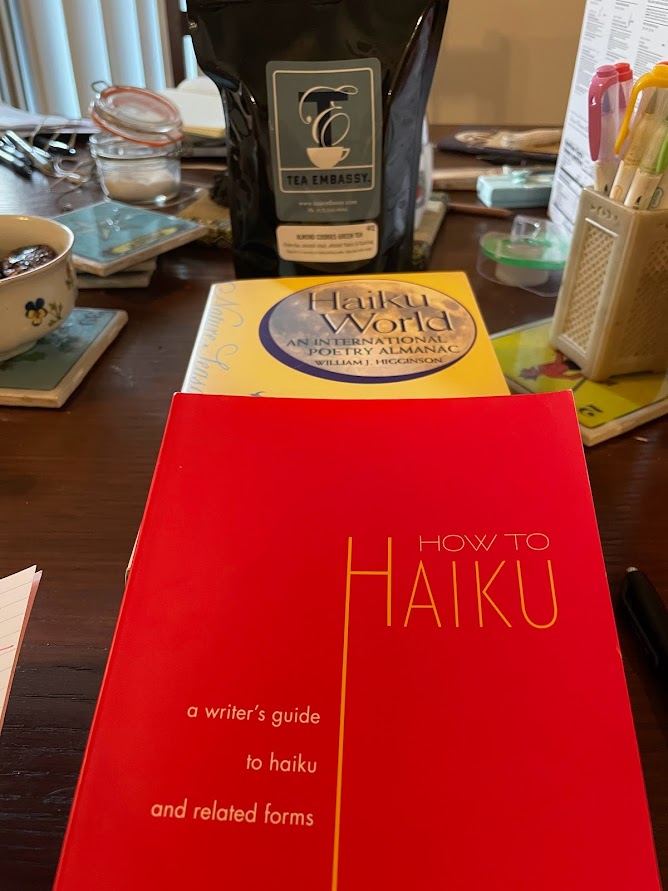
Haiku World: An International Poetry Almanac by William J. Higginson
Note: This essay was originally intended to run in the January issue of the Haiku Society of America newsletter. However, it got preempted by an obituary for an HSA member. Given that this piece won’t be timely in February, I figured I might as well share it here, so it doesn’t just linger on my hard drive. (Because if I save it for 2025, I will probably forget that it exists.)
As someone who takes on a shocking number of projects, you probably aren’t surprised that I love the reflection and goal-setting aspect of the new year. I’m also wary of absolutes like, “You should write every day.” As we go through the different seasons of life, our relationship to our poetry evolves. I wanted to start out 2024 with a list of practices you can use to support your haiku practice. Whether you’re a new practitioner, or more seasoned and looking for fresh inspiration, I hope some of these ideas resonate with you.
1. Sign up for a time-bound daily writing challenge such as National Haiku Writing Month (https://www.nahaiwrimo.com/) or Poetry Postcard Fest (https://cascadiapoeticslab.org/poetrypostcards/). Daily writing is a fantastic discipline, and committing to a one-month period can make it seem like a more manageable task. (Note that Poetry Postcard Fest is not specific to haiku/senryu, but the postcard format is a perfect fit!)
2. If you feel extra ambitious about daily writing, try the Buson Challenge: 10 haiku a day for 100 days. (I confess I have attempted this challenge at least four times and haven’t yet succeeded.) You can listen to Mike Rehling talk about the challenge here: 3 Michael Rehling.
3. Make a calendar of submission deadlines for the coming year. Most publications have their deadlines established already, and you can set up recurring deadlines easily using Google Calendar or iCal. Don’t forget to turn on email or push notifications so you always get a reminder! (I like to set notifications for both the opening date and closing date.)
4. If you don’t have a system yet for tracking your haiku submissions, this is the year to set one up! Most of us (myself included) have accidentally submitted something that’s out for consideration elsewhere. A solid submission system helps! There are many services out there, such as Duotrope, that help you track your submissions (usually for a fee). However, you can use a spreadsheet or Word document as well. I’ve been using a color-coded Excel spreadsheet for three years, and it works great!
5. Work with a saijiki (a compendium of kigo), picking one word a day to start as a jumping-off point. My favorite is William J. Higginson’s Haiku World: An International Poetry Almanac. However, it’s out of print and copies can be expensive. I am also a fan of Jane Reichhold’s A Dictionary of Haiku, available as a free PDF from the Haiku Foundation.
6. Commit to a revision streak. Often, we get focused on generating new work and don’t devote as much time to revision. Consider taking a few weeks off from writing new poems (unless you get struck with divine inspiration, of course!) and focus on daily revision of existing work.
7. Spend a chunk of time every day observing your environment: sunrise and sunset, traffic patterns (they can be seasonal!), the emergence of plants, the clothes that people wear. Start to develop your own personal saijiki related to the area where you live.
8. We often overlook the sense of smell in our writing. Try spending a week writing down every scent you encounter as you go about daily life. Use your scent list as a springboard for your haiku, senryu, and other forms.
9. Join forces with a haiku friend or a small group and write some renku, rengay, or split sequences. If you don’t have a writing buddy in your area, you can write via email, online chat, text message, or Zoom.
10. Participate in a ginkgo (haiku walk). If you don’t have a group in your area to walk with, you can have a solitary ginkgo. (Or maybe start a ginkgo group in your area!) You can learn more about ginkgo practice in the article “Haiku as a Nature Connection Practice” from seasonwords.com.
11. Make a small chapbook as a birthday or holiday gift for a loved one, especially if you have a number of haiku/senryu written about them and experiences you have shared.
12. Take a poetic risk this year: submit to a journal or contest that feels out of reach, self-publish a collection, give a public reading, or start a podcast. Maybe launch a print-on-demand store of postcards featuring your haiga. Whatever is calling to you but seems scary, give it a shot.
Which of these ideas will you try this year? Let me know! And be sure to check back in to tell me about your experience.
Laura Van Prooyen’s new collection, Frances of the Wider Field
I met Laura Van Prooyen at Poetry at Round Top when she was promoting Our House Was on Fire. I still remember seeing her cast in the warm stage lights of the Round Top concert hall, reading these poems about uncertainty, illness, and motherhood. Her new collection, Frances of the Wider Field, was released in March. While I was sad that we couldn’t celebrate her new release in person at Round Top this year, I did enjoy the online workshop I took with her in the online version of the festival. I’m excited to share this interview that we conducted via email over the past few months, while dealing with the Texas freeze, teaching duties, family responsibilities, and the work that goes into a book launch. That we wrote our questions and responses amidst the hustle and bustle of daily life reflects something that I admire about Laura’s poetry: our other work, our obligations, do not take us away from poetry. They are the stuff of which poetry is made.
[AW] My favorite lines in “Against Nostalgia” are “What defines me is constancy of place, / and my urge against it.” Like you, I’m from the Midwest, and have made a life in Texas. I find that the longer I am away from Ohio, the more the tension of being a native of one place but choosing to live in another comes through with more intensity in my poems. Has being of a particular place but then making your life in another place influenced your poetry in a particular way?
[LVP] Thanks for this question. It is hard to be away from home, but when I visit my parents it is also hard. So, yes, that inherent paradox informs my poems. I grew up in a house my grandfather literally built. I never met him, but I have a picture of him with a crew digging the basement. My grandmother lived next door to us, and my great-grandmother next to her. My mom has never moved in her life. She’s still there now, at 81 years old and with dementia. Our roots are deep. I opted for sun, warmth, and new experiences, a choice I don’t regret but wrestle with all the same. I feel torn a lot, wishing to be in multiple locations at once. That tension fuels a lot of the poems in Frances of the Wider Field.
As I read through Frances of the Wider Field, I think of my own grandmothers, one who died suddenly 30 years ago, and one who died 17 years ago from Parkinson’s. I often feel that I never really got to know them, and that is its own kind of grief. I see your poems as a way to stay in conversation with people you cannot converse with anymore, at least not in the way you once did. Do you feel there is something special about poetry as a genre that allows for these conversations to happen?
I hadn’t really thought about it like this before, but yes. Poetry allows for all kinds of unexpected turns as opposed to, say, a mode that has some expectation of linearity. It seems to me that poems are not only a way to stay in conversation with people we can no longer access, but that writing into the unknown allows us to converse with mysteries. The Frances poems originated with that energy, of being open to conversations with people I never met, with places that existed before me, with lineage, with ghosts, with concepts of god. The energy was at first an impulse to write toward a very specific absence, but the poems turned into presence–Frances began permeating the landscape, the dailiness of past, present and maybe even future. I’m interested in the continuum of time and memory and how we move long through different planes of experience, sometimes all at once.
Speaking of lineage, I love the ways in which that theme shows up in this collection. One of my fascinations is with the idea of a writer’s lineage, and the ways in which creative lineage can be expansive. We have our family lineage, and we also have the poets/writers we read over and over. We have the teachers that have taught us about craft, or form, or topics that had nothing to do with writing, but nonetheless had a profound influence. Anne Sexton and Natalie Goldberg are part of my creative lineage; so are the Austin poets who have been both mentors and friends over the past 13 years. Finally, that list includes my 9th grade geography teacher (who taught kindness as much as she taught geography), my aunt, and my grandmothers. How do you trace your own creative lineage? What are the different threads or spokes that have come together to help make you the poet that you are today?
One pivotal moment in my life was my first semester at the university. I was a first generation college student. My first semester I took a seminar called “Creating Selves.” I have no idea if we had choices for these seminars, but somehow I lucked into this class taught by a professor who had us read Rainer Maria Rilke’s Letters to a Young Poet, Maxine Hong Kingston’s The Woman Warrior, Dag Hammarskjöld’s Markings, and Helen Hanff’s 84 Charing Cross Road. She required that we keep a journal, a mix of personal insights mixed with responses to the texts. I have been keeping a journal since that class, since I was 18 years old. I still have my marked up copy of Letters to a Young Poet, and I’m actually still in touch with that professor. She came to my virtual book release just last week. I hold close poems from Louise Gluck, Larry Levis, Brigit Pegeen Kelly, Vievee Francis, John Donne, Adelia Prado and Olena Kalytiak Davis among many others, too. I’m also a fan of Lynda Barry. I wanted to be a visual artist before I ever thought about being a writer. I suppose there’s still time.
I love the way you depict work in these poems, specifically, the work Frances performs. “Avenue F” is the most striking example: the work of wringing and hanging laundry, of polishing the baby’s shoes. In “Lilacs Full of Bees,” Frances has cleaned gutters, polished the car, and soaked her feet after a long day. I’d love to hear more about your approach to depicting those daily tasks. Did you have a specific approach to incorporating them? I think some poets are hesitant to bring dailiness into their poems because they worry it comes across as boring. How did you incorporate Frances’ daily, domestic work in a way that made the poems come alive?
It’s wonderful to hear that for you the poems came alive. Dailiness is life. I’m interested in specificity, and if I had a particular approach, I suppose it was to write toward the specifics. I also had to make choices. I had ideas and things popping up, like polishing the car and cleaning the white walled tires with a toothbrush. Not every daily task made the final cut. When I really get into revision, I read my work aloud. What stays is what sounds right. As in, sonically. I ask myself (consciously or intuitively) how the sounds of words play off each other, how can the poem create a sonic landscape that works in relation to the details.
Finally, is there anything you never get asked about your work that you’ve always wanted to talk about?
I love your final question, but I cannot think of anything in particular that I’ve never been asked. I love talking about the creative process and hearing from other makers what they do, what they’re reading, what art they’ve seen or music they’d listened to. I like to talk to people who are curious, because staying curious feels right to me. Learning new things. Being open. That’s part of the work.
Laura Van Prooyen
Thanks to Laura for participating in this interview. I hope you enjoyed learning more about this engaging collection. You can buy Frances of the Wider Field from Laura’s website (the most direct way to help a poet get paid!), Lily Poetry Review Books, Bookshop.org, major book retailers, or your local independent bookstore.
I never can remember the first time I met someone who became a close friend. I know that I met Elizabeth Kropf at AIPF, and I’ve known her close to a decade, if not more. There have been periods when we’ve spent a lot of time together, and periods where work, school, and family meant we went a long time without talking. The death of our friend Wade Martin earlier this year provided a sad yet vital opportunity to reconnect. One of the first things she told me was that her first chapbook, what mothers withhold, had been accepted for publication. It’s now in preorder until November 6th, and I’m thrilled for her. To celebrate, I thought it would be fun to interview Elizabeth about her upcoming publication. This interview is inspired by the style of Divedapper.
[Allyson Whipple] I’ve always wanted to discuss the role that faith plays in relation to your poetry. I remember being shocked the first time you told me you were a practicing Christian, because back then I knew many people whose actions gave Christianity a bad name. While you don’t seem to write much overtly religious poetry, at the same time, I find that our spiritual practices often end up infused in our work. Does your spiritual life connect with your creative life, and if so, what’s your relationship to poetry and faith?
[Elizabeth Kropf] I take your shock as a compliment. The graduate program I attended was Perelandra College, which is the name of a C.S. Lewis novel. The philosophy of the college is that Christians should be good writers because we have access to the Holy Spirit. Ken Kuhlken’s book Writing and the Spirit expanded on this idea. I took a course called “The Bible as Story,” which was about looking at Scripture as a story. I wrote my first published poem in that class, so I think responding to Scripture is powerful for me. There is one poem in “What Mothers Withhold” that is based off a verse in Exodus. Poetry is a way to wrestle with God and is an act of worship. My spiritual journey has been influenced by the writings of Sarah Bessey and Rachel Held Evans, and I highly recommend their writing to anyone struggling with faith. What I hope to accomplish in my poetry is to share my story without excluding anyone. I don’t want someone without a Christian background to feel alienated, and I don’t want someone who is not a mother to not have any way to connect to my work.
[AW] One of the things that fascinates me about spiritual practice is the ways in which form lies at the heart of worship. We can find form in the instructions for Islamic prayer, in Communion rituals, and in meditation practice. I’m curious as to whether the formal aspects of Christian practice connect in some way to your love of the sestina form.
[EK] I hadn’t thought about that connection. I didn’t grow up with a lot of rituals, but they are valuable to me now. I didn’t grow up celebrating Lent, but it is something I practice as an adult. Something fascinating about Lent is that you can just fast from certain things, such a sugar, or add a practice during Lent. That would be a wonderful exercise as a poet- to fast from something commonly used, or to add something for a period of time. For me, I could abstain from writing in first person, or add an image from nature in each poem.
I recently started practicing TaeKwonDo, which has form. My instructor said that no one would use form during a fight, but it is about practicing the movement and creating muscle memory. Form can be considered an exercise to make us stronger writers. I recommend The Poetry Dictionary by John Drury because it defines many forms and other poetry terms.
What I love about form is that it prevents poets from just bleeding into the page. The sestina is my favorite because it creates a theme with the repeated words, but it is subtle enough that the reader doesn’t anticipate the next line. Ezra Pound said the sestina is “a thin sheet of flame folding and infolding upon itself.”
[AW ] I have always enjoyed list poems and how-to poems. Even though I’ve made the choice to not have children, the poem “how not to get pregnant” is one of my favorites because of the way it plays with the how-to form, since ultimately the desired goal doesn’t materialize, at least for a long time. I also think this poem speaks to something universal, whether you’re trying to have children or not: that is, putting all of your energy and attention into something, and despite doing everything right, it never comes to fruition. I can feel the sorrow and frustration that led to this poem, and yet despite those emotions, this poem also has moments of humor. The image of trying to remember your temperature until you find a pen and the imperative, “Don’t argue when you are ovulating” are funny, not because they are not serious, but because when we are in pursuit of our soul’s deepest desire, sometimes the things we put ourselves through are a little comical. Now that you’ve had some distance from the initial struggle that led to this poem, do you find humor in it? Has your relationship changed to the poem at all?
[EK] I’m glad you connected poem, and I remember that you write this kind of poem as well. I probably copied the concept from you! I have a few “how to” poems, and two of them are about attending funerals. A list or how-to poem can give some distance to be able to approach intense topics without just bleeding onto the page. I recommend any poet try that as a way to write about something they are struggling to articulate. It would make a fantastic anthology.
I’m glad that the humor in the poem came through, as I was going for a lighter approach. The process is quite absurd. There are literally apps to track ovulation symptoms. My relationship to the poem has changed because we were fortunate enough to have another child. As I am looking at what is the final version of the manuscript (I have been sending the manuscript out for years), I see how it ties into the theme in other poems of my struggle to accept when things are different than I planned or expected. My delivery with my oldest was very difficult for that reason, and I wrote so many poems just to process it.
[AW] I’m thinking now about how I saw Vievee Francis speak on a panel at Poetry at Round Top, and she talked about how the process of creating her poems and books was not necessarily therapeutic. The writing did help her process and make sense of the life she’d lived growing up Black in rural Texas, and yet they didn’t necessarily provide closure. Natalie Goldberg has said that writing practice isn’t therapy. It’s clear that poetry has been part of your healing process. I’m wondering if it gave you the closure you were expecting, or whether the work only got you so far.
[EK] Poetry absolutely has given me closure. There is something beautiful about crystalizing an experience and saying, hey, I would have liked for this to turn out differently. Part of my healing also was sharing the poems with others. There are tragedies that there cannot be closure for, and in those instances at least acknowledging pain is powerful. I wrote a poem about the mass shooting in my hometown of Thousand Oaks, California and I don’t have closure about that.
Poems about a lack of closure can also be powerful. I remember a poem from Round Top about a woman whose adult daughter died, and she had a metaphor about how she would be okay and then pain would come back like a piece of glass in her foot. I think the poem was called “Smithereens.”
Since having my youngest daughter I have worked with a life coach, and I realize now that I could have had closure much sooner with some things. I was creating more suffering for myself because I was struggling with the idea that what happened should not have happened. With my first daughter, I very much did not want an epidural, but was induced and ended up getting one. The epidural was incredibly painful and didn’t work. If I had been able to let go of my anger over that, I would have had closure on that aspect of the birth much sooner. I recommend the website https://thework.com/ for more about challenging our thoughts. That itself would be an amazing workshop, to challenge our thoughts about something we don’t have closure on.
[AW]On the Commonplace podcast, poet Rachel Zucker has often talked about her attempts to write an essay about the poetics of motherhood, and ultimately finding she could not write the essay she intended. It wasn’t because motherhood and poetry were incompatible, but because she found that the nature of motherhood was not something that could be neatly tied up into poetics. What are your thoughts? Do you think it’s possible to have a poetics of motherhood, or does motherhood defy that kind of categorization? How do motherhood and poetics connect for you, if at all?
[EK] My strongest poems are about motherhood. However, there are things I have not been able to write about yet. I have very few poems about my youngest, even though she is delightful and exuberant. It is hard to write about certain things without being smarmy. I also try to have a “turn” in a poem, which I learned from Cindy Huyser. I don’t remember who she said stated it, but she believes every poem should have a turn. There are things I want to write about but I haven’t figure out how to do it well.
Motherhood has brought the most intense experiences I have had. For me, poetry is a way to tell a story and connect to the reader. You don’t have to experience their story to relate to the emotion. I’m reading David Meischen’s poetry book Anyone’s Son, and it is incredibly moving. I like the concept of a poetics of motherhood as a verb. How do we mother? How are we mothered? Can we mother the reader?
[AW] That leads me back to Rachel Zucker’s work, because she also has spoken and written in defense of sentimentality. In the essay “Terribly Sentimental,” she writes: “I have less and less patience with poems that don’t in some way engage human emotion. Poems in which I do not feel the presence of a feeling (as well as thinking) human being. This preference is, I think gendered. I hear my students talk about their fear of sentiment (they seem as afraid of sentiment as of sentimentality or do they just not distinguish between the two?) and I can’t figure out where this is coming from. I used to be afraid of writing poetry of witness, a sort of AA poetry, but now I think I prefer that to the mechanistic poetry that wants to be person-less. Is this about age? Gender again?” Is smarminess different from sentimentality? I think “Chocolate Chip Cookies with Madeleine L’Engle” and “heel-click” are poems that are sentimental without being smarmy. What is your relationship to sentimentality, and what kind of potential do you think there is in being willing to engage with it?
[EK] I really connected with this essay, and it drew attention to many of the ideas I have about what I was not prepared for with birth specifically. I do have some sentimental poems, and I selected the poems you referred to in order to balance out the intense themes in the other poems. “Chocolate chip cookies with Madeline L’Engle” is one of the most recent, if not the most recent, poem in the collection. Even though it is not as personal as the other poems, it still draws on the theme of wanting to protect others, which might be seen as sentimentality.
There is value in engaging with sentimentality, and I always will. My previous answer was more from a place of examining what I feel I am able to succeed in accomplishing. I am more drawn to poems that have a human connection, as talked about in Zucker’s piece. I’m not drawn to poems about nature. I recognize the skill in their writing, but it’s not what I’m drawn to read. I enjoy being outside, but I have almost no poems about nature.
[AW] Is there anything you never get asked about your work that you’ve always wanted to talkabout?
[EK] I wanted to talk about the cover art for my book. Tamryn Spruill is an amazing artist. When I found out I got to select the cover art for my book, I asked her to create something. She asked what I had in mind and I said “I have no idea.” She read my manuscript then created this sculpture. She asked me what color my anxiety was and I said orange. The thread around the woman is orange, and the belly is covered with images from the book. I am grateful she created such an exquisite sculpture.
Note: Preorder your copy of what mothers withhold by November 6th. Poets depend on preorders more than ever. If you know someone who you think would resonate with this book, preorder a copy for them as well! This chapbook is scheduled to ship on January 4th, 2021.
The sixth Big Poetry Giveaway is up and running! The fabulous Kelli Russell Agodon is hosting again. And I’m looking forward to another great year of meeting new poets and sharing poetry.
This year, I’m giving away two books. First up is my chapbook, We’re Smaller Than We Think We Are (Finishing Line Press, 2013).
I wrote the poems that became this chapbook after I had lived in Texas for about two years. It’s about finding place, falling in love with geography, taking journeys.
The second book I’m offering is an anthology called America Zen: A Gathering of Poets. You don’t have to be a Buddhist to love this anthology. The poets in it are Buddhists, but their meditative, spiritual, joyful work transcends a single spiritual label.
So how do you win? Just leave a comment with a name and email address anytime between now and 11:59 p.m. on April 30th. I’ll randomly select a winner in May!
For details on how to join BPG, see Kelli’s post here.
Since Big Poetry Giveaway always draws new readers here, I like to take a cue from Kelli and do a little introduction of sorts. Kelli gave herself some great interview questions this year, so I’ll be using those.
Welcome! My name is Allyson Whipple. I run the Austin Feminist Poetry Festival and am co-editor of the 2015 Texas Poetry Calendar. I have a black belt in Hung Gar Kung Fu and am training to become an instructor. I also teach business and technical writing at Austin Community College.
Last year I: Saw my favorite band twice in two days, earned my black belt, got divorced, got some of Kay Ryan’s poetry tattooed on my arm, and applied to an MFA program (I am still waiting their decision).
I believe in universal healthcare.
I like sunshine, red wine, tacos, steak, the ocean, silver tequila, and jeans.
I am always looking for ketchup potato chips, which are nearly impossible to find in Texas.
People think I am not interested in hip-hop or country music, when in fact I like both.
I recently: perfected my homemade bagel recipe.
If I could live anywhere: I would stay where I am, except in a house that didn’t have foundation problems or a roommate.
I do not buy bread from the grocery store. I’ve gotten too spoiled from my own baking.
I am thankful for the amazing poetry opportunities that have come my way in the past few months.
I cheer for Cleveland and Ohio State (on the rare occasion I pay attention, which is almost never).
To me, success is actually pretty much 100% what Kelli said: “being able to control my own time and schedule.”
My writing process is all up in the air right now, as I’ve turned my attention to getting my first full-length collection prepared for publication. (Hopefully this year, but we’ll see.)
The places we love most in life can harm us as well as sustain us. Childhood can be idyllic and beautiful, but even the most bucolic towns can have lurking dangers. Jeannine Hall Gailey’s The Robot Scientist’s Daughter is a collection that is part science-fiction fairy tale and part revelation. Drawing on her childhood in Oak Ridge, Tennesse (also known as The Atomic City), Gailey sheds light on a piece of American scientific history that you might have not learned about in school. Gailey was the daughter of a researcher at the Oak Ridge nuclear site. The town, as it turns out, was toxic, tainted by nuclear waste. The Robot Scientist’s Daughter brings us a beautiful, magical place with a horror story lying beneath. It will break your heart, and it will make you think.
While The Robot Scientist’s Daughter is a fairy tale composed in poetry, the book I thought of most while I was reading it was Ray Bradbury’s Dandelion Wine. Bradbury didn’t just write compelling science fiction. He also composed fantastical stories that touched on the ways in which childhood is magical and beautiful, but also dangerous, fraught, and terrifying. Gailey’s poems reflect a love for Oak Ridge, but also an acknowledgement of the dangers and horrors that came from living in a town that had basically been poisoned by the nuclear research site there. There is fantastic beauty in the janitor’s overgrown tomatoes and flower; there is also terror when you realize the flora is overgrown due to radiation, and that the janitor is slowly dying of radiation poisoning.
One of the difficulties of politically-motivated poetry is how to get the point across without being polemical. Gailey does that masterfully in this collection. She doesn’t have to yell at us about the ways in which nuclear waste is harmful, about the fact that nuclear power is dangerous. We see it in the sick children, the dying researchers, the land perhaps irreparably corrupted. While it seems that energy debates have been going on my entire life, and while I have heard many people extol the virtues of nuclear power, The Robot Scientist’s Daughter is a collection that made me think. It compelled me to research and learn. At its best, political poetry forces you to consider what you have known, learn, and change.
It is hard to pick a favorite poem from this book. So many of them left me stunned, shocked, or on the verge of tears. “Cesium Burns Blue” is, I think, one of the definitive poems in this book:
Cesium Burns Blue
Copper burns green. Sodium yellow,
strontium red. Watch the flaming lights
that blaze across your skies, America—
there are burning satellites
even now being swallowed by your horizon,
the detritus of space programs long defunct,
the hollowed masterpieces of dead scientists.
Someone is lying on a grassy hill,
counting shooting stars,
wondering what happens
when they hit the ground.
In my back yard in Oak Ridge,
they lit cesium
to measure the glow.
Hold it in your hand:
foxfire, wormwood, glow worm.
Cesium lights the rain,
is absorbed in the skin,
unstable, unstable,
dancing away, ticking away
in bones, fingernails, brain.
Sick burns through, burns blue.
This poem is the cell from which the rest of the book grows. I am struck by how much it contains, and how easily the other poems seem to shape themselves around it.
The Robot Scientist’s Daughter will officially be released on March 1st. You can preorder it at Mayapple Press. (Which you should definitely do. Not just because it’s an amazing collection, but because if you order now you can get it at a fantastic sale price.)
Jamaal May’s poetry has won numerous awards. Starting in the slam tradition, he writes the kind of poetry that is powerful both on the page and off. He’s currently a Kenyon Review Fellow and co-directs Organic Weapon Arts with Tarfia Faizullah.
I first encountered Jamaal May’s work when reading “The Gun Joke” in a workshop this fall. It is a life-changing poem, and essential reading. Find Jamaal May’s “The Gun Joke” at Apogee.
In honor of Martin Luther King Day, I’m celebrating some amazing poets. I have scheduled several posts to appear throughout the day. I hope you are as inspired as I am by these amazing writers.
I first saw Jericho Brown at Poetry at Round Top last year. Hearing him read in the chapel on Sunday morning was a life-changing experience. He’s a poet who manages to be vulnerable and yet completely powerful at the same time. Reading his work on the page is incredible, but go hear him read if you get the chance. You won’t regret it.
Jericho Brown won the American Book Award for his first collection, Please. He holds both a Ph.D. (University of Houston) and an M.F.A. (University of New Orleans). He has received numerous awards for his work.
In honor of Martin Luther King Day, I’m celebrating some amazing poets. I have scheduled several posts to appear throughout the day. I hope you are as inspired as I am by these amazing writers.
It is an honor to be able to call Fatima Hirsi a friend. Every time I see her perform, I develop new admiration for her work. She is one of the few poets whose work consistently moves me to tears. Whenever I take one of her workshops, I am amazed at the poems that result.
Fatima Hirsi currently lives in Texas, where she works at a bookstore and teaches writing workshops to children at the Writer’s Garret. She recently completed a Sidewalk Poetry tour of the western United States.