Category: seasons

  • Innumerable Autumns

    Innumerable Autumns

    The classical Japanese season words have hundreds of years of cultural buy-in from Japanese haijin. Those of us who study saijiki know that each season has its own word associations that are deep and subtle. The season words (kigo) not only place us in the season as a whole, but also indicate where in the season (early, middle, late) the poem lives. Some classical terms seem universal. For example, “snow” is a well-established winter haiku.  

    alpine winds
    the soft timbre
    of fresh snow

    Mona Bedi, Autumn Moon 9:1

    Most people who live in temperate zones in both the Northern and Southern hemispheres experience snow at some point during their winter months. (Note that the hemispheres have their winter and summer months reversed.) While amounts vary, snow occurs frequently enough in winter that we have more or less global buy-in about the term as a winter kigo. 

    While season words have well-established associations, they are still malleable. For example, in the classical tradition, “moon” is an autumn kigo. Poets have to modify the word, or use a different kigo entirely, in order to place the poem in another season. 

    the end of visiting hours cold moon

    ang katapusan ng oras ng pagbisita malamig na buwan 

    ​            Alvin B. Cruz, Autumn Moon 9:1

    In Alvin’s haiku above, “cold moon” places us in winter; the cold moon is the full moon that appears in December (https://www.almanac.com/full-moon-december). 

    The malleability of season words allows us to recognize that natural and wild phenomena have the potential to appear all year. The moon doesn’t just appear in autumn, so we have evolved our poetic language to write about the moon in all seasons. Likewise, while it can be difficult to fathom, no single weather phenomena belongs to a single season. I struggle to imagine snow in winter, but in high-latitude northern countries such as Iceland, snow can appear in the summer months. While it’s not frequent or heavy, it’s also a documented phenomena. Even in lower-latitude countries, mountainous regions can experience snow in the summer; we can see this throughout Europe and Asia, as well as South America. While I’m not likely to experience summer snow in my life (owing to my dislike of cold and tendency toward serious altitude sickness), I couldn’t realistically read a haiku that included the term “summer snow” and outright declare it preposterous. While season words such as snow seem universal, the experience of snow at different points in the year can never be truly universal, as said experience is dependent on fluctuations in geography and climate. 

    I’ve written frequently about how, as a child, I felt out of step with the seasons as they were dictated by the Gregorian calendar. Of course, I didn’t have a sense that different calendars had been used throughout history. I didn’t even have a concept that people operated within different calendar systems in contemporary society; my first exposure to that was when I was dating my first husband, and would occasionally attend shabbat services with him. That was where I learned about the Jewish liturgical calendar, which was operating on its own sense of time. 

    The Gregorian calendar creates a boundaried approach to the seasons, meaning that it uses the equinoxes and solstices as hard stop and end points. The upcoming spring equinox will signal a hard stop to winter and a hard beginning to spring. Meanwhile, as I drove to work this morning, yellow daffodils lined the grass of my exit ramp. There are buds on the crab apple and maple trees. Spring has definitely arrived in St. Louis . . . but we’re likely to get one more hard freeze later in the month. I might be wearing sandals today, but I know the remains of winter lurk in the atmosphere. Because of the hard seasonal boundaries it creates, the Gregorian calendar has value for the scientific community, but the organizational schema does not allow for the malleability of seasonal change. It creates a fixed view of when seasons start and stop and, in my opinion, that tends to create a sense of seasonal ownership versus seasonal association. When we operate exclusively with a fixed, boundaried view of the seasons, we limit our perception and our writing. Snow can only belong to winter . . . though if you’ve ever lived in Cleveland1 (or worse), you know perfectly well it can show up in spring. 

    While not everyone who is raised exclusively under the Gregorian calendar will inherently develop a fixed relationship to the seasons, it certainly happened to me. This is why I could get frustrated and say, “It’s spring! It’s not supposed to snow on my birthday!” Well, when you live in Ohio, snow doesn’t care about the equinox or about spring birthdays. A fixed understanding of the seasons ultimately led me to a mental framework that frequently set me up for disappointment and also inhibited my approach to haiku. A malleable view of the seasons becomes even more important as the effects of climate change continue to unfold2. John can say, “It’s not supposed to be 90 degrees in October,” and while historically St. Louis might not have seen persistent 90-degree weather in mid-autumn, the concept of supposed to becomes less and less relevant as the climate destabilizes. If we are going to maintain whatever emotional equilibrium is possible during the current era, and also continue to be able to write season-based poetry, we need to leave room to allow for the changing seasons as they are, even as we resist the forces leading us toward our own destruction. 

    When I first began my study of saijiki, I found it difficult to operate within two calendars at once. The classical haiku calendar, which uses the solstices and equinoxes as the midpoints of the seasons, made more sense in relation to my lived experience. However, the Gregorian calendar guides the country in which I live. Sometimes, it is deeply frustrating to see people celebrating “the first day of spring” when spring has been evident for weeks. I get irrationally annoyed that The Old Farmer’s Almanac – an inherently agricultural text! – eschews the preindustrial boundaries of the seasons and adopts the Gregorian seasonal boundaries. However, my exposure to different religious traditions helped me understand that all over the world, people adhere to different calendars. I’ve of course learned about the Jewish liturgical calendar; life in St. Louis has also exposed me to the Catholic liturgical year, as well as the Orthodox Christian year. In my own personal studies, I’ve learned about Hindu and Buddhist calendars as well. Most people with a specific religious or cultural identity navigate their specific calendar along with the Gregorian one. There’s no reason why a haiku poet can’t do that as well. 

    Likewise, my understanding of season words and what they mean cannot be limited to my experiences living in the Midwest and the American South my entire life. I have to recognize that my experience of summer will never be the same as the experience of someone living in Iceland. The world is too big to contain any individual’s limited knowledge of seasons. In fact, it’s too big to contain any one saijiki’s attempts to categorize the seasons. That doesn’t mean we shouldn’t study saijiki. Rather, we have the saijiki as a foundation that guides our experience, but doesn’t dictate it. After all, even the strictest saijiki won’t refuse to let poets write about the moon in the spring. 

    As I wrap up this post, I’m reminded of this enduring haiku from Shiki:

    for me going
    for you staying—
    two autumns

    This haiku points to the individual experiences of two friends who will spend autumn in different regions. Today, it has me thinking about how there are in fact innumerable autumns (and winters and springs and summers). That is not to say that we should take a purely individualistic approach to the seasons, but rather that we should recognize the incredible variety within collective experience. Within the St. Louis area, we will all experience redbud flowers, bird migration, and the nerve-wracking experience of tornado season; due to geographic differences even in a relatively small area some of us will be more prone to flooding than others. Even in a single city, there is variability within each season. As haiku poets, it’s imperative that we study saijiki, understand our environmental foundations, and also leave room for the broader malleability of seasonal experience. 

    1I will always have a fondness for Cleveland, but not the lake effect snow.

    2This is not to say that we shouldn’t do what we can to combat climate change, but when the AI bubble hasn’t burst and the US is rolling back environmental regulations, well . . .

  • What Groundhog Day Can Teach Us About the Seasons

    What Groundhog Day Can Teach Us About the Seasons

    Now that I’m using a slightly more spacious template for my personal phenology project, I find myself occasionally noticing things beyond my immediate surroundings. For example, last week I was making some notes before work. My brain wasn’t at its sharpest, but I had a thought about Groundhog Day that had never quite occurred to me before: that the prediction is whether or not spring will arrive at the old-fashioned start of the season (yes, February) or if it will arrive at the Gregorian start of the season (the spring equinox). I jotted down some coherent notes and went about my day, but have been mulling the idea over ever since. This initial thought required that I learn more about Groundhog Day as well as further my research about how different cultures have marked and tracked the seasons. Ultimately, this passing thought has yielded me some useful insights into my Culinary Saijiki manuscript, and I think learning more about the historic practice of Groundhog Day can provide a fruitful framework for naturalist and/or creative practices.

    Groundhog Day emerges from a German custom in which a badger was the actual predictor of spring’s arrival. While badgers exist in North America, they’re primarily found in the Great Planes, and rarely in the regions where the Pennsylvania Dutch settled. As a result, Germans in the eastern United States decided to bestow responsibility on hedgehogs. Groundhog Day served an agricultural function back when our ability to track weather wasn’t as real-time and technological as it is now. The habits of the badger, and then the groundhog, provided a signal about the best time to start planting crops. A cloudy day on Groundhog Day (in which the groundhog would not see its shadow) suggested that planting weather was going to arrive soon. On the other hand, a sunny day actually indicated that a longer wintry period was in store, with a later planting season. The behavior of animals on the ground combined with the presence or absence of clouds in the sky provided humans with suggestions about when to begin the agricultural year. 

    The origins of Groundhog Day come out of ancient agricultural traditions in which the equinoxes and solstices were the height or midpoint of each season, unlike the Gregorian calendar, which uses these points as the beginning of each season. That means the starting points are days of the year that are less astronomically significant. Haiku practitioners know that in the classical Japanese calendar, spring begins around February 5th. In the Celtic tradition, Imbolc was the start of spring and generally occurred around February 2nd, the same as Groundhog Day. Even the old Christian observance of Candlemas, also occurring on February 2nd in Catholic and Protestant traditions, was considered the beginning of spring before the Gregorian calendar took over. 

    Today, Groundhog Day is observed almost exclusively in the United States and Canada, with the belief that if the Groundhog sees its shadow, there will be six more weeks of winter. However, if the Groundhog does not see its shadow, spring will arrive early . . . though according to the historical model, it wouldn’t be arriving early at all! Using the Gregorian calendar, Groundhog day tells us if spring will be early or on time. In older agricultural models, Groundhog Day tells us if spring will be on time or late. And while both models are valid, ultimately, the old agricultural models are more in line with lived human experience. I may be writing this on what we in the Midwest refer to as Fool’s Spring, but even that is a sign that the year is turning and a change is on the way. The material reality of spring will be here well before the equinox.

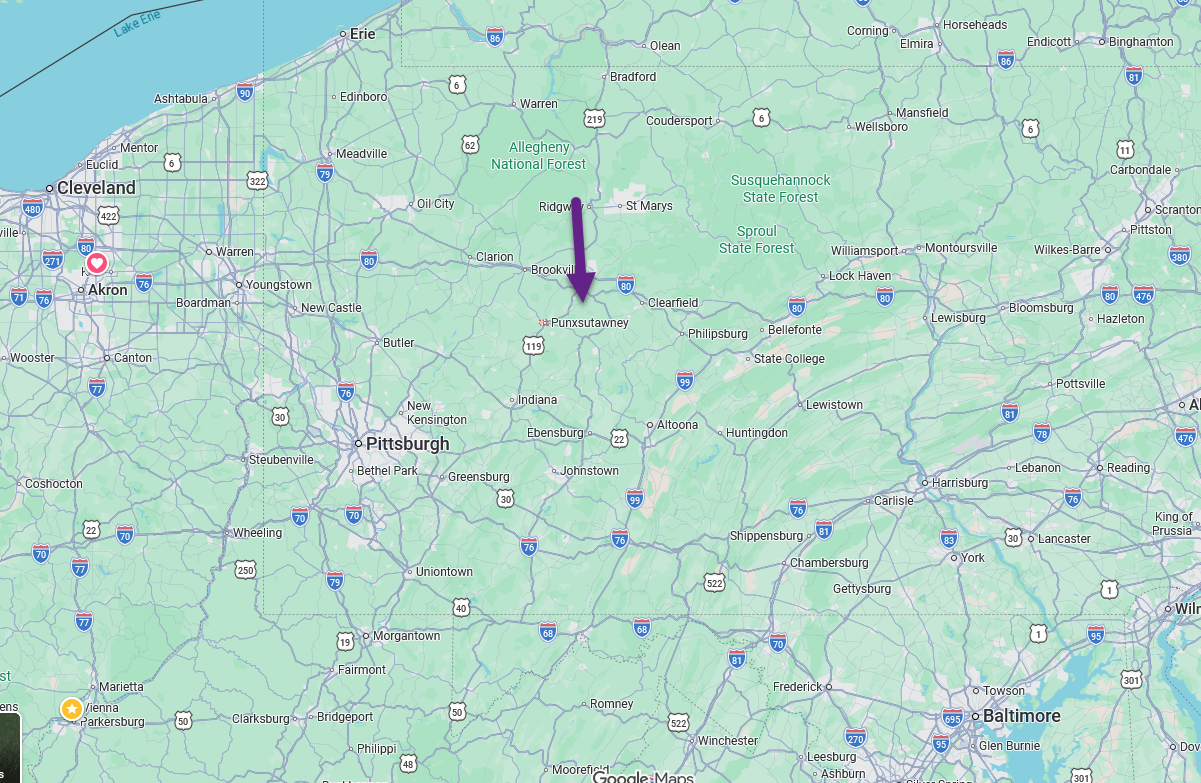
    Although there isn’t empirical evidence that the actions of Punxsutawney Phil accurately predict the arrival of spring weather, I feel that’s ultimately beside the point. First, given the geographic diversity of the United States and Canada, spring does not arrive at the same time for every reigion–and nor does spring look the same. Cherry blossoms appear in Washington, D.C. and Seattle, but the lack of cherry blossoms in St. Louis doesn’t mean spring hasn’t arrived; we look for redbud blossoms instead. Further, it seems like too much a responsibility to ask a groundhog in Pennsylvania to predict the arrival of spring all the way out in Vancouver. 

    Perhaps Punxsutawney Phil’s predictions should only be applicable to Pennsylvania and parts of Northeast Ohio. Given the width of Pennsylvania, I’m not even sure Phil’s predictions can or should extend all the way to Philadelphia. But that doesn’t mean we can’t observe it if we live beyond that area. We can find our own groundhogs, or badgers, or other relevant animals. In fact, there are prognosticating animals all over the United States, such as an opossum in Alabama and an alligator in Texas. (You can view the map here: https://groundhog-day.com/map). 

    I think the purpose of Groundhog Day in the modern era is to encourage us to look for signs of spring wherever we are. It also serves as a reminder that we don’t have to wait for the equinox for spring to come. Historically, there have been many ways of documenting and tracking seasons, and ultimately, spring is going to come on its own time no matter what calendars or division systems that humans use. It’s less important to adhere strictly to a single calendar and more important to pay attention to the world around us.

  • Haiku Girl Summer is taking submissions!

    Haiku Girl Summer is taking submissions!

    Haiku Girl Summer is officially open for submissions! The window is a little shorter this year; submissions are now only open until August 15th. However, that’s still 3 solid months to get work in, and you can submit up to 3 times during the cycle.

    Please submit 3-5 haiku or senryu using the form here: https://forms.gle/foXpvuaS19jHcyaR8

    I’m also excited to have the following guest editors lined up:

    • Jessica Allyson
    • Kathryn Haydon
    • Jennifer Gurney
    • Lakshmi Iyer
    • Kimberly Kuchar
    • Lorraine A Padden
    • Kelly Sargent
    • Vidya Shankar
    • C.X. Turner
    • Caroline Wermuth
    • Katherine E. Winnick

    2025 guidelines are available here: https://haikugirlsummer.substack.com/p/submission-information. I’ve just made a few changes, mostly on the housekeeping side. Please note the definition of “previously published” for this journal, and also note the AI statement.

    The biggest reminder: poems should not contain the word “summer.” The goal is to convey the season using descriptive language rather than naming it directly.

    I look forward to seeing your 2025 poems!

  • Soulard Haiku Hike on January 25th!

    Soulard Haiku Hike on January 25th!

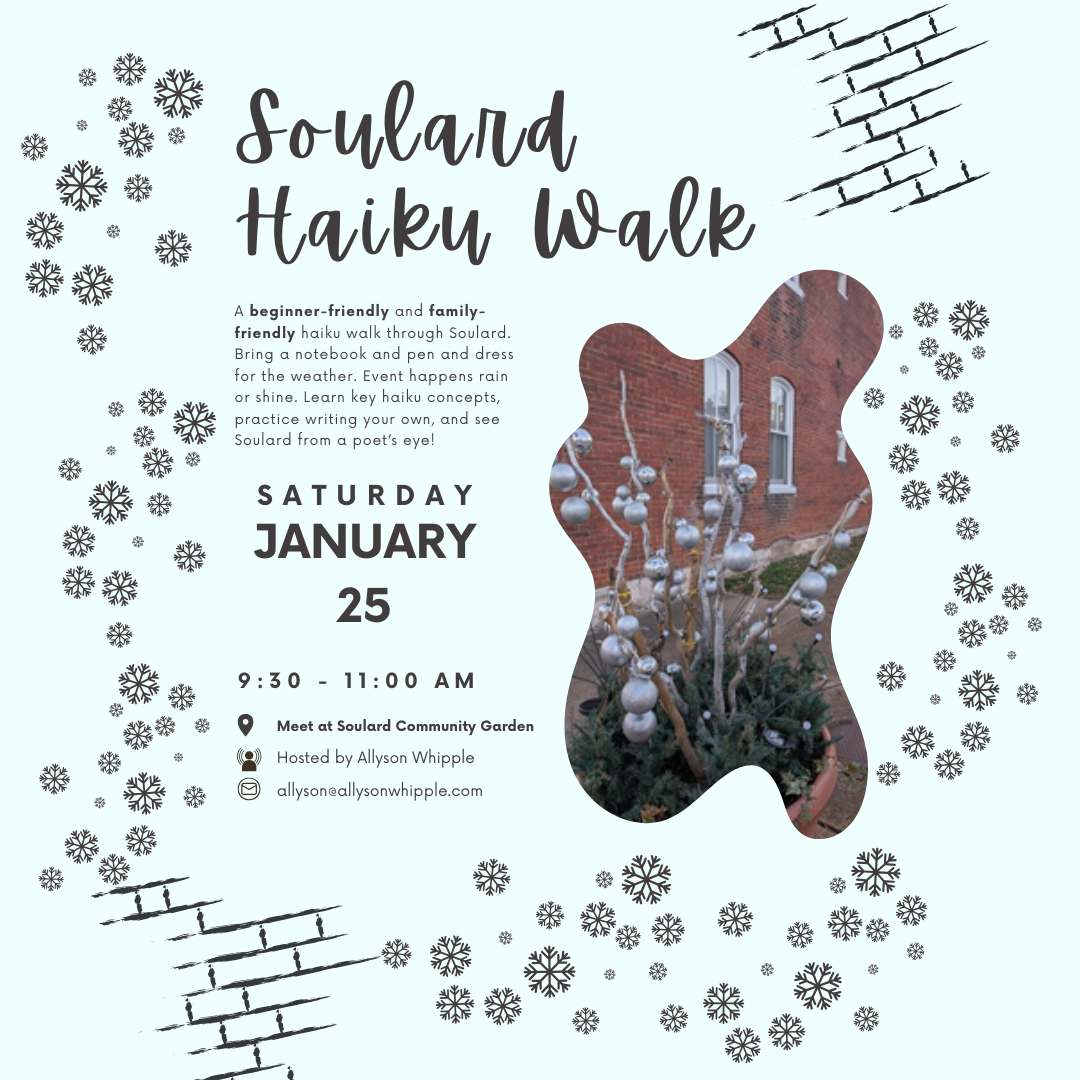
    I’m excited to be hosting another Soulard Haiku Walk this Saturday, January 25th at 9:30 a.m. I know that many of the people who read this blog are not local to St. Louis, but if you know someone in the area who might be interested, feel free to forward them this post.

    The Soulard Haiku Walk is a quarterly series that is beginner- and family-friendly. The aim is to introduce haiku to people who have limited to no knowledge, though experienced haijin are still welcome to attend.

    The walk begins at the Soulard Garden Co-Op, progresses to Pontiac Square Park, and ends at Soulard Market Park. Attendees are free to enjoy the Soulard Market and surrounding restaurants after the event. At each stop on the walk, I’ll give some instruction on haiku as well as a bit of local history. You’ll have plenty of time to write, and the event will end with a Q&A period as well as an optional chance to share your work. (No critique involved.)

    The January hike will provide a review of syllables in English-language haiku and give an introduction to season words (kigo). You can get more details via the Soulard website. If you have any questions, the fastest way to get in touch is email me at allyson[at]allysonwhipple[dot][com].

    I look forward to sharing my love of haiku with you!

  • Soulard Haiku Walks Launch in October

    Soulard Haiku Walks Launch in October

    I’m thrilled to announce that next month, I’m launching a quarterly ginko (haiku walk) series around the Soulard neighborhood. The first event takes place on Saturday, October 26th at 9:30 a.m. It’s free, family-friendly, and open to anyone in the St. Louis area.

    I’ve wanted to start hosting ginkos in St. Louis for over a year now, but with everything else I have going on, it kept getting pushed to the back burner. Finally, though, I realized I could start hosting them in conjunction with the Soulard Restoration Group Community Involvement & Events Committee.

    Here are my goals for the series:

    1. Provide free haiku education in a digestible format.
    2. Provide space for people to practice writing haiku without worrying about critique or judgment.
    3. Create a family- and beginner-friendly event.
    4. Explore Soulard and learn about its unique history.
    5. Recognize that haiku can be written in any environment, and that urban spaces are just as legitimate haiku spaces as pastoral ones.

    We will meet at the Soulard Community Garden and spend 90 minutes learning about haiku, walking, exploring, and writing. The event concludes at the historic Soulard Market, a great place to explore at the conclusion of events.

    If you have any haikurious friends in the St. Louis area, forward this post along to them!

  • S2E6: Community Open Mic

    S2E6: Community Open Mic

    Thank You, Contributors!

    Not all of this episode’s contributors have a dedicated online presence, so in the interest of fairness, I am not including supplemental links in these show notes. However, I encourage you to seek out these poets in the various print and online haiku journals:

    • Phillip Woodruff
    • Adele Evershed
    • Vandana Parashar
    • Eavonka Ettinger
    • Peter Larsen
    • Kimberly Kuchar

    Thank you again for being willing to share your work, as well as having patience with the technological issues!

    In Gratitude

    Thanks to Pamela P. for buying me a coffee! I appreciate the support. If you want to support this project financially, you can do so at at ⁠⁠⁠⁠https://www.buymeacoffee.com/culinarysaijiki⁠⁠⁠⁠. You can also help by sharing this podcast with anyone who you think might enjoy it.

    Postcards from Texas is available for preorder

    Preorder one, or all three, of the Cuttlefish chapbooks for summer 2023: ⁠⁠⁠https://cuttlefishbooks.wixsite.com/home/2023-summer-book-launch⁠⁠⁠

    If you preorder my book or the entire bundle, send me your address and I’ll mail you a thank-you postcard!

    You can also read my interview with fellow Cuttlefish author Julie Bloss Kelsey at my personal blog: ⁠https://allysonwhipple.com/2023/08/29/chapbook-interview-julie-bloss-kelsey/⁠

    On the Blog

    An overview of Full Moon is Rising: The Lost Haiku of Matsuo Basho and Travel Haiku of Matsuo Basho, a New Rendering, by James David Andrews. Read it here: ⁠https://culinarysaijiki.com/2023/08/23/lost-haiku-authorship-and-translation/⁠

    Join the Conversation

    This season, I am welcoming both podcast guests and guest bloggers. If you’re interested in joining one or both, visit ⁠⁠⁠⁠https://culinarysaijiki.com/join-the-conversation/ ⁠⁠⁠⁠for details.

    Theme Music

    “J’attendrai” by Django Reinhardt, performing at Cleveland Music Hall, 1939. This recording is in the public domain. Hear the whole song at ⁠⁠⁠https://clevelandhistorical.org/files/show/6045⁠⁠⁠.

  • S2E4: Interdependence: A Conversation with Elliot Nicely

    S2E4: Interdependence: A Conversation with Elliot Nicely

    Postcards from Texas is available for preorder

    Preorder one, or all three, of the Cuttlefish chapbooks for summer 2023: ⁠https://cuttlefishbooks.wixsite.com/home/2023-summer-book-launch⁠

    Get Elliot’s Book

    If you would like a copy of Elliot’s chapbook weathered clapboard, you can email him at elliotnicely [at] yahoo [dot] com. This is a limited print run, so get yours today!

    More From Elliot Nicely

    An analysis of one of Elliot’s haiku on Haiku Commentary: ⁠https://haikucommentary.wordpress.com/2019/07/19/elliot-nicelys-new-love/⁠

    Order Elliot’s chapbook The Black Between Stars: ⁠https://www.amazon.com/Black-Between-Stars-Elliot-Nicely/dp/1940996406⁠

    Elliot’s teaching resources: ⁠https://www.teacherspayteachers.com/Store/Elliot-Nicely⁠

    Now on Apple Podcasts!

    The wait is over! If Apple Podcasts is your listening platform of choice, find the show here: ⁠https://podcasts.apple.com/us/podcast/the-culinary-saijiki/id1632986084⁠

    Community Open Mic Airs August 30th

    Click the Send a Voice Message button here: ⁠https://podcasters.spotify.com/pod/show/culinarysaijiki/message⁠

    Deadline: Saturday, August 26th at 11:59 pm CST.

    Theme: Transitions

    On the Blog

    A consideration of when animal constitute food, and when they do not: ⁠https://culinarysaijiki.com/2023/07/26/classifying-animals-as-meat/⁠

    Join the Conversation

    This season, I am welcoming both podcast guests and guest bloggers. If you’re interested in joining one or both, visit ⁠⁠https://culinarysaijiki.com/join-the-conversation/ ⁠⁠for details.

    Support the Project

    Buy me a coffee at ⁠https://www.buymeacoffee.com/culinarysaijiki⁠. You can also help by sharing this podcast with anyone who you think might appreciate it.

    Theme Music

    “J’attendrai” by Django Reinhardt, performing at Cleveland Music Hall, 1939. This recording is in the public domain. Hear the whole song at ⁠https://clevelandhistorical.org/files/show/6045⁠.

  • An Overview of Six Seasons: A New Way with Vegetables

    An Overview of Six Seasons: A New Way with Vegetables

    “The seasons don’t ever divide themselves neatly,” writes Joshua McFadden in the opening of the Early Summer chapter of Six Seasons: A New Way with Vegetables. “Spring flows into early summer in fits and starts. A week of T-shirt weather may be followed by a string of cool gray days challenging our optimism about summer’s arrival.”

    Almost as soon as I began working with saijiki in my haiku practice, I struggled with the definition of seasons. The lunar-based haiku seasons didn’t correspond neatly with the Gregorian calendar under which I lived. I was living in Texas, where the seasonal expression is quite different from where I live now. And it’s true that the Earth doesn’t give us neat divisions. In the Gregorian calendar, summer has just started. In the haiku calendar, we’re in the middle of it. Two weeks ago, the last time I went to the farmer’s market, I saw an abundance of early summer (beets, potatoes) vegetables and midsummer vegetables (broccoli, cauliflower). But the early summer fennel and celery were out of season, and the summer squashes hadn’t arrived yet. I have started learning to live in the liminal space of seasons, and this book is an excellent guide for that.

    Six Seasons includes the standard spring, autumn, and winter. Summer, however, is divided into three sections: early, mid, and late. Each chapter contains a few key vegetables as the centerpiece, and McFadden details how their flavors and textures change throughout the season. Not only do seasons not divide themselves evenly, but vegetables are not the same through their entire growing range. What is sweet enough to eat raw one week might be moving toward bitterness a week later, and would benefit from cooking. It might be an insult to the carrot to cook it early in the season, but doing so toward the end of its peak enhances the flavors that are starting to fade. There is no one right way to eat or cook a vegetable; that depends as much on time of year as anything else.

    Over on the podcast, I’ve raved about the salad recipes I’ve tried from this book. Ultimately, though, there are two components of Six Seasons that make it more than a standard-issue cookbook:

    1. It focuses on techniques and practices. To be clear, it’s not a textbook; you won’t learn fancy knife skills (and that’s probably not really something best taught in a book anyway). But McFadden sprinkles in small things that make a big difference. For example, I’ve learned that if you’re making pasta with broccoli, the best way to cook the broccoli is to throw it in for the last few minutes of the pasta cook time. That way, it gets infused with the salted, starchy water, amping up the flavor. (I also swear it makes the broccoli come out brighter, but maybe that’s a placebo effect.)

    2. It reminds me that eating seasonally means surrendering control and will. For example, I’m writing this at the end of June. No matter how much I might hypothetically be craving butternut squash (really, I could just go for a good breakfast taco), there’s no way I’m going to find the requisite ingredients at the peak of freshness. Sure, I could go to a supermarket and there would probably be a butternut squash there, given the world we live in. But that doesn’t mean the squash is in great condition. If I wanted a savory squash dish, zucchini boats stuffed with sausage, cheese, and Italian seasoning would be a better menu option.

    That doesn’t mean you have to somehow align your cravings with the seasons, though I think most of us do to some degree (I want more salads in the middle of summer than I do in the middle of winter). That doesn’t mean that if you indulge the hankering for the comfort of an out-of-season dish, you’re a morally inferior person. It doesn’t mean you can’t make a smoothie out of frozen berries in January, if that’s what you’re into.

    What it does mean, though, is that if you really want to get in tune with the seasons, you have to relinquish expectation. Maybe you can’t wait to make roasted beets. But maybe the week you’re expecting to find them at the farmer’s market, they’re not there. Maybe three weeks goes by before they’re finally ready. Frustrating? Sure. But the fact is that we’ve been trying to bend the world to human whim for a long time now, and it’s clearly not going well.

    To eat seasonally means that you can’t plan too hard. As someone who likes to rigidly plan out all her meals for the week and go shopping in one fell swoop, this was a tough lesson to learn. The farms aren’t going to yield to what my mind has decided is the most efficient or delicious. I can either change my plan on the fly, or I can make that dreaded second stop to another store to buy what I want, even if it’s not quite ripe.

    To eat seasonally is to recognize that the world is so much bigger than your individual wants, and so beyond your individual control. That, I think, is the greatest lesson of Six Seasons, even if it’s not made explicit. Rather, if you make the book a guide to how you approach vegetables generally, that lesson will reveal itself over and over. Which is good, because if you’re anything like me, you’re going to need a reminder.

  • Season Two Introduction

    Season Two Introduction

    In Gratitude
    Thank you to Peg Cherrin-Myers and Kimberly Kuchar for the coffees they bought me this month. I am now 80% of the way to covering my hosting costs!

    If you want to contribute, you can buy me a coffee here: https://www.buymeacoffee.com/culinarysaijiki

    Join the Show: https://culinarysaijiki.com/join-the-conversation/

    Read the Blog: https://culinarysaijiki.com/blog/(New posts start up next week!)

    Haiku North America Info: http://www.haikunorthamerica.com/2023-conference.html

    Books I Referenced

    Six Seasons: A New Way with Vegetables by Joshua McFadden. Artisan Press, 2017. https://www.joshuamcfadden.com/sixseasons

    Haiku edited by Peter Washington. Everyman’s Library Pocket Poets, 2003. https://www.penguinbookshop.com/book/9781400041282

  • Mark Scott: Haiku, Food, and the Micro-Seasons

    Mark Scott: Haiku, Food, and the Micro-Seasons

    More about Mark Scott
    Learn more about the micro-seasons at https://naturalistweekly.com/.
    Support Naturalist Weekly: https://www.buymeacoffee.com/naturalistCFind Naturalist Weekly on Instagram at: https://www.instagram.com/naturalistweekly/

    Harvest Time
    Read the most recent community blog post at: https://culinarysaijiki.com/2022/12/04/bonus-post-community-harvest/

    Join the Conversation
    Season 2 will focus on food as it appears on classical haiku. If you would like to be on a Season 2 podcast episode, or write a guest post on this topic, contact me at allyson@allysonwhipple.com.

    Support the Project
    Buy me a coffee at https://www.buymeacoffee.com/culinarysaijiki. You can also help by sharing this podcast with anyone who you think might appreciate it.

    Theme Music
    “J’attendrai” by Django Reinhardt, performing at Cleveland Music Hall, 1939. This recording is in the public domain. Hear the whole song at https://clevelandhistorical.org/files/show/6045.