Category: challenges

  • A Buson Challenge Reading List

    A Buson Challenge Reading List

    The day before my birthday, I completed a second round of the Buson Challenge. This time, I had friends joining me via email, Discord, and WhatsApp. Though I had a bigger group of writing buddies, this go-around was a bigger struggle than last year. Winter is not my most creative time, and the state of the world really has me down. Plus, my job is intense (and I’m unhappy in my current role). There’s been a lot weighing on my mind, and that never makes for a smooth writing experience.

    But the point of the Buson Challenge, for me, is that it’s a time-bound period in which you commit to showing up no matter what. And as always, such a big project reveals new insights. I’m still pondering some of the ideas that surfaced for me, so more on those later. But I did want to share the reading list I used this time around.

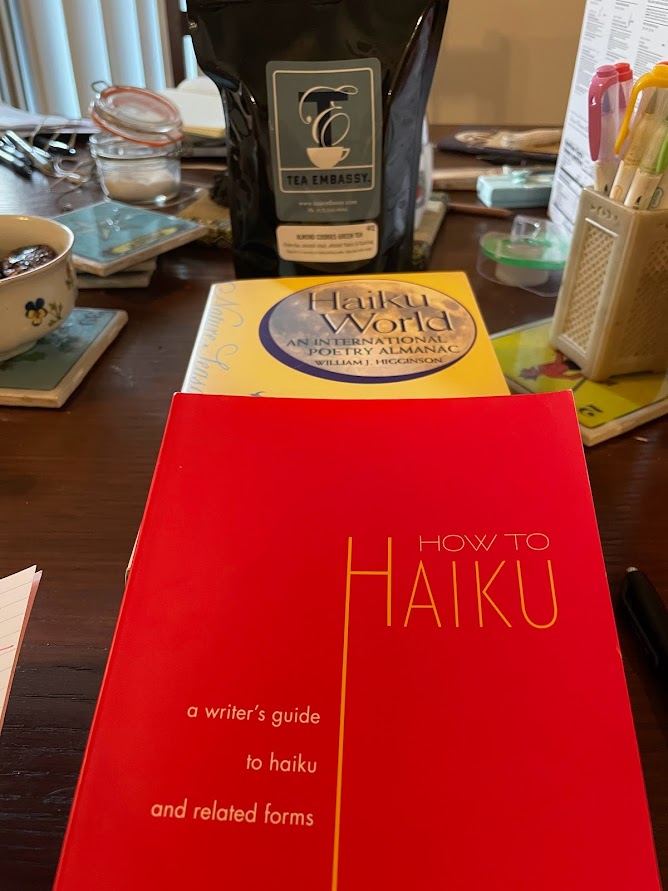
    I didn’t go into Round 2 expecting to come up with a reading list. But as I was communicating with my fellow writing buddies, I often found myself referencing texts I thought would be helpful. Many of these are reference texts or educational essays; some are more general writing advice. But they all served a purpose in some way. Some of them might seem out of place for a haiku challenge. I certainly was surprised to find myself reaching for a handbook on metrical verse in Week 2! But when creative intuition calls, you follow.

    Almanacs and Saijiki

    The Old Farmer’s Almanac (use the one for the current year)

    Haiku World: An International Poetry Almanac by William J. Higginson

    A Dictionary of Haiku Classified by Season Words with Traditional and Modern Methods by Jane Reichhold. (Available as a PDF at https://thehaikufoundation.org/omeka/items/show/1798)

    The Five Hundred Essential Japanese Season Words by Kenkichi Yamamoto (Available as a PDF at https://thehaikufoundation.org/omeka/items/show/821)

    Haiku Scholarship

    “A Definition of Haiku” by Michael Dylan Welch (Available here: https://www.graceguts.com/essays/a-definition-of-haiku)

    “Fragment and Phrase Theory” by Jane Reichhold (Available here: https://thehaikufoundation.org/omeka/items/show/781)

    “Beyond the Haiku Moment: Bashō, Buson, and Modern Haiku Myths” by Haruo Shirane (Available here: https://thehaikufoundation.org/juxta/juxta-1-1/beyond-the-haiku-moment-basho-buson-and-modern-haiku-myths/)

    Poetry Pea S7E33: Madku Workshop with Bona M. Santos. Available here: https://poetrypea.com/s7e33-madku-featuring-west-coast-poet-bona-m-santos/

    Additional Resources

    Rules for the Dance: A Handbook for Writing and Reading Metrical Verse by Mary Oliver

    “Belief and Technique for Modern Prose” by Jack Kerouac (Available here: https://writing.upenn.edu/~afilreis/88v/kerouac-technique.html)

    Bernadette Mayer’s list of journal ideas and writing experiments: https://www.writing.upenn.edu/library/Mayer-Bernadette_Experiments.html 

    Natalie Goldberg’s 7 Rules for Writing Practice from Writing Down the Bones (Available as a PDF here: https://lauradavis.net/wp-content/uploads/2020/04/Rules-of-Writing-Practice.pdf)

    “The Etiquette of Freedom” by Gary Snyder from The Practice of the Wild. (Available as a PDF here: https://bewildrewild.org/wp-content/uploads/The-Practice-of-the-Wild-by-Gary-Snyder.pdf)

  • Midwinter Day Renku: First Notes on a New Form

    Midwinter Day Renku: First Notes on a New Form

    For the past two years, I’ve collaborated with haiku friends on what I call the Midwinter Day Renku. I created this renku variation in response to one of my all-time favorite works of literature, Bernadette Mayer’s epic poem Midwinter Day

    The story behind Midwinter Day is that Mayer composed the entire thing on Friday, December 22nd, 1978, the date of the winter solstice. The title refers to the fact that many older, lunar-based calendars consider the solstice the midpoint of the season rather than the beginning, which is the designation of the astronomical calendar we use today. 

    Midwinter Day is a 100-ish page poem about the day in the life of a young family (Mayer, her husband, and their two children) living in Lenox, Massachusetts. Largely free verse, this poem is highly allusive, contains numerous lists, and frequently incorporates poetic devices such as rhyme. In Midwinter Day, poetry is not separate from parenthood and grocery shopping; it’s intertwined. There is no distinction between art and the rest of life; they are one and the same. 

    Since first reading this poem in 2015, I wanted to create some sort of homage to it. But my attempts to truly imitate Bernadette Mayer fell flat, and didn’t feel true to the way I like to approach my own poetry. Once I went deeper into studying haiku and learned about the various forms of linked verse, I began experimenting with a linked form that I wrote solo throughout the day. But while you can certainly write a renku or other linked form alone, I found I didn’t really enjoy that. I wanted to collaborate. Midwinter Day might have been written by a sole author, and yet she is anything but alone. 

    After a couple of years of noodling around ideas, I finally settled on a shorter version of the renku. I wrote the first one with my friend Claire, a poetry friend from my Austin days. Last year, I tried with a larger group: six people in three time zones emailing back and forth. Tomorrow, I will write the third-ever Midwinter Day renku with my friend Dan, who lives in another country. It’s the first international Midwinter Day renku! I’ve kept it just the two of us because juggling such disparate time zones is going to be a bit of a challenge, and I decided a smaller size would help navigate that. 

    This approach to the form is still a work in progress. Not only do I keep learning more about renku, but I keep wanting to adjust the specifics of the structure itself. I’m already thinking of adjustments I want to make for next year, but I didn’t want to make more changes at the last minute and throw off this year’s game. The parameters for 2024 and 2025 will be different, but that’s just fine. I’m excited to see how this form evolves over the next few years, and look forward to the eventual feeling that I’ve gotten it just right. 

    Poem Structure

    A traditional kasen renku has 36 verses, though shorter variations exist as well. My first renku was an 18-line version because my in-person group didn’t have enough time to do a full 36. 

    The Midwinter Day Renku has only 24 verses. Since the lore behind Midwinter Day is that it was written in the span of a single day, the 24 verses stand for each hour of the day in which it is written. 

    The writing process does not have to span 24 hours (unless you have a lot of energy and ambition), and each verse does not literally have to correspond to a specific hour, either. Just as Midwinter Day is not a literal accounting of hour by hour, this poem should not be a ponderous notation that happened in each block of time. Rather, the decision to use 24 verses is a nod to the time span of the original Midwinter Day epic poem.

    The Season

    A traditional renku incorporates all four seasons, with certain verses assigned a seasonal designation. The Midwinter Day Renku, however, focuses on one season: winter. It’s written on a winter day and influenced by a different winter poem, so invoking additional seasons didn’t feel right. I wanted the whole poem to be fully grounded in the time of year.

    That being said, 2024 is only the third year I’ve tried out this form, and I’m still refining the details. I’m not opposed to potentially putting other seasons in if I get to a point where it feels like the correct choice.

    Topics

    Most renku verses have a designated topic, and that topic is usually a specific season. The only other topic we occasionally see is love. 

    For the first two years, I tried this form, I did not use any topics. Since I’m not changing the season, I just kept every verse open. However, the original Midwinter Day poem is rife with topics that could be fun to use. Not only does the poem detail the events of a young family throughout the day, but it’s rife with cultural and historical allusions, as well as details of the current events at the time it was written.

    This year, I decided to try assigning one topic for each verse. While in a renku some verses have no topic, Midwinter Day is so full of potential topics that I decided to try 24 topics. Again, this is only the third year of working with this form, so that might change in 2025. Right now I’m having fun and seeing what happens with each year’s iteration. 

    Verse Topics (2024 Edition)

    Verse 1: Dreams

    Verse 2: People you know

    Verse 3: Love

    Verse 4: Children

    Verse 5: Cultural allusion

    Verse 6: Memory

    Verse 7: Food

    Verse 8: Current events

    Verse 9: A discovery

    Verse 10: Art

    Verse 11: Incorporate rhyme

    Verse 12: A book title

    Verse 13: A store of some kind

    Verse 14: Walking

    Verse 15: Friendship

    Verse 16: Cooking a meal

    Verse 17: Religion

    Verse 18: Music

    Verse 19: Philosophy

    Verse 20: Reference another poet

    Verse 21: A list

    Verse 22: Science

    Verse 23: Love

    Verse 24: The sun / light  

    Writing Strategies

    While renku were traditionally written in-person at gatherings specifically designed for writing this type of poetry, long-distance renku have been written for a long time. Poets have written them slowly via postal mail, and in the internet era, people compose them via email or messaging apps.

    I think that the Midwinter Day renku is well-suited to writing at a distance. The past two years, I’ve composed via email. This year, I’ll be composing via direct message in the Station of the Metro Haiku Discord. Just as the original Midwinter Day was written throughout the day, in between childcare and errands and the other facets of life, writing long-distance via email or another system allows you to go about your various activities and allow those to drift into the poem. If a verse comes in while you’re in the middle of wrapping gifts or feeding your kids, you can finish what you’re doing before writing the next verse. The things you do throughout your day have the potential to enrich the entire writing process.

    If you want to write in person and you live with people or have friends/family visiting for the holidays, consider leaving a sheet of paper out on a table and come back to it throughout the day. Let the rhythms of your life guide the writing. Let the renku composition take place in those brief moments of pause throughout the day. (But if your life has a tendency to get hectic, maybe set yourself a few phone reminders to go work on it.)

    Of course, if you want to sit down and write with another person in one session, that’s totally fine as well. And you can certainly compose by yourself, either throughout the day or in one shot. My goal in devising this form was to honor the Winter Solstice through one of my favorite poetic forms. 

    Beyond that, the only thing I would recommend is that you create an outline of the verse, topic, and the person who will be writing it. I think that’s especially important when you’re writing long-distance. Although this form is shorter than a standard renku, it’s still possible to get confused or lose your place. Having an outline and plan will help. 

    2022 Poem: The Hidden Sun

    I posted the first-ever Midwinter Day Renku as a Haiku Girl Summer bonus post. If you would like to read what I first wrote with my friend Claire, you can view it here: https://haikugirlsummer.substack.com/p/midwinter-interlude-the-hidden-sun

    Not only was this the first attempt at the form, but I also knew less about renku than I do now. So I hope that those of you who know the form well can overlook the stylistic issues of this novice attempt.

    2023 Poem: Wassailing Within

    Wassailing Within

    A Midwinter Day Renku written by Allyson Whipple (St. Louis, MO), Peter H. Schmidt (Lexington, MA), Eavonka Ettinger (Long Beach, CA), and Claire Vogel Camargo (Austin, TX)

    Thursday, December 21st, 2023

    iceless river
    one prolonged blast
    of a salvage barge                           (AW)

    sideways sleet
    maple javelins spear the earth         (PHS)

    the yearly
    arrival of homemade
    family stollen                                  (EE)

    how the time feels shorter
    between holidays                            (CVC)

    smell of snow due soon
    silent slate blue clouds hover
    soothe my solo heart                       (PHS

    picking oranges from
    the roadside farm stand                  (EE) 

    bare tree branches
    reveal empty nests waiting
    signals of green sprigs                     (CVC)

    finding the long way
    back to the office                            (AW)

    wild parrots
    flying against
    el nino rains                                    (EE) 

    the soup he makes
    for me this cold day                        (CVC) 

    spotted tabby tum
    smiling cat face sleeping
    sun patch on blanket                       (PHS) 

    one last cigarette
    at nightfall                                       (AW)

    moon frost
    the chill in her words
    after the smile                                  (CVC) 

    crunching bubbles
    fists deep in my pockets                 (PHS)

    city walk
    another fruitless
    search for stars                                (AW)

    lightning flashes
    on the darkest night                        (EE)

    dream waked
    slip from bed unnoticed
    drink in Christmas tree glow          (PHS)

    another cup of tea
    to warm me from the inside            (AW)

    all the gifts
    yet to be wrapped
    or bought                                         (EE)                

    the two weeks it takes
    to heal from surgery                        (CVC) 

    one year in
    a stack of moving boxes
    still unpacked                                  (AW)

    glitter spangled envelopes
    piled on the kitchen counter           (PHS)

    magnolia trees
    rethinking landscapes and scents
    to wake to                                       (CVC) 

    wassailing within
    as sirens wail outside                      (EE)
  • Let’s Write 1,000 Haiku in 2025

    On my birthday this year, I started what would become my first successful completion of the Buson Challenge, in which you write 10 haiku a day for 100 days. You can read more about my 2024 experience here: Buson Challenge Blog Post.

    I didn’t create the Buson Challenge; I learned about it in a talk from Failed Haiku founder Mike Rehling in his 2020 presentation at the online Haiku Society of America annual conference. You can watch the clip here: https://www.youtube.com/embed/ozWETA0PeQI?si=T6hpIGni8rfPMl_R&t=939

    I’m planning to start 2025 with another round of the Buson Challenge. The biggest thing that helped me was having a group to work with. Our regular check-ins made me want to push through on the tough writing days; I didn’t want to have to come back to the group and say I didn’t get my writing done. We didn’t check in every day; we came and went as necessary.

    While I connected with fellow Buson Challengers through the Station of the Metro Discord, you don’t need to join that to participate. There are lots of communication channels in the world, and I use most of them. So if you want to take the challenge with me starting January 1st, 2025, just shoot me a message. I’d be happy to have you write along with us.

    (And since I’m a fan of prizes . . . I have stickers available when you finish!)

  • 12 Haiku Resolutions for the New Year

    12 Haiku Resolutions for the New Year

    Note: This essay was originally intended to run in the January issue of the Haiku Society of America newsletter. However, it got preempted by an obituary for an HSA member. Given that this piece won’t be timely in February, I figured I might as well share it here, so it doesn’t just linger on my hard drive. (Because if I save it for 2025, I will probably forget that it exists.)

    As someone who takes on a shocking number of projects, you probably aren’t surprised that I love the reflection and goal-setting aspect of the new year. I’m also wary of absolutes like, “You should write every day.” As we go through the different seasons of life, our relationship to our poetry evolves. I wanted to start out 2024 with a list of practices you can use to support your haiku practice. Whether you’re a new practitioner, or more seasoned and looking for fresh inspiration, I hope some of these ideas resonate with you.

    1. Sign up for a time-bound daily writing challenge such as National Haiku Writing Month (https://www.nahaiwrimo.com/) or Poetry Postcard Fest (https://cascadiapoeticslab.org/poetrypostcards/). Daily writing is a fantastic discipline, and committing to a one-month period can make it seem like a more manageable task. (Note that Poetry Postcard Fest is not specific to haiku/senryu, but the postcard format is a perfect fit!)

    2. If you feel extra ambitious about daily writing, try the Buson Challenge: 10 haiku a day for 100 days. (I confess I have attempted this challenge at least four times and haven’t yet succeeded.) You can listen to Mike Rehling talk about the challenge here: 3 Michael Rehling.  

    3. Make a calendar of submission deadlines for the coming year. Most publications have their deadlines established already, and you can set up recurring deadlines easily using Google Calendar or iCal. Don’t forget to turn on email or push notifications so you always get a reminder! (I like to set notifications for both the opening date and closing date.)

    4. If you don’t have a system yet for tracking your haiku submissions, this is the year to set one up! Most of us (myself included) have accidentally submitted something that’s out for consideration elsewhere. A solid submission system helps! There are many services out there, such as Duotrope, that help you track your submissions (usually for a fee). However, you can use a spreadsheet or Word document as well. I’ve been using a color-coded Excel spreadsheet for three years, and it works great!

    5. Work with a saijiki (a compendium of kigo), picking one word a day to start as a jumping-off point. My favorite is William J. Higginson’s Haiku World: An International Poetry Almanac. However, it’s out of print and copies can be expensive. I am also a fan of Jane Reichhold’s A Dictionary of Haiku, available as a free PDF from the Haiku Foundation

    6. Commit to a revision streak. Often, we get focused on generating new work and don’t devote as much time to revision. Consider taking a few weeks off from writing new poems (unless you get struck with divine inspiration, of course!) and focus on daily revision of existing work. 

    7. Spend a chunk of time every day observing your environment: sunrise and sunset, traffic patterns (they can be seasonal!), the emergence of plants, the clothes that people wear. Start to develop your own personal saijiki related to the area where you live. 

    8. We often overlook the sense of smell in our writing. Try spending a week writing down every scent you encounter as you go about daily life. Use your scent list as a springboard for your haiku, senryu, and other forms.

    9. Join forces with a haiku friend or a small group and write some renku, rengay, or split sequences. If you don’t have a writing buddy in your area, you can write via email, online chat, text message, or Zoom.

    10. Participate in a ginkgo (haiku walk). If you don’t have a group in your area to walk with, you can have a solitary ginkgo. (Or maybe start a ginkgo group in your area!) You can learn more about ginkgo practice in the article “Haiku as a Nature Connection Practice” from seasonwords.com.

    11. Make a small chapbook as a birthday or holiday gift for a loved one, especially if you have a number of haiku/senryu written about them and experiences you have shared.

    12. Take a poetic risk this year: submit to a journal or contest that feels out of reach, self-publish a collection, give a public reading, or start a podcast. Maybe launch a print-on-demand store of postcards featuring your haiga. Whatever is calling to you but seems scary, give it a shot. 

    Which of these ideas will you try this year? Let me know! And be sure to check back in to tell me about your experience.

  • June Poetry Contest

    Photo by Michelle Leman on Pexels.com

    “Do you always watch for the longest day of the year and then miss it? I always watch for the longest day of the year and then miss it.”

    Daisy Buchanan, The Great Gatsby by F. Scott Fitzgerald


    Let’s try not to miss the summer solstice this year! In honor of the official transition into summer, write a poem on the theme of daylight. Let your poem span at least one entire page.

    Email your poem to allyson@allysonwhipple.com by 11:59 pm on June 20th (the summer solstice!). The winner will receive a gift certificate to the independent bookstore of their choice, or I will make a donation in their honor to a nonprofit.

    View past contest winners here.

  • May Poetry Contest Winner

    My poetry contest continues to bring amazing poetry entries from an international audience! I truly never thought I’d be getting responses from other continents.

    This month, the winning poem comes from Medha Goel, a poet living in India. Medha posts short poems under the instagram handle of @whyj_st.

    The $25 prize will be send to Medha directly.

    Medha’s poem was created using page 242 of Like a Charm by Karin Slaughter.

  • May Poetry Contest: Blackout

    Photo by Filipe Delgado on Pexels.com

    Maybe you tried to write a poem a day during National Poetry Month, and now you’re feeling a little tapped out. When I want to create but don’t feel I have anything to say, I like to turn to blackout poetry. If you’re unfamiliar you can check out “The History of Blackout Poetry” and “Erasure and Blackout Poems: Poetic Forms.”

    This month, create an erasure or blackout poem. If you’re struggling to choose a source text, consider a long-form newspaper or magazine article. You can draw over a hard copy source text, or use your word processing software to black out original material.

    You can send your poem as a Word or PDF file; I will also accept .jpg and .png files if it makes more sense to send your poem that way. Please also include the name and author of the source text in your submission.

    Email your poem to allyson@allysonwhipple.com by 11:59 pm on May 20th. The winner will receive a gift certificate to the independent bookstore of their choice, or I will make a donation in their honor to a nonprofit.

    View past contest winners here.

  • April Poetry Contest Winner

    Another month, another surprising entry in my monthly poetry contest! In April, the winner of the contest is not an individual, but a SurvivalWolves, a creative collective.

    The collective asked that the $25 donation be made directly to Kaze Shadow, the leader of their team. You can read their poem below.

    It is my time

    For the ones who are unaware, it is my time
    I have come from a position that is a far
    In my forgotten spirit, I’ll become greatly divine

    For the words within the book of me will evolve from its line 
    Ignite more flames of passion than the bright stars
    For the ones who are unaware, it is my time

    I was lost, so lost that all I could find 
    Pushing me forward was my hatred and scars
    In my forgotten spirit, I’ll become greatly divine

    I soon found more within me, more within life
    Something beyond the smoke and blinding bars
    For the ones who are unaware, it is my time

    Now I move quick, quicker than a piercing knife
    Empujando obstáculos, con fuego para ganar
    In my forgotten spirit, I’ll become greatly divine

    For the people who believed that I wouldn’t strive
    Now beyond the clouds, I fly on heaven’s radar
    For the ones who are unaware, it is my time
    In my forgotten spirit, I’ll become greatly divine

  • April Poetry Contest: Villanelle

    Photo by Anna Shvets on Pexels.com

    April is my birthday month! And the villanelle is my favorite form. So this month, the contest prompt is to write a villanelle incorporating at least one of the following:

    • Glitter
    • Peonies
    • Oolong tea
    • The beach
    • A word in a language other than English
    • Spaghetti carbonara
    • Craftsman furniture
    • Cedar Point

    Email your poem to allyson@allysonwhipple.com by 11:59 pm on April 20th. The winner will receive a gift certificate to the independent bookstore of their choice, or I will make a donation in their honor to a nonprofit.

    View complete contest rules and past winners here.

  • March Poetry Contest: Equanimity

    Equal parts cookie and cream

    March is the month of the spring equinox. My favorite equinox memory is when my 9th grade geography teacher brought Double-Stuff Oreos for all of her students, because they had equal parts light and dark. (Apparently the true balance of this particular cookie has been debunked, but it remains a wonderful memory nonetheless.)

    For the March contest, create a poem that incorporates the theme of equanimity. You can do this any number of ways:

    • Write a poem in which the content is concerned with equanimity;
    • Write a concrete poem representing equanimity;
    • Use, bend, or break the rules of a poetic form to create a sense of equanimity.

    I am so excited to see what you come up with!

    Email your poem to allyson@allysonwhipple.com by 11:59 pm on March 20th. The winner will receive a gift certificate to the independent bookstore of their choice, or I will make a donation in their honor to a nonprofit.

    View past contest winners here.