Category: Prompts

  • 12 Haiku Resolutions for the New Year

    12 Haiku Resolutions for the New Year

    Note: This essay was originally intended to run in the January issue of the Haiku Society of America newsletter. However, it got preempted by an obituary for an HSA member. Given that this piece won’t be timely in February, I figured I might as well share it here, so it doesn’t just linger on my hard drive. (Because if I save it for 2025, I will probably forget that it exists.)

    As someone who takes on a shocking number of projects, you probably aren’t surprised that I love the reflection and goal-setting aspect of the new year. I’m also wary of absolutes like, “You should write every day.” As we go through the different seasons of life, our relationship to our poetry evolves. I wanted to start out 2024 with a list of practices you can use to support your haiku practice. Whether you’re a new practitioner, or more seasoned and looking for fresh inspiration, I hope some of these ideas resonate with you.

    1. Sign up for a time-bound daily writing challenge such as National Haiku Writing Month (https://www.nahaiwrimo.com/) or Poetry Postcard Fest (https://cascadiapoeticslab.org/poetrypostcards/). Daily writing is a fantastic discipline, and committing to a one-month period can make it seem like a more manageable task. (Note that Poetry Postcard Fest is not specific to haiku/senryu, but the postcard format is a perfect fit!)

    2. If you feel extra ambitious about daily writing, try the Buson Challenge: 10 haiku a day for 100 days. (I confess I have attempted this challenge at least four times and haven’t yet succeeded.) You can listen to Mike Rehling talk about the challenge here: 3 Michael Rehling.  

    3. Make a calendar of submission deadlines for the coming year. Most publications have their deadlines established already, and you can set up recurring deadlines easily using Google Calendar or iCal. Don’t forget to turn on email or push notifications so you always get a reminder! (I like to set notifications for both the opening date and closing date.)

    4. If you don’t have a system yet for tracking your haiku submissions, this is the year to set one up! Most of us (myself included) have accidentally submitted something that’s out for consideration elsewhere. A solid submission system helps! There are many services out there, such as Duotrope, that help you track your submissions (usually for a fee). However, you can use a spreadsheet or Word document as well. I’ve been using a color-coded Excel spreadsheet for three years, and it works great!

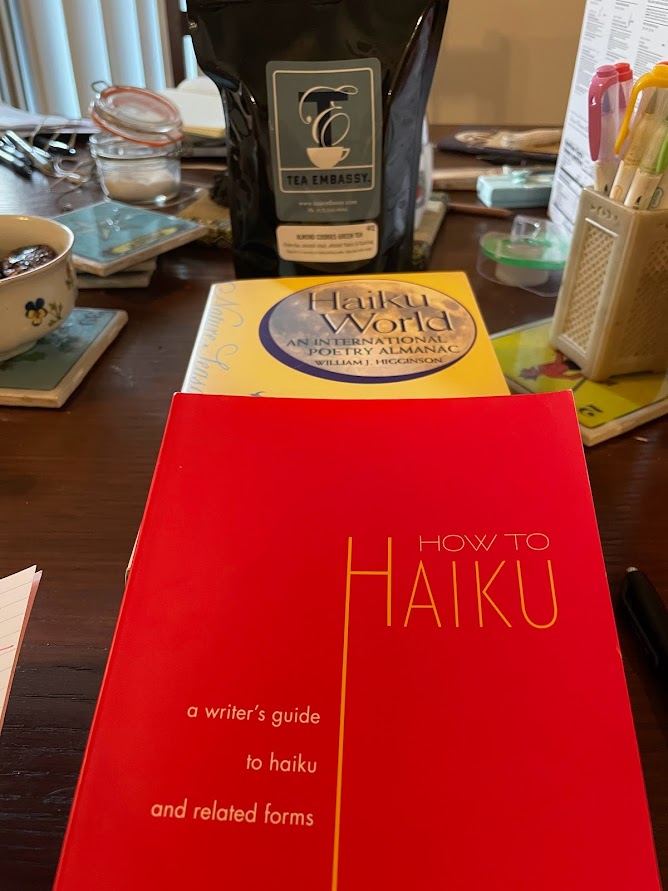
    5. Work with a saijiki (a compendium of kigo), picking one word a day to start as a jumping-off point. My favorite is William J. Higginson’s Haiku World: An International Poetry Almanac. However, it’s out of print and copies can be expensive. I am also a fan of Jane Reichhold’s A Dictionary of Haiku, available as a free PDF from the Haiku Foundation

    6. Commit to a revision streak. Often, we get focused on generating new work and don’t devote as much time to revision. Consider taking a few weeks off from writing new poems (unless you get struck with divine inspiration, of course!) and focus on daily revision of existing work. 

    7. Spend a chunk of time every day observing your environment: sunrise and sunset, traffic patterns (they can be seasonal!), the emergence of plants, the clothes that people wear. Start to develop your own personal saijiki related to the area where you live. 

    8. We often overlook the sense of smell in our writing. Try spending a week writing down every scent you encounter as you go about daily life. Use your scent list as a springboard for your haiku, senryu, and other forms.

    9. Join forces with a haiku friend or a small group and write some renku, rengay, or split sequences. If you don’t have a writing buddy in your area, you can write via email, online chat, text message, or Zoom.

    10. Participate in a ginkgo (haiku walk). If you don’t have a group in your area to walk with, you can have a solitary ginkgo. (Or maybe start a ginkgo group in your area!) You can learn more about ginkgo practice in the article “Haiku as a Nature Connection Practice” from seasonwords.com.

    11. Make a small chapbook as a birthday or holiday gift for a loved one, especially if you have a number of haiku/senryu written about them and experiences you have shared.

    12. Take a poetic risk this year: submit to a journal or contest that feels out of reach, self-publish a collection, give a public reading, or start a podcast. Maybe launch a print-on-demand store of postcards featuring your haiga. Whatever is calling to you but seems scary, give it a shot. 

    Which of these ideas will you try this year? Let me know! And be sure to check back in to tell me about your experience.

  • Support the Missouri Haiku Project

    Support the Missouri Haiku Project

    I’m excited to help spread the word about the Missouri Haiku Project, an initiative by Maryfrances Wagner, the poet laureate of Missouri. Maryfrances is accepting haiku from poets across the state to share on social media and in public venues. Many poets and teachers are offering workshops as well. The project runs until May of 2023, but why wait? Let’s spend the last of winter and all of spring celebrating haiku! Read on for Maryfrances’ guidelines, as well as all the other ways you can participate!

    All information below comes from Maryfrances Wagner. If you want to send her your haiku or contact her about other ways to participate, her address is in the guidelines.

  • June Poetry Contest

    Photo by Michelle Leman on Pexels.com

    “Do you always watch for the longest day of the year and then miss it? I always watch for the longest day of the year and then miss it.”

    Daisy Buchanan, The Great Gatsby by F. Scott Fitzgerald


    Let’s try not to miss the summer solstice this year! In honor of the official transition into summer, write a poem on the theme of daylight. Let your poem span at least one entire page.

    Email your poem to allyson@allysonwhipple.com by 11:59 pm on June 20th (the summer solstice!). The winner will receive a gift certificate to the independent bookstore of their choice, or I will make a donation in their honor to a nonprofit.

    View past contest winners here.

  • May Poetry Contest: Blackout

    Photo by Filipe Delgado on Pexels.com

    Maybe you tried to write a poem a day during National Poetry Month, and now you’re feeling a little tapped out. When I want to create but don’t feel I have anything to say, I like to turn to blackout poetry. If you’re unfamiliar you can check out “The History of Blackout Poetry” and “Erasure and Blackout Poems: Poetic Forms.”

    This month, create an erasure or blackout poem. If you’re struggling to choose a source text, consider a long-form newspaper or magazine article. You can draw over a hard copy source text, or use your word processing software to black out original material.

    You can send your poem as a Word or PDF file; I will also accept .jpg and .png files if it makes more sense to send your poem that way. Please also include the name and author of the source text in your submission.

    Email your poem to allyson@allysonwhipple.com by 11:59 pm on May 20th. The winner will receive a gift certificate to the independent bookstore of their choice, or I will make a donation in their honor to a nonprofit.

    View past contest winners here.

  • April Poetry Contest: Villanelle

    Photo by Anna Shvets on Pexels.com

    April is my birthday month! And the villanelle is my favorite form. So this month, the contest prompt is to write a villanelle incorporating at least one of the following:

    • Glitter
    • Peonies
    • Oolong tea
    • The beach
    • A word in a language other than English
    • Spaghetti carbonara
    • Craftsman furniture
    • Cedar Point

    Email your poem to allyson@allysonwhipple.com by 11:59 pm on April 20th. The winner will receive a gift certificate to the independent bookstore of their choice, or I will make a donation in their honor to a nonprofit.

    View complete contest rules and past winners here.

  • March Poetry Contest: Equanimity

    Equal parts cookie and cream

    March is the month of the spring equinox. My favorite equinox memory is when my 9th grade geography teacher brought Double-Stuff Oreos for all of her students, because they had equal parts light and dark. (Apparently the true balance of this particular cookie has been debunked, but it remains a wonderful memory nonetheless.)

    For the March contest, create a poem that incorporates the theme of equanimity. You can do this any number of ways:

    • Write a poem in which the content is concerned with equanimity;
    • Write a concrete poem representing equanimity;
    • Use, bend, or break the rules of a poetic form to create a sense of equanimity.

    I am so excited to see what you come up with!

    Email your poem to allyson@allysonwhipple.com by 11:59 pm on March 20th. The winner will receive a gift certificate to the independent bookstore of their choice, or I will make a donation in their honor to a nonprofit.

    View past contest winners here.

  • February Poetry Contest: Golden Shovel

    Photo by Scott R on Pexels.com

    I can’t wait to see what y’all write for this month’s poetry contest! There are two prize options: 1) A $25 gift certificate to the independent bookstore of your choice, or 2) A $25 donation to the literacy nonprofit, aid organization, or public library of your choice. Please see the Monthly Contest Page for complete rules (there aren’t many) and past winners. This month’s deadline is Friday, February 20th.

    Prompt
    The golden shovel is a form invented by poet Terrance Hayes. He created it in homage to Gwendolyn Brooks. In honor of Black history month, the February contest is to write a golden shovel related to environmental or climate issues. Feel free to be creative with the source text. My friend E. Kristin Anderson has a series of golden shovels based on Ke$ha songs.

    If you’re unfamiliar with this form, read the poem “Golden Shovel” by Terrance Hayes as a reference point. Notice how the line endings in both parts are made up from Brooks’ “We Real Cool.” Notice how Hayes uses the words in a more straightforward way in the first section, and focuses more on sound in the section section. (Note: you do not need to write a multi-section poem; go with what works for you.)

    Email your golden shovel to allyson@allysonwhipple.com by 11:59 pm on February 20th. Please also send me the title and author of the poem or song you used as your source text. (Include a link if possible.) The winner will receive a gift certificate to the independent bookstore of their choice, or I will make a donation in their honor to a nonprofit.

  • January Poetry Contest

    First snow. Not impressed.

    It’s time for another poetry contest! I can’t wait to see what y’all send me this month. There are two prize options: 1) A $25 gift certificate to the independent bookstore of your choice, or 2) A $25 donation to the literacy nonprofit or public library of your choice. Please see the Monthly Contest Page for complete rules (there aren’t many) and past winners. This month’s deadline is Wednesday, January 20th at 11:59 pm.

    Prompt
    Write a haiku with the following theme: inside/outside. You do not have to include the theme words in your poem; explore different ways of embodying the theme through language and image. Haiku can range from 1-3 lines. 5-7-5 syllable structure is not required. Please keep haiku to approximately 17 total syllables for the entire poem.

    Email your haiku to allyson@allysonwhipple.com by 11:59 pm on January 20th. Given the brevity of the form, poems pasted into the body of the email are preferred. If you have unique formatting that requires submitting as and attachment, that’s fine.

  • December Poetry Contest

    It’s time for another poetry contest! I can’t wait to see what y’all send me this month. I’m now offering two options for prizes: 1) A $25 gift certificate to the independent bookstore of your choice, or 2) A $25 donation to the literacy nonprofit or public library of your choice. Please see the Monthly Contest Page for complete rules (there aren’t many) and past winners. This month’s deadline is Tuesday, December 15th at 11:59 pm.

    Prompt
    I love the cento form. It’s a kind of collage poem, where you build a piece out of found text, usually other people’s poems. You can find out more about the cento here: https://poets.org/glossary/cento.

    Create a holiday cento. It can be any holiday from any tradition; you don’t have to limit yourself to the impending winter festivities. You can draw from poems, but also feel free to explore other types of text. Try creating cento out of liturgical passages or prayers. Dig into that pile of greeting cards you’ve saved from Easter, Valentine’s Day, or Christmas past. Create a cento out of advertising copy for holiday sales. Email your poem to allyson@allysonwhipple.com by 11:59 pm on December 15th. The winner will receive a gift certificate to the independent bookstore of their choice, or I will make a donation in their honor to a literacy nonprofit.

  • November Poetry Contest

    I’m excited for another round of the Monthly Poetry Contest! This time around, I’ve extended the deadline so that people have more time to draft and send a poem. Once again, the prize is a $25 gift card to the independent bookstore of the winner’s choosing. See the Monthly Poetry Contest page for complete rules (there aren’t many).

    Prompt
    Last month, I had a dream where an angel allowed me to see my favorite writer’s afterlife records. One of the tabs in the folder was labeled, “Bad Surprises from Good Decisions.” When I woke up, that phrase stayed with me.

    Write a poem of any length, using “Bad Surprises from Good Decisions” either in your title and/or the poem itself. Emailyour poem to allyson@allysonwhipple.com by 11:59 pm on November 15th. The winner will receive a gift certificate to the independent bookstore of their choice.