Tag: buson challenge

  • A Buson Challenge Reading List

    A Buson Challenge Reading List

    The day before my birthday, I completed a second round of the Buson Challenge. This time, I had friends joining me via email, Discord, and WhatsApp. Though I had a bigger group of writing buddies, this go-around was a bigger struggle than last year. Winter is not my most creative time, and the state of the world really has me down. Plus, my job is intense (and I’m unhappy in my current role). There’s been a lot weighing on my mind, and that never makes for a smooth writing experience.

    But the point of the Buson Challenge, for me, is that it’s a time-bound period in which you commit to showing up no matter what. And as always, such a big project reveals new insights. I’m still pondering some of the ideas that surfaced for me, so more on those later. But I did want to share the reading list I used this time around.

    I didn’t go into Round 2 expecting to come up with a reading list. But as I was communicating with my fellow writing buddies, I often found myself referencing texts I thought would be helpful. Many of these are reference texts or educational essays; some are more general writing advice. But they all served a purpose in some way. Some of them might seem out of place for a haiku challenge. I certainly was surprised to find myself reaching for a handbook on metrical verse in Week 2! But when creative intuition calls, you follow.

    Almanacs and Saijiki

    The Old Farmer’s Almanac (use the one for the current year)

    Haiku World: An International Poetry Almanac by William J. Higginson

    A Dictionary of Haiku Classified by Season Words with Traditional and Modern Methods by Jane Reichhold. (Available as a PDF at https://thehaikufoundation.org/omeka/items/show/1798)

    The Five Hundred Essential Japanese Season Words by Kenkichi Yamamoto (Available as a PDF at https://thehaikufoundation.org/omeka/items/show/821)

    Haiku Scholarship

    “A Definition of Haiku” by Michael Dylan Welch (Available here: https://www.graceguts.com/essays/a-definition-of-haiku)

    “Fragment and Phrase Theory” by Jane Reichhold (Available here: https://thehaikufoundation.org/omeka/items/show/781)

    “Beyond the Haiku Moment: Bashō, Buson, and Modern Haiku Myths” by Haruo Shirane (Available here: https://thehaikufoundation.org/juxta/juxta-1-1/beyond-the-haiku-moment-basho-buson-and-modern-haiku-myths/)

    Poetry Pea S7E33: Madku Workshop with Bona M. Santos. Available here: https://poetrypea.com/s7e33-madku-featuring-west-coast-poet-bona-m-santos/

    Additional Resources

    Rules for the Dance: A Handbook for Writing and Reading Metrical Verse by Mary Oliver

    “Belief and Technique for Modern Prose” by Jack Kerouac (Available here: https://writing.upenn.edu/~afilreis/88v/kerouac-technique.html)

    Bernadette Mayer’s list of journal ideas and writing experiments: https://www.writing.upenn.edu/library/Mayer-Bernadette_Experiments.html 

    Natalie Goldberg’s 7 Rules for Writing Practice from Writing Down the Bones (Available as a PDF here: https://lauradavis.net/wp-content/uploads/2020/04/Rules-of-Writing-Practice.pdf)

    “The Etiquette of Freedom” by Gary Snyder from The Practice of the Wild. (Available as a PDF here: https://bewildrewild.org/wp-content/uploads/The-Practice-of-the-Wild-by-Gary-Snyder.pdf)


  • Five Strategies for Completing the Buson Challenge

    Five Strategies for Completing the Buson Challenge

    Last week, after at least five failed attempts over the past four years, I finally completed the Buson Challenge. The goal of this challenge is to write 10 haiku a day for 100 days. Other than that, there aren’t many guidelines, though you can hear Mike Rehling talk a bit about it in his 2020 HSA conference talk here: YouTube link

    Even if you dare to write badly, writing that many haiku in that short a time is difficult. So if you think you want to give this a try, read on for some tips that finally helped me make it to the finish line.

    1. Get a challenge buddy

    This attempt at the Buson Challenge was the first one where I put out the call for an accountability partner. I found one in the haiku Discord group I’m part of; we started on the same day, and occasionally sent each other updates and drafts. We didn’t check in every day, but just often enough to keep each other motivated and on track. Knowing there was another person in it with me helped me stay focused. Plus, I appreciated having someone to share both my good and bad writing days, who really knew what it was like to not feel the creative spark but to show up and write anyway. Even when your community is small, having community at all is a game-changer.

    2. Don’t overthink it

    Most days, you’re going to write at least a few haiku that are duds. That’s okay. If you get too hung up on trying to write 10 absolutely skillful poems a day, I think you’re going to struggle unnecessarily. Don’t worry if they’re good enough; just write them down. If, after your 10 poems, you have a creative burst and want to write more, write more; you don’t have to limit yourself if your creativity becomes completely unbridled. Don’t worry if you think you’re repeating yourself thematically (you probably are). Don’t worry if your haiku feel repetitive; sometimes that might be true, but sometimes it might just be your perception after trying to write so many haiku. Just get the writing done. All you have to do is write 10 haiku a day. Let that be good enough. 

    3. Have a tracking system

    When you’re trying to do something every day for an extended period of time, having some sort of tracker helps you stay organized and on track. You can do whatever you want; in the past, I’ve just used a spreadsheet with the day and the number of poems I managed to write. This time around, I set up the tracker in my bullet journal. I I had the date, what day of the challenge it was, and the number of poems I wrote that day. I also had a space to keep track of my extras (described below). Using the tracker made it easier for me to remember what day I was on and to keep myself motivated. It wasn’t just an organizational tool; it was a concrete depiction of my challenge progress. 

    4. Bank your extras

    You might think that there’s no possible way that you might write more than 10 haiku a day. I know I was surprised when one morning, I attended a haiku group and drafted 14 poems during the writing period. On one particularly emotional day, I drafted 23 haiku and senryu. Days when I drafted more than 10 were few and far between; I only wrote extra pieces on 6 out of 100 days. Still, those extras mattered. While one of my challenge buddies chose to apply their extras to the next day (so if they wrote 12 one day, they only had to write 8 the next day), I chose to bank mine for days when things didn’t go as planned. I kept a running record of how many extras I had in my haiku bank, and on one of the 7 days I didn’t manage to write 10 poems, I simply applied the extras toward that day, and adjusted my banked amount accordingly. I still completed the challenge with 13 extras! 

    5. Plan a reward

    In theory, writing 1,000 haiku in just over 3 months would be a reward unto itself. However, sometimes you don’t just need a finish line; you need a shiny trophy at the end of it. So decide how you’re going to celebrate. Maybe you’ll buy a new notebook (since this challenge is a great way to fill all those half-used ones lying around), or a haiku anthology you’ve had your eye on. I decided to make myself a set of stickers for crossing the finish line. Making myself a medal wasn’t practical, but stickers sure were! And the best part is, they’re easy to share! I’m mailing them out to my challenge buddies. (If you’ve completed this challenge in the past and would like a sticker, I’m happy to mail you some as well! Just message me at my contact form.)

    While the Buson challenge could be considered a once-in-a-lifetime writing event, I actually find myself wanting to try yet again. I’ve decided I’ll start another round on January 1st, 2025. Starting the new year with a big writing challenge sounds fun. I’ll be posting more about those plans in December to keep those who want to join me in the loop.

  • Buson Challenge Days 1-12

    Buson Challenge Days 1-12

    The Buson Challenge is, in short, an attempt to write 10 haiku a day for 100 days. If you want to know more, view this clip from Mike Rehling’s 2020 talk “Finding Yourself in a Poem,” presented at the 2020 HSA Conference. (In case the link doesn’t work correctly, the part about the Buson Challenge starts at 14:45.) This year is my third go-around, and hopefully my first successful attempt.

    At the moment, I can’t locate the spreadsheet where I tracked my initial efforts. Maybe it got deleted somewhere down the line. But either way, I tried in 2020 and 2021, and neither time resulted in me completing the challenge. I don’t think I even got halfway through. Even when you’re giving yourself permission to write downright terrible haiku, it’s not easy to write 10 a day. The first two times, my biggest issue wasn’t getting the haiku down; I gave myself permission to write some truly awful stuff, which meant I could meet the quantity requirement. (Thankfully there is no quality requirement.) My biggest issue was simply remembering to actually get in 10 a day. I might get 3 in one writing session, 4 in another, and then get distracted and forget the rest.

    This year, after I announced Haiku Girl Summer (my limited-run online haiku journal), a haiku friend asked me if I’d heard of the Buson Challenge. I had completely forgotten about it! 2022 was a terrible year for my creative life, and writing 10 haiku a day for 100 days was not going to work with everything else I was juggling. But now I’ve settled into a job I like, the house is getting more organized, and I have the brain space to actually write again.

    As of this writing, I’ve successfully completed 12/100 days. I’ve definitely written more mediocre and genuinely bad haiku than good, though since most of the haiku are still in my notebook and not typed up, I don’t have sense of the overall proportion so far. But I’m surprising myself; the overall quality each day is better than anticipating. Most days, I manage at least one haiku that has potential.

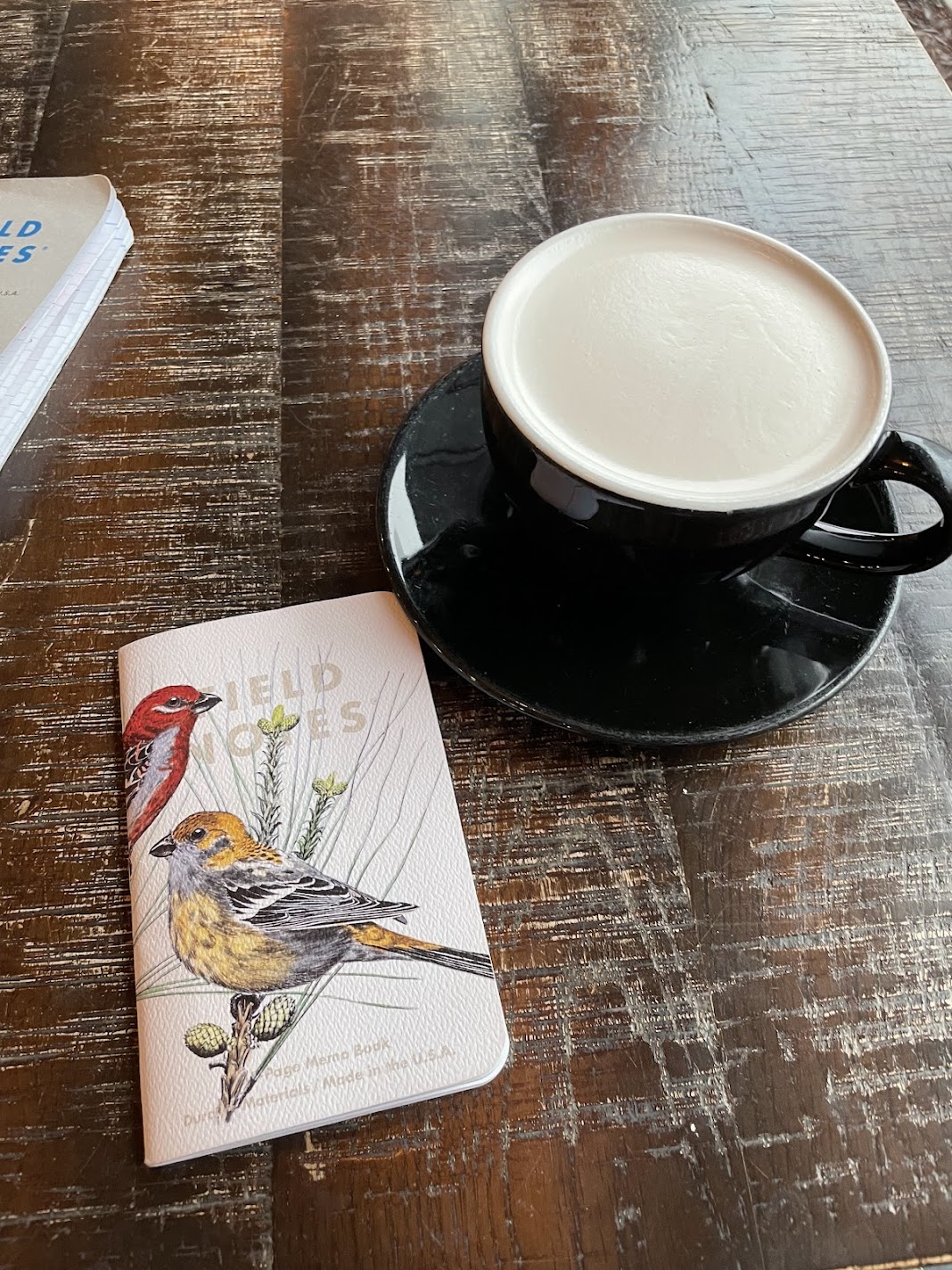
    Preferred notebook: Field Notes

    Notebooks filled: 1

    Places I’ve written:

    So far, I’m having a fantastic time with this challenge, and feel optimistic that I might actually get all the way through!