Tag: haiku

  • A Buson Challenge Reading List

    A Buson Challenge Reading List

    The day before my birthday, I completed a second round of the Buson Challenge. This time, I had friends joining me via email, Discord, and WhatsApp. Though I had a bigger group of writing buddies, this go-around was a bigger struggle than last year. Winter is not my most creative time, and the state of the world really has me down. Plus, my job is intense (and I’m unhappy in my current role). There’s been a lot weighing on my mind, and that never makes for a smooth writing experience.

    But the point of the Buson Challenge, for me, is that it’s a time-bound period in which you commit to showing up no matter what. And as always, such a big project reveals new insights. I’m still pondering some of the ideas that surfaced for me, so more on those later. But I did want to share the reading list I used this time around.

    I didn’t go into Round 2 expecting to come up with a reading list. But as I was communicating with my fellow writing buddies, I often found myself referencing texts I thought would be helpful. Many of these are reference texts or educational essays; some are more general writing advice. But they all served a purpose in some way. Some of them might seem out of place for a haiku challenge. I certainly was surprised to find myself reaching for a handbook on metrical verse in Week 2! But when creative intuition calls, you follow.

    Almanacs and Saijiki

    The Old Farmer’s Almanac (use the one for the current year)

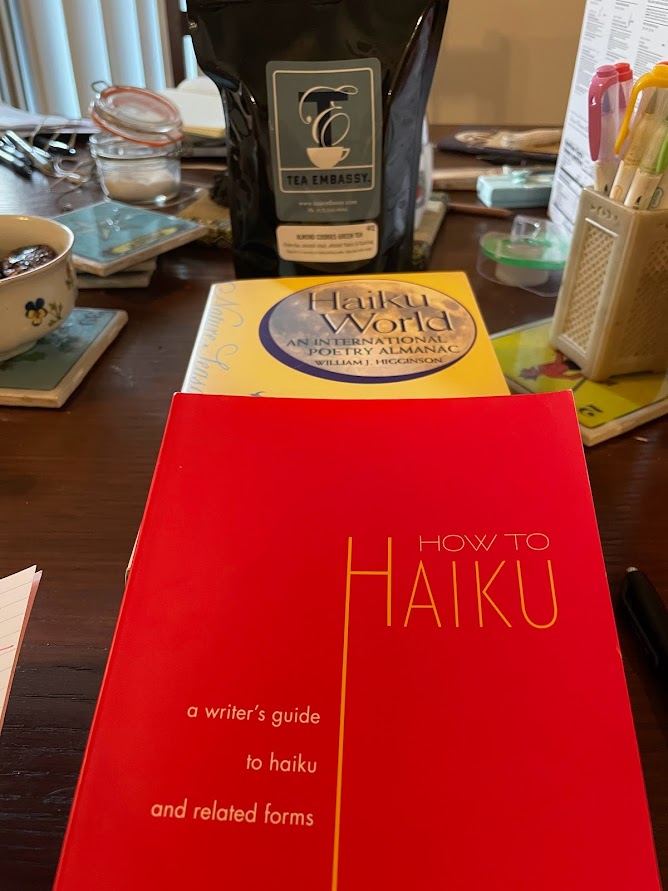
    Haiku World: An International Poetry Almanac by William J. Higginson

    A Dictionary of Haiku Classified by Season Words with Traditional and Modern Methods by Jane Reichhold. (Available as a PDF at https://thehaikufoundation.org/omeka/items/show/1798)

    The Five Hundred Essential Japanese Season Words by Kenkichi Yamamoto (Available as a PDF at https://thehaikufoundation.org/omeka/items/show/821)

    Haiku Scholarship

    “A Definition of Haiku” by Michael Dylan Welch (Available here: https://www.graceguts.com/essays/a-definition-of-haiku)

    “Fragment and Phrase Theory” by Jane Reichhold (Available here: https://thehaikufoundation.org/omeka/items/show/781)

    “Beyond the Haiku Moment: Bashō, Buson, and Modern Haiku Myths” by Haruo Shirane (Available here: https://thehaikufoundation.org/juxta/juxta-1-1/beyond-the-haiku-moment-basho-buson-and-modern-haiku-myths/)

    Poetry Pea S7E33: Madku Workshop with Bona M. Santos. Available here: https://poetrypea.com/s7e33-madku-featuring-west-coast-poet-bona-m-santos/

    Additional Resources

    Rules for the Dance: A Handbook for Writing and Reading Metrical Verse by Mary Oliver

    “Belief and Technique for Modern Prose” by Jack Kerouac (Available here: https://writing.upenn.edu/~afilreis/88v/kerouac-technique.html)

    Bernadette Mayer’s list of journal ideas and writing experiments: https://www.writing.upenn.edu/library/Mayer-Bernadette_Experiments.html 

    Natalie Goldberg’s 7 Rules for Writing Practice from Writing Down the Bones (Available as a PDF here: https://lauradavis.net/wp-content/uploads/2020/04/Rules-of-Writing-Practice.pdf)

    “The Etiquette of Freedom” by Gary Snyder from The Practice of the Wild. (Available as a PDF here: https://bewildrewild.org/wp-content/uploads/The-Practice-of-the-Wild-by-Gary-Snyder.pdf)

  • Soulard Haiku Hike on January 25th!

    Soulard Haiku Hike on January 25th!

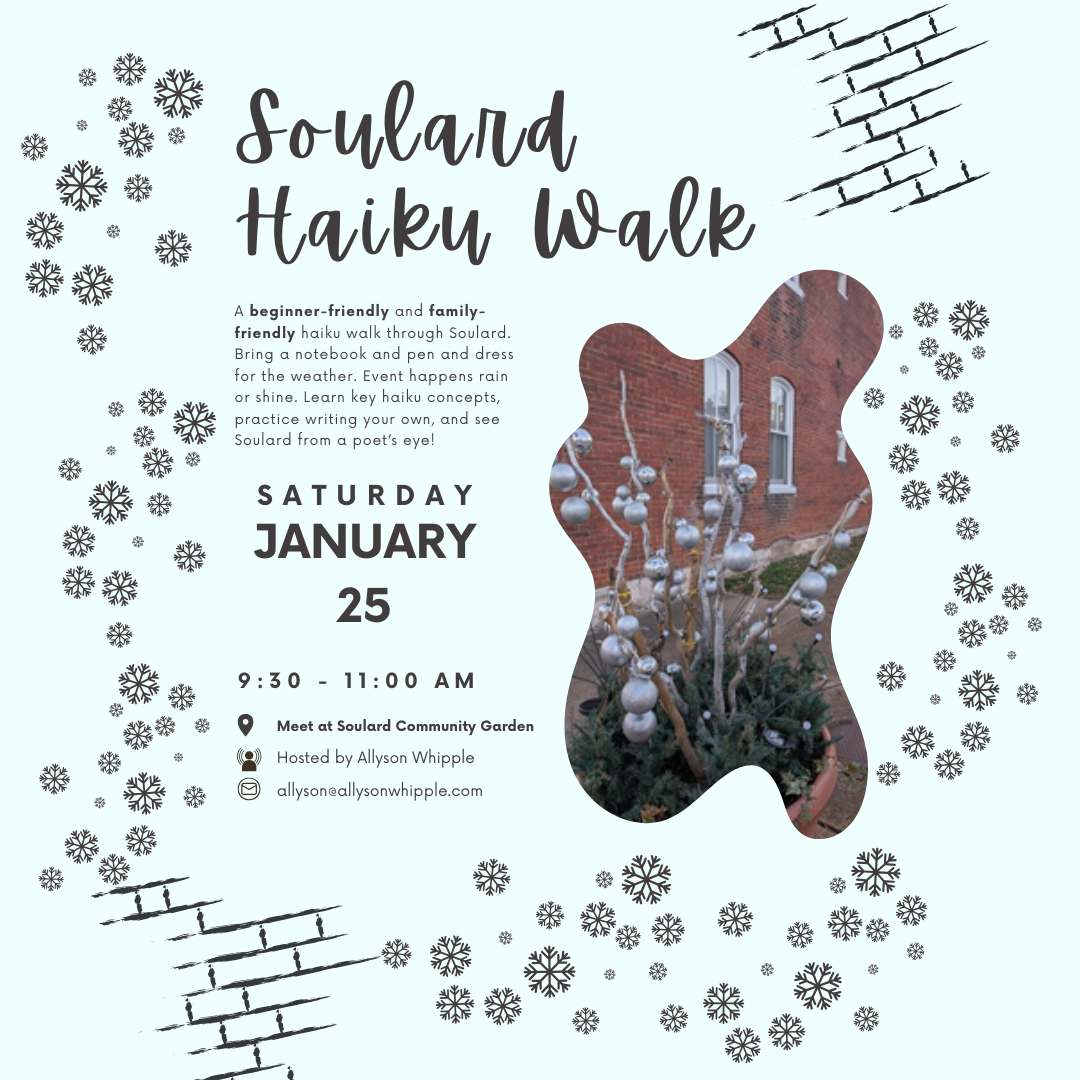
    I’m excited to be hosting another Soulard Haiku Walk this Saturday, January 25th at 9:30 a.m. I know that many of the people who read this blog are not local to St. Louis, but if you know someone in the area who might be interested, feel free to forward them this post.

    The Soulard Haiku Walk is a quarterly series that is beginner- and family-friendly. The aim is to introduce haiku to people who have limited to no knowledge, though experienced haijin are still welcome to attend.

    The walk begins at the Soulard Garden Co-Op, progresses to Pontiac Square Park, and ends at Soulard Market Park. Attendees are free to enjoy the Soulard Market and surrounding restaurants after the event. At each stop on the walk, I’ll give some instruction on haiku as well as a bit of local history. You’ll have plenty of time to write, and the event will end with a Q&A period as well as an optional chance to share your work. (No critique involved.)

    The January hike will provide a review of syllables in English-language haiku and give an introduction to season words (kigo). You can get more details via the Soulard website. If you have any questions, the fastest way to get in touch is email me at allyson[at]allysonwhipple[dot][com].

    I look forward to sharing my love of haiku with you!

  • Let’s Write 1,000 Haiku in 2025

    On my birthday this year, I started what would become my first successful completion of the Buson Challenge, in which you write 10 haiku a day for 100 days. You can read more about my 2024 experience here: Buson Challenge Blog Post.

    I didn’t create the Buson Challenge; I learned about it in a talk from Failed Haiku founder Mike Rehling in his 2020 presentation at the online Haiku Society of America annual conference. You can watch the clip here: https://www.youtube.com/embed/ozWETA0PeQI?si=T6hpIGni8rfPMl_R&t=939

    I’m planning to start 2025 with another round of the Buson Challenge. The biggest thing that helped me was having a group to work with. Our regular check-ins made me want to push through on the tough writing days; I didn’t want to have to come back to the group and say I didn’t get my writing done. We didn’t check in every day; we came and went as necessary.

    While I connected with fellow Buson Challengers through the Station of the Metro Discord, you don’t need to join that to participate. There are lots of communication channels in the world, and I use most of them. So if you want to take the challenge with me starting January 1st, 2025, just shoot me a message. I’d be happy to have you write along with us.

    (And since I’m a fan of prizes . . . I have stickers available when you finish!)

  • Soulard Haiku Walks Launch in October

    Soulard Haiku Walks Launch in October

    I’m thrilled to announce that next month, I’m launching a quarterly ginko (haiku walk) series around the Soulard neighborhood. The first event takes place on Saturday, October 26th at 9:30 a.m. It’s free, family-friendly, and open to anyone in the St. Louis area.

    I’ve wanted to start hosting ginkos in St. Louis for over a year now, but with everything else I have going on, it kept getting pushed to the back burner. Finally, though, I realized I could start hosting them in conjunction with the Soulard Restoration Group Community Involvement & Events Committee.

    Here are my goals for the series:

    1. Provide free haiku education in a digestible format.
    2. Provide space for people to practice writing haiku without worrying about critique or judgment.
    3. Create a family- and beginner-friendly event.
    4. Explore Soulard and learn about its unique history.
    5. Recognize that haiku can be written in any environment, and that urban spaces are just as legitimate haiku spaces as pastoral ones.

    We will meet at the Soulard Community Garden and spend 90 minutes learning about haiku, walking, exploring, and writing. The event concludes at the historic Soulard Market, a great place to explore at the conclusion of events.

    If you have any haikurious friends in the St. Louis area, forward this post along to them!

  • Five Strategies for Completing the Buson Challenge

    Five Strategies for Completing the Buson Challenge

    Last week, after at least five failed attempts over the past four years, I finally completed the Buson Challenge. The goal of this challenge is to write 10 haiku a day for 100 days. Other than that, there aren’t many guidelines, though you can hear Mike Rehling talk a bit about it in his 2020 HSA conference talk here: YouTube link

    Even if you dare to write badly, writing that many haiku in that short a time is difficult. So if you think you want to give this a try, read on for some tips that finally helped me make it to the finish line.

    1. Get a challenge buddy

    This attempt at the Buson Challenge was the first one where I put out the call for an accountability partner. I found one in the haiku Discord group I’m part of; we started on the same day, and occasionally sent each other updates and drafts. We didn’t check in every day, but just often enough to keep each other motivated and on track. Knowing there was another person in it with me helped me stay focused. Plus, I appreciated having someone to share both my good and bad writing days, who really knew what it was like to not feel the creative spark but to show up and write anyway. Even when your community is small, having community at all is a game-changer.

    2. Don’t overthink it

    Most days, you’re going to write at least a few haiku that are duds. That’s okay. If you get too hung up on trying to write 10 absolutely skillful poems a day, I think you’re going to struggle unnecessarily. Don’t worry if they’re good enough; just write them down. If, after your 10 poems, you have a creative burst and want to write more, write more; you don’t have to limit yourself if your creativity becomes completely unbridled. Don’t worry if you think you’re repeating yourself thematically (you probably are). Don’t worry if your haiku feel repetitive; sometimes that might be true, but sometimes it might just be your perception after trying to write so many haiku. Just get the writing done. All you have to do is write 10 haiku a day. Let that be good enough. 

    3. Have a tracking system

    When you’re trying to do something every day for an extended period of time, having some sort of tracker helps you stay organized and on track. You can do whatever you want; in the past, I’ve just used a spreadsheet with the day and the number of poems I managed to write. This time around, I set up the tracker in my bullet journal. I I had the date, what day of the challenge it was, and the number of poems I wrote that day. I also had a space to keep track of my extras (described below). Using the tracker made it easier for me to remember what day I was on and to keep myself motivated. It wasn’t just an organizational tool; it was a concrete depiction of my challenge progress. 

    4. Bank your extras

    You might think that there’s no possible way that you might write more than 10 haiku a day. I know I was surprised when one morning, I attended a haiku group and drafted 14 poems during the writing period. On one particularly emotional day, I drafted 23 haiku and senryu. Days when I drafted more than 10 were few and far between; I only wrote extra pieces on 6 out of 100 days. Still, those extras mattered. While one of my challenge buddies chose to apply their extras to the next day (so if they wrote 12 one day, they only had to write 8 the next day), I chose to bank mine for days when things didn’t go as planned. I kept a running record of how many extras I had in my haiku bank, and on one of the 7 days I didn’t manage to write 10 poems, I simply applied the extras toward that day, and adjusted my banked amount accordingly. I still completed the challenge with 13 extras! 

    5. Plan a reward

    In theory, writing 1,000 haiku in just over 3 months would be a reward unto itself. However, sometimes you don’t just need a finish line; you need a shiny trophy at the end of it. So decide how you’re going to celebrate. Maybe you’ll buy a new notebook (since this challenge is a great way to fill all those half-used ones lying around), or a haiku anthology you’ve had your eye on. I decided to make myself a set of stickers for crossing the finish line. Making myself a medal wasn’t practical, but stickers sure were! And the best part is, they’re easy to share! I’m mailing them out to my challenge buddies. (If you’ve completed this challenge in the past and would like a sticker, I’m happy to mail you some as well! Just message me at my contact form.)

    While the Buson challenge could be considered a once-in-a-lifetime writing event, I actually find myself wanting to try yet again. I’ve decided I’ll start another round on January 1st, 2025. Starting the new year with a big writing challenge sounds fun. I’ll be posting more about those plans in December to keep those who want to join me in the loop.

  • An Update on the Culinary Saijiki

    An Update on the Culinary Saijiki

    Earlier this year, I announced an end to the Culinary Saijiki blog and podcast in order to focus on developing the book manuscript. The first five months of a year were a struggle in that regard. The structure I’d tried wasn’t working, and at the end of May, I scrapped the whole endeavor and started over. While that does put me behind schedule with my initial goal of completing a manuscript by the end of the year, it was the right call. Those first several months of struggling actually gave me some great insight for what I want the book to me, so the effort was not wasted. (Clara of Hmm That’s Interesting touches on the value of failed effort in her recent post “let’s talk about AI,” which I recommend.)

    As I have also mentioned on various platforms, the word I selected for 2024 was “Simplicity.” And yes, I am still taking on too many volunteer opportunities and projects and hobbies. And no, my house is not the clutter-free space I’m hoping to get to but never reach. But using the word as a guiding principle has nonetheless helped me find areas where I can minimize.

    One of the things I decided to do was get rid of the independent Culinary Saijiki website. At the start of this year I was managing three different sites: this one, Culinary Saijiki, and my Pilates studio site. One of the things I realized is that I genuinely hate having to maintain multiple website. Even though the Culinary Saijiki site was just an archive, it was still out there, still needed security and tech updates, and still cost money. And when I found out my plan rate was going up, I decided to export everything to this blog and host it here.

    All Culinary Saijiki blog posts and podcast episodes now live here. I have organized everything on this page: https://allysonwhipple.com/the-culinary-saijiki/. I still own the original URL, and it redirects there, so anyone who has the old site bookmarked can access things easily. And I’ll keep posting project updates here as they become relevant.

    Thanks to all who supported the initial phase of this project. Phase 2 has had some challenges, but I’m glad to finally be making real progress.

  • The Best of It: 2023 Edition

    1. My first trip to London
    2. My first time attending Haiku North America
    3. The publication of Postcards from Texas, my first all-haiku chapbook
    4. Editing the 2023 Haiku Society of America members’ anthology
    5. Completing both my comprehensive and national Pilates certifications
  • 12 Haiku Resolutions for the New Year

    12 Haiku Resolutions for the New Year

    Note: This essay was originally intended to run in the January issue of the Haiku Society of America newsletter. However, it got preempted by an obituary for an HSA member. Given that this piece won’t be timely in February, I figured I might as well share it here, so it doesn’t just linger on my hard drive. (Because if I save it for 2025, I will probably forget that it exists.)

    As someone who takes on a shocking number of projects, you probably aren’t surprised that I love the reflection and goal-setting aspect of the new year. I’m also wary of absolutes like, “You should write every day.” As we go through the different seasons of life, our relationship to our poetry evolves. I wanted to start out 2024 with a list of practices you can use to support your haiku practice. Whether you’re a new practitioner, or more seasoned and looking for fresh inspiration, I hope some of these ideas resonate with you.

    1. Sign up for a time-bound daily writing challenge such as National Haiku Writing Month (https://www.nahaiwrimo.com/) or Poetry Postcard Fest (https://cascadiapoeticslab.org/poetrypostcards/). Daily writing is a fantastic discipline, and committing to a one-month period can make it seem like a more manageable task. (Note that Poetry Postcard Fest is not specific to haiku/senryu, but the postcard format is a perfect fit!)

    2. If you feel extra ambitious about daily writing, try the Buson Challenge: 10 haiku a day for 100 days. (I confess I have attempted this challenge at least four times and haven’t yet succeeded.) You can listen to Mike Rehling talk about the challenge here: 3 Michael Rehling.  

    3. Make a calendar of submission deadlines for the coming year. Most publications have their deadlines established already, and you can set up recurring deadlines easily using Google Calendar or iCal. Don’t forget to turn on email or push notifications so you always get a reminder! (I like to set notifications for both the opening date and closing date.)

    4. If you don’t have a system yet for tracking your haiku submissions, this is the year to set one up! Most of us (myself included) have accidentally submitted something that’s out for consideration elsewhere. A solid submission system helps! There are many services out there, such as Duotrope, that help you track your submissions (usually for a fee). However, you can use a spreadsheet or Word document as well. I’ve been using a color-coded Excel spreadsheet for three years, and it works great!

    5. Work with a saijiki (a compendium of kigo), picking one word a day to start as a jumping-off point. My favorite is William J. Higginson’s Haiku World: An International Poetry Almanac. However, it’s out of print and copies can be expensive. I am also a fan of Jane Reichhold’s A Dictionary of Haiku, available as a free PDF from the Haiku Foundation

    6. Commit to a revision streak. Often, we get focused on generating new work and don’t devote as much time to revision. Consider taking a few weeks off from writing new poems (unless you get struck with divine inspiration, of course!) and focus on daily revision of existing work. 

    7. Spend a chunk of time every day observing your environment: sunrise and sunset, traffic patterns (they can be seasonal!), the emergence of plants, the clothes that people wear. Start to develop your own personal saijiki related to the area where you live. 

    8. We often overlook the sense of smell in our writing. Try spending a week writing down every scent you encounter as you go about daily life. Use your scent list as a springboard for your haiku, senryu, and other forms.

    9. Join forces with a haiku friend or a small group and write some renku, rengay, or split sequences. If you don’t have a writing buddy in your area, you can write via email, online chat, text message, or Zoom.

    10. Participate in a ginkgo (haiku walk). If you don’t have a group in your area to walk with, you can have a solitary ginkgo. (Or maybe start a ginkgo group in your area!) You can learn more about ginkgo practice in the article “Haiku as a Nature Connection Practice” from seasonwords.com.

    11. Make a small chapbook as a birthday or holiday gift for a loved one, especially if you have a number of haiku/senryu written about them and experiences you have shared.

    12. Take a poetic risk this year: submit to a journal or contest that feels out of reach, self-publish a collection, give a public reading, or start a podcast. Maybe launch a print-on-demand store of postcards featuring your haiga. Whatever is calling to you but seems scary, give it a shot. 

    Which of these ideas will you try this year? Let me know! And be sure to check back in to tell me about your experience.

  • Chapbook Interview: Julie Bloss Kelsey

    Chapbook Interview: Julie Bloss Kelsey

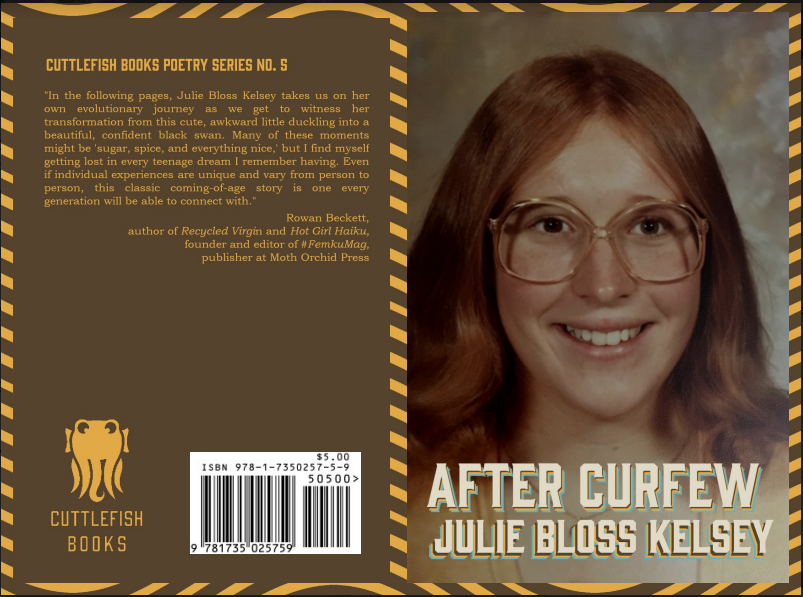
    We’re in the final three days of preorder for the Cuttlefish Books Summer Book Launch! I’m grateful to all of you who have ordered copies so far. Earlier this month, I featured fellow Cuttlefish poet Lenard D. Moore, and today I want to feature the other member of my cohort: Julie Bloss Kelsey.

    Julie creates the New to Haiku column for The Haiku Foundation, and also serves as the THF secretary. Her first collection, Grasping the Fading Light: A Journey through PTSD, won the 2021 International Women’s Haiku Contest. Julie is also a freelance writer, environmental scientist, and a mother.

    You mentioned on Instagram that After Curfew  was inspired by Rowan Beckett’s Hot Girl Haiku. Can you say more about that inspiration, and how it helped you write and shape your collection?

    Rowan held an online launch party on Facebook for their book, Hot Girl Haiku, in May 2022. My friend, haiku poet Susan Burch, reminded me to attend. I’d never been to an online launch party. It was fun! Rowan had posts and videos set up on a schedule. One of the prompts was to write our own “hot girl haiku.” It brought me back to that time in early adolescence and young adulthood when I wanted so much to be a “hot girl” but I was more of a “geeky girl.” I wrote this in the comments:

    face-first
    in a stranger’s lap—
    tequila shots

    Joshua Gage, of Cuttlefish Books, wrote back that he’d like to hear more of that story. I said there wasn’t much to tell — I didn’t think I had too many “hot girl” moments. But it got me thinking, which led to writing the collection. 

    On a related note, I read online that you wrote most of After Curfew in one sitting. Do you usually write in big spurts? How was creating this collection similar to or different from your usual process? 

    I rarely write in big spurts! This was very different than my usual plodding along. I just felt inspired. It was like Rowan gave me permission to write about my past. 

    What was your editing process like? Did you have to cut any haiku? Was there a point where you found yourself needing to add some to supplement the original poems? 

    I wrote the poems quickly at first, jotting them down as they came to me. When it came time to order them, I wanted to tell a cohesive story: of first love, of loss, of moving on. When I realized that I really did have a collection, I wrote a few poems to fill gaps in the narrative, and I dropped a few that didn’t fit. Originally, I had a few tanka in there too.

    In English-language haiku, poets are often instructed to focus on composing from the present moment. After Curfew is written in the present tense, but concerns the past. Did you make a conscious decision to keep the poems in the present tense? Or did that emerge organically during the writing process?

    I think the present tense brings an immediacy to haiku — writing in past tense puts some distance between the reader and the poem. I’d like to say something profound about how I wanted the reader to share in my awkward moments, but the truth is, I was reliving my memories as I wrote them.

    What was it like to relive those awkward teenage years in such an immediate and compressed way? Did that awkwardness feel fresh, or has distance lessened it? 

    Oh my goodness, reliving those years still feels awkward! But I can laugh alongside the discomfort now. I’ve read this collection aloud to friends and most laugh and nod along. We’ve all been there, but when you are living those years, it’s so tough.

    Cuttlefish Books has been posting some of my haiku from the book on Instagram. I was really struck by the response to this one:

    strangers at the bar
    trying to remember
    my fake name

    To me, that was a funny memory of getting called out for using a fake name. But when I saw a hashtag about the patriarchy, I realized that’s true as well. I was using a fake name to keep myself safe. That experience was just so normalized for me that I never saw it that way. It adds a whole new dimension to the poem, and to the collection. Rowan wrote an Afterward for me that touches on this.

    What level of vulnerability was required to not only write these haiku, but publish them in a collection? Is it similar to, or different than, the levels of vulnerability required in other areas of your work?

    I’ve said that my first print collection, Grasping the Fading Light: A Journey through PTSD, was equally embarrassing, but for different reasons. This collection is much easier for me to see in print. I’m not sure I will ever publish anything that makes me feel as vulnerable as my trauma collection does.

    I love that you used your 8th grade class photo as the cover image. What was the thought process that went into your cover design decisions?  

    My best friend posted that picture of me on Facebook for my birthday one year! I saved it and reposted it to my Facebook wall in December of last year. Joshua Gage, of Cuttlefish Books, noticed it and asked if we could use it for the cover. 

    Is there anything else I haven’t asked that you’d like to say about After Curfew, or about haiku in general? 

    Reading over my answers, I realized that Facebook played a huge role in this book coming into existence! Social media, for all of its ills, can be a great tool for poets. I cut my teeth writing haiku on Twitter. 

    Writing haiku can be isolating. Most of us don’t interact with other haiku poets in person in our daily lives. Helping new haiku poets find connection is a primary goal of my haiku column, New to Haiku, at The Haiku Foundation.

    More from Julie Bloss Kelsey

    Check out the New to Haiku series at The Haiku Foundation.

    Order a copy of Grasping the Fading Light: A Journey Through PTSD.

    Read more about Julie’s literary accomplishments in the Poets & Writers Directory.

  • Chapbook Interview: Lenard D. Moore

    Chapbook Interview: Lenard D. Moore

    If you’ve been following any of my social media this month, you know that I’m thrilled to be in the company of Lenard D. Moore as part of the Cuttlefish Books 2023 Summer Book Launch. Lenard is a military veteran, executive chair of the North Carolina Haiku Society, founder and executive chair of the Carolina African American Writers Collective, and the author of several books.

    Although Lenard and I only had the chance to meet briefly at HNA, I have long admired the depth, breadth, and skill of his haiku. His attention not just to the details of the present, but also to the stories of the past, reflects a sense of artistic discipline that’s worth emulating. In celebration of his forthcoming chapbook, A Million Shadows at Noon, I wanted to feature him here to learn more about his process with this new collection. Read on for the full interview.

    Cuttlefish Books is currently in the preorder period for the summer 2023 chapbook series. You can reserve your copy of Lenard’s book, A Million Shadows at Noon, or buy the whole bundle of three!

    AW: What is the thematic focus of A Million Shadows at Noon? What compelled you to create this chapbook?

    The thematic focus of A Million Shadows at Noon is brotherhood, family, love and unity. I was compelled to create this project, because I drew inspiration from such a significant historical event. It was so powerful to see so many Black men come together and march for important issues. By now, I hope you know that I am referring to the Million Man March, which will celebrate its thirtieth anniversary in 2025. I wanted to do something innovative with the haiku form or a haiku sequence, an extensive of my poetic risks with my book, Desert Storm. Perhaps, I need to write one more book-length poem, employing the haiku form. To that end, maybe there is a trilogy in the making. Let’s see what happens with my future work.

    AW: What are the particular challenges of writing a haiku sequence? On the flip side, what is it about writing sequences that you find inspiring?

    The challenges of writing a haiku sequence are varied. Firstly, I had to ensure that all of the haiku resonate as individual poems. Secondly, I had to ensure that I was writing the same poem again and again, if you will, or similar poems. Thirdly, I had to ensure that all of the haiku linked some kind of way. Fourthly, I had to ensure that the poems worked in chronological order. At least, that is the way I saw the sequence developing. Fifthly, I had to ensure that the natural world played a major role in the sequence. Sixthly, I had to ensure that I infused rhythm or musical elements throughout A Million Shadows at Noon. Seventhly, I had to ensure that I employed strong verbs in the haiku sequence. Eighthly, I had to ensure that the contrasts were effective throughout the sequence. Ninthly, I had to ensure that the symbolism worked well. Tenthly, I had to ensure that the poems told a story. Tenthly, I had to ensure that the haiku sequence was original. Eleventhly, I had to ensure that the poems did not reveal everything. Twelfthly, I had to ensure that I employed vivid imagery. Of course, there are other elements and characteristics that I strove to employ in the sequence.

    AW: How do you perceive the difference between a structured haiku sequence versus a less structured collection of haiku addressing common themes?

    The difference between a structured haiku sequence and a less structured collection of haiku addressing common themes is that the structured haiku sequence unfolds like a novel. It must work as a whole work, reeling in readers and closing with a surprise ending. The sequence should address the five who, what, where, when and why. The less structured collection of haiku does its own thing.

    AW: Was this chapbook one you worked on over a period of months or years? Or did it come to you fairly quickly?

    A Million Shadows at Noon came to me quite quickly. I think I wrote the poems over a weekend. Of course, I worked on ordering the poem. I am sure I tweaked some of them. Many of the poems originally work, because I felt like I was in a writing zone.

    AW: What was your editing process like? If you decided to cut poems, how did you make that choice?

    My editing process was to cut out or delete any poems that I was might be weak or did not work with the sequence. I also take a close look at the musical elements and how the poems might do something new.

    AW: In the English-language haiku world, we are often taught that haiku should come from a moment in daily life. The emphasis on the haiku moment is often overemphasized, even though both the classical and contemporary editions are filled with counterexamples. I imagine that when working on a narrative sequence, many of these haiku did not come from a specific moment. To what extent was your direct experience relevant to this collection? How did history, or the lives of other people, factor into your writing?

    History certainly plays a role. Interviews play a role. What I see plays a role. For my book, Desert Storm, all of those factors played a role. With Desert Storm, photographs also played a role, though interviews mostly worked. Of course, I am a Veteran. To that end, I have had training, too.

    AW: What went into the design process for the cover art? How did you use color and shadow to reinforce the thematic focus of the poetry?

    The publisher did an excellent job with the design process for the cover art. I thoroughly like the colors red, black and green and what they symbolize. In the 1960s and 1970s, those colors were very important in the Black community. I do not go into what each color symbolizes. Maybe my readers, students and scholars will be inspired to do research. I hope so.

    AW: Is there anything I haven’t asked that you would like to say about this book?

    I hope the book will garner reviews and trigger discussions of it. I also hope the book sells well. In addition, I hope the book will be taught in classrooms and considered for book clubs and libraries.

    More from Lenard D. Moore
    Listen to Lenard’s interview as part of Grace Cavalieri’s The Poet and the Poem series: link to mp3.

    Listen to “Gardening with Poet Lenard Moore” on the 27 Views podcast: episode link.

    Read Crystal Simone Smith’s “Mentoring a New Generation of African American Haiku Writers: In Conversation with Lenard D. Moore”: Project MUSE link.

    Lenard is the featured guest poet in Upstate Dim Sum Fall 2022. Read more here: issue link.

    Read the news article about Lenard’s 1996 collection Forever Home: read here.