Tag: seasons

  • Innumerable Autumns

    Innumerable Autumns

    The classical Japanese season words have hundreds of years of cultural buy-in from Japanese haijin. Those of us who study saijiki know that each season has its own word associations that are deep and subtle. The season words (kigo) not only place us in the season as a whole, but also indicate where in the season (early, middle, late) the poem lives. Some classical terms seem universal. For example, “snow” is a well-established winter haiku.  

    alpine winds
    the soft timbre
    of fresh snow

    Mona Bedi, Autumn Moon 9:1

    Most people who live in temperate zones in both the Northern and Southern hemispheres experience snow at some point during their winter months. (Note that the hemispheres have their winter and summer months reversed.) While amounts vary, snow occurs frequently enough in winter that we have more or less global buy-in about the term as a winter kigo. 

    While season words have well-established associations, they are still malleable. For example, in the classical tradition, “moon” is an autumn kigo. Poets have to modify the word, or use a different kigo entirely, in order to place the poem in another season. 

    the end of visiting hours cold moon

    ang katapusan ng oras ng pagbisita malamig na buwan 

    ​            Alvin B. Cruz, Autumn Moon 9:1

    In Alvin’s haiku above, “cold moon” places us in winter; the cold moon is the full moon that appears in December (https://www.almanac.com/full-moon-december). 

    The malleability of season words allows us to recognize that natural and wild phenomena have the potential to appear all year. The moon doesn’t just appear in autumn, so we have evolved our poetic language to write about the moon in all seasons. Likewise, while it can be difficult to fathom, no single weather phenomena belongs to a single season. I struggle to imagine snow in winter, but in high-latitude northern countries such as Iceland, snow can appear in the summer months. While it’s not frequent or heavy, it’s also a documented phenomena. Even in lower-latitude countries, mountainous regions can experience snow in the summer; we can see this throughout Europe and Asia, as well as South America. While I’m not likely to experience summer snow in my life (owing to my dislike of cold and tendency toward serious altitude sickness), I couldn’t realistically read a haiku that included the term “summer snow” and outright declare it preposterous. While season words such as snow seem universal, the experience of snow at different points in the year can never be truly universal, as said experience is dependent on fluctuations in geography and climate. 

    I’ve written frequently about how, as a child, I felt out of step with the seasons as they were dictated by the Gregorian calendar. Of course, I didn’t have a sense that different calendars had been used throughout history. I didn’t even have a concept that people operated within different calendar systems in contemporary society; my first exposure to that was when I was dating my first husband, and would occasionally attend shabbat services with him. That was where I learned about the Jewish liturgical calendar, which was operating on its own sense of time. 

    The Gregorian calendar creates a boundaried approach to the seasons, meaning that it uses the equinoxes and solstices as hard stop and end points. The upcoming spring equinox will signal a hard stop to winter and a hard beginning to spring. Meanwhile, as I drove to work this morning, yellow daffodils lined the grass of my exit ramp. There are buds on the crab apple and maple trees. Spring has definitely arrived in St. Louis . . . but we’re likely to get one more hard freeze later in the month. I might be wearing sandals today, but I know the remains of winter lurk in the atmosphere. Because of the hard seasonal boundaries it creates, the Gregorian calendar has value for the scientific community, but the organizational schema does not allow for the malleability of seasonal change. It creates a fixed view of when seasons start and stop and, in my opinion, that tends to create a sense of seasonal ownership versus seasonal association. When we operate exclusively with a fixed, boundaried view of the seasons, we limit our perception and our writing. Snow can only belong to winter . . . though if you’ve ever lived in Cleveland1 (or worse), you know perfectly well it can show up in spring. 

    While not everyone who is raised exclusively under the Gregorian calendar will inherently develop a fixed relationship to the seasons, it certainly happened to me. This is why I could get frustrated and say, “It’s spring! It’s not supposed to snow on my birthday!” Well, when you live in Ohio, snow doesn’t care about the equinox or about spring birthdays. A fixed understanding of the seasons ultimately led me to a mental framework that frequently set me up for disappointment and also inhibited my approach to haiku. A malleable view of the seasons becomes even more important as the effects of climate change continue to unfold2. John can say, “It’s not supposed to be 90 degrees in October,” and while historically St. Louis might not have seen persistent 90-degree weather in mid-autumn, the concept of supposed to becomes less and less relevant as the climate destabilizes. If we are going to maintain whatever emotional equilibrium is possible during the current era, and also continue to be able to write season-based poetry, we need to leave room to allow for the changing seasons as they are, even as we resist the forces leading us toward our own destruction. 

    When I first began my study of saijiki, I found it difficult to operate within two calendars at once. The classical haiku calendar, which uses the solstices and equinoxes as the midpoints of the seasons, made more sense in relation to my lived experience. However, the Gregorian calendar guides the country in which I live. Sometimes, it is deeply frustrating to see people celebrating “the first day of spring” when spring has been evident for weeks. I get irrationally annoyed that The Old Farmer’s Almanac – an inherently agricultural text! – eschews the preindustrial boundaries of the seasons and adopts the Gregorian seasonal boundaries. However, my exposure to different religious traditions helped me understand that all over the world, people adhere to different calendars. I’ve of course learned about the Jewish liturgical calendar; life in St. Louis has also exposed me to the Catholic liturgical year, as well as the Orthodox Christian year. In my own personal studies, I’ve learned about Hindu and Buddhist calendars as well. Most people with a specific religious or cultural identity navigate their specific calendar along with the Gregorian one. There’s no reason why a haiku poet can’t do that as well. 

    Likewise, my understanding of season words and what they mean cannot be limited to my experiences living in the Midwest and the American South my entire life. I have to recognize that my experience of summer will never be the same as the experience of someone living in Iceland. The world is too big to contain any individual’s limited knowledge of seasons. In fact, it’s too big to contain any one saijiki’s attempts to categorize the seasons. That doesn’t mean we shouldn’t study saijiki. Rather, we have the saijiki as a foundation that guides our experience, but doesn’t dictate it. After all, even the strictest saijiki won’t refuse to let poets write about the moon in the spring. 

    As I wrap up this post, I’m reminded of this enduring haiku from Shiki:

    for me going
    for you staying—
    two autumns

    This haiku points to the individual experiences of two friends who will spend autumn in different regions. Today, it has me thinking about how there are in fact innumerable autumns (and winters and springs and summers). That is not to say that we should take a purely individualistic approach to the seasons, but rather that we should recognize the incredible variety within collective experience. Within the St. Louis area, we will all experience redbud flowers, bird migration, and the nerve-wracking experience of tornado season; due to geographic differences even in a relatively small area some of us will be more prone to flooding than others. Even in a single city, there is variability within each season. As haiku poets, it’s imperative that we study saijiki, understand our environmental foundations, and also leave room for the broader malleability of seasonal experience. 

    1I will always have a fondness for Cleveland, but not the lake effect snow.

    2This is not to say that we shouldn’t do what we can to combat climate change, but when the AI bubble hasn’t burst and the US is rolling back environmental regulations, well . . .

  • Soulard Haiku Walks Launch in October

    Soulard Haiku Walks Launch in October

    I’m thrilled to announce that next month, I’m launching a quarterly ginko (haiku walk) series around the Soulard neighborhood. The first event takes place on Saturday, October 26th at 9:30 a.m. It’s free, family-friendly, and open to anyone in the St. Louis area.

    I’ve wanted to start hosting ginkos in St. Louis for over a year now, but with everything else I have going on, it kept getting pushed to the back burner. Finally, though, I realized I could start hosting them in conjunction with the Soulard Restoration Group Community Involvement & Events Committee.

    Here are my goals for the series:

    1. Provide free haiku education in a digestible format.
    2. Provide space for people to practice writing haiku without worrying about critique or judgment.
    3. Create a family- and beginner-friendly event.
    4. Explore Soulard and learn about its unique history.
    5. Recognize that haiku can be written in any environment, and that urban spaces are just as legitimate haiku spaces as pastoral ones.

    We will meet at the Soulard Community Garden and spend 90 minutes learning about haiku, walking, exploring, and writing. The event concludes at the historic Soulard Market, a great place to explore at the conclusion of events.

    If you have any haikurious friends in the St. Louis area, forward this post along to them!

  • S2E8: Buson, Translation, and Food Part 2

    S2E8: Buson, Translation, and Food Part 2

    Highlights from Poetry Pea

    I’ve learned a great deal from Patricia’s two-part conversation with Janice Doppler about the concept of zoka in haiku. I think it’s her best workshop yet! Be sure to check it out, so you’ll be ready to submit your haiku when the submission period opens.

    Part 1 link: ⁠https://poetrypea.com/s6e31-zoka-how-to-use-it-in-your-writing-part-1-featuring-janice-doppler/⁠

    Part 2 link: ⁠https://poetrypea.com/s6e32-zoka-part-2-a-tool-for-all-writers-featuring-janice-doppler/⁠

    Postcards from Texas is available now!
    You can buy my new chapbook, Postcards from Texas, one of two ways:

    1. Purchase from Cuttlefish Books at this link: ⁠https://cuttlefishbooks.wixsite.com/home/poetry-series⁠

    2. Email me at allyson@allysonwhipple.com to order a signed copy.

    On the Blog
    A long-form essay about the challenges of reading haiku in translation. Read it here: ⁠⁠https://culinarysaijiki.com/2023/09/06/accepting-the-challenges-of-translation/⁠⁠

    Buy Me a Coffee
    If you would like to make a donation to cover production costs, visit ⁠⁠https://www.buymeacoffee.com/culinarysaijiki⁠⁠

    Join the Conversation
    This season, I am welcoming both podcast guests and guest bloggers. If you’re interested in joining one or both, visit ⁠⁠⁠⁠⁠⁠https://culinarysaijiki.com/join-the-conversation/ ⁠⁠⁠⁠⁠⁠for details.

    Looking Ahead to Season 3
    I’m already preparing for Season 3 of The Culinary Saijiki. I want to create a full 52 weeks of blog posts and podcasts episodes centered around the theme of “Feasts and Festivals.” My goal is to curate a global celebration of food and haiku in 2024, focusing on everything from bombastic national holidays to sacred religious traditions. To do that, I need your help! Start thinking about blog posts or podcast episodes you’d like to create, and be on the looking for full details soon.

    Theme Music
    “J’attendrai” by Django Reinhardt, performing at Cleveland Music Hall, 1939. This recording is in the public domain. Hear the whole song at ⁠⁠⁠⁠⁠https://clevelandhistorical.org/files/show/6045⁠⁠⁠⁠⁠.

  • Source Text: The Sound of Water

    Source Text: The Sound of Water

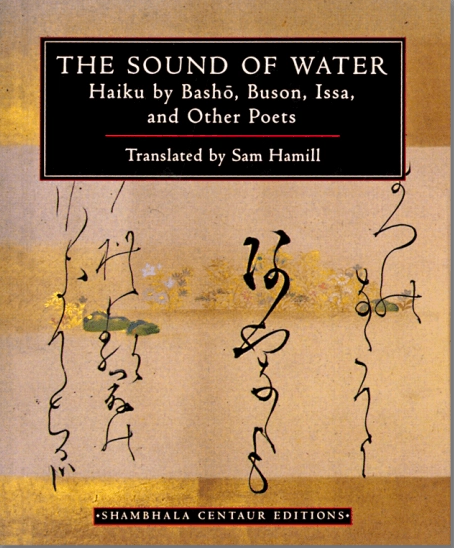
    One of the things I find helpful in the study haiku is people sharing the various sources they use in their own writing practice. A few weeks ago, I gave an overview of Joshua McFadden’s Six Seasons: A New Way with Vegetables, which is one of my non-haiku source texts. I also thought it would be worth while to share some of the haiku-specific books I’ve chosen. Since Sam Hamill’s The Sound of Water: Haiku by Bashō, Buson, Issa, and Other Poets was the first full anthology of translated haiku I ever read, and I’ve returned to it several times, I thought it would be a good starting point.

    I first purchased The Sound of Water in the summer of 2017, for nature writing workshop I was taking as part of my MFA coursework. We had a unit on haiku, and in hindsight, I have mixed feelings about the fact that haiku got lumped in with nature writing and was never addressed in any other context. Although the truly egregious part was that the professor did not have a haiku practice. Even with the incredibly limited knowledge I had about haiku in 2017 (at least compared to what I know now), I knew many of the things he was telling the class, and the feedback he was giving on my poems, were not coming from an intimate knowledge of the form. (But at least he knew better than to make us stick to 5-7-5.)

    I read The Sound of Water in 2017, returned to it in 2019, and for too long, it remained the only classical anthology that lived on my shelf. Eventually, I started engaging with other translations, and didn’t return to this particular book until beginning The Culinary Saijiki in 2022. One of the most fascinating things about returning to a book you have loved after a few years is seeing to what extent it still resonates.

    To prepare to write this post, I reviewed the introduction to the book again; I don’t think I’ve read that portion since 2017. I was surprised to see Hamill definitively use the definition of three lines, 17 syllables, and the 5-7-5 count structure (p. ix). The introduction is dated with the year of 1993; I might have been mislearning haiku in my third grade classroom at this point, but I know that among my American haiku elders, the 5-7-5 debate was already well underway. (Practitioners were also having discussions about whether or not English-language haiku should be one line to better reflect Japanese writing.) I don’t begrudge anyone having a preference; to definitively state that 5-7-5 is the only way seems erroneous even for 1993. I admit that I didn’t learn any better until 2012, but that was at the point in which I began to actually dabble in the community of serious practitioners. If Hamill was working on serious translation, it seems to me that he should have been aware of the structural discussions. Certainly Hamill didn’t have room for a full analysis of the issue in this tiny volume; a sentence of acknowledgement might have sufficed.

    But I suppose what I really struggle with is that, although Hamill is definitive about the 5-7-5 structure, he cannot stick to it in every translation. Buson’s haiku below has a 5-6-6 structure.

    Not cherry blossoms
    but peach blossom sweetness
    surrounds this little house

    Buson, trans. Hamill

    While the above haiku is not 5/7/5, it still manages the 17-syllable count that Hamill believes in. Yet he cannot even maintain the 17 syllable rule throughout the entire book. The Bashō haiku below is 5/6/5, for a total of 16 syllables.

    The banana tree
    blown by wind pours raindrops
    into the bucket

    Bashō, trans Hamill.

    Effective translation is one of the most difficult literary challenges one can undertake. I don’t think it would be possible to do 5-7-5 or 17 syllables 100% of the time and still produce engaging poems. The problem to me isn’t the structure of the translations itself; it’s that he makes claims about haiku structure that were already tenuous, and to which he could not possibly uphold 100% of the time. It’s the lack of nuance in the introduction that frustrates me.

    I don’t have major complaints about the haiku themselves. Sometimes, Hamill’s use of punctuation feels perfunctory, and honestly, I think The Sound of Water contributed to my own unartistic use of punctuation for several years. Some of the poems feel bloated given the commitment to 5-7-5, but there’s also a sense of translational mastery here; none of them feel like fill-in-the-blank exercises. I feel like Hamill is a translator of a transitional period. He still has some of the trappings of Blyth: capitalizing the first letter of each poem; often using standard punctuation. Yet he also eschews some of that punctuation, and his versions of these classic poems feel a little less rigid. It’s not the minimalist work that would come to dominate much of the 21st century, but rather a gesture toward it.

    I do have a number of other quibbles, and many of them might be described as petty. For example, Hamill says Basho wrote haibun (xvi), not that he developed the form itself. I also take issue with the idea that, “[A]lmost anyone can learn to make decently readable haiku in no time at all. Just as anyone can learn to write a quatrain or a sonnet” (xiii). I’d say it took me about three years of committed haiku practice to be able to write “decently readable haiku” consistently (and there’s a reason I never published many sonnets back in my mainstream poetry days). I’m sure there are some haiku geniuses out there for who the form comes easy. But I bristle at even the implied idea that haiku is an easy form for everyone. I still see that idea reflected in the mainstream poetry world.

    And ultimately, I think that Sam Hamill is more of a mainstream poet. When I first read The Sound of Water, I was also a mainstream poet, hoping the MFA I was so foolishly pursuing would make it easier for me to find tenure-track creative writing jobs (we know how that turned out). Six years later, the whole world has changed; my creative and professional lives are quite different from what I imagined. I think the strong reactions I’m having now are because The Sound of Water feels in many ways like a mainstream poet dabbling in haiku.

    And from 2012-2017, that’s exactly what I was: a mainstream poet dabbling in haiku. But for all of my complaints about The Sound of Water now, I can look back on that summer spent reading it and realize this book was the start of my transition into committed haiku practice. Hamill’s book is what inspired me to begin my weekly haiku exchange with my friend Warren, and start writing and reading haiku regularly. I still wouldn’t get really serious until 2020, but 2017 and The Sound of Water was an artistic turning point for me.

    Ultimately, while I’m less-enamored with The Sound of Water than I used to be, it will always hold a special place in my heart. I might nitpick about it now, but I cannot deny that in the path of my creative life, it had a big impact.

    Community Open Mic Reminder:

    n August, the podcast will feature a community open mic. Everyone is welcome to contribute! Please review the requirements below, and send me an audio recording to include on the show!

    Click the Send a Voice Message link here: https://podcasters.spotify.com/pod/show/culinarysaijiki/message

    Deadline: Saturday, August 26th at 11:59 pm CST.

    Theme: Transitions

    Details:

    • Please include your name before you read
    • Please read each haiku twice
    • Poets are limited to a maximum of three haiku
    • Haiku should include food as well as the theme
    • Please keep your ku family-friendly
    • Please reach out if you run into recording issues!

    Preorder Postcards from Texas

    I’m thrilled that my third chapbook (and first haiku chapbook!) is about to make its way into the world. I’m especially happy to be sharing the lineup with Lenard D. Moore and Julie Bloss Kelsey. You can order titles individually, or bundle them all (which comes with a discount and some bonus swag).

  • Food, Haiku, and Your Roots: 2023 HNA Presentation

    Food, Haiku, and Your Roots: 2023 HNA Presentation

    An Overview of Six Seasons: A New Way With Vegetables

    Read the most recent community blog post here: https://culinarysaijiki.com/2023/06/28/an-overview-of-six-seasons-a-new-way-with-vegetables/

    Join the Conversation

    This season, I am welcoming both podcast guests and guest bloggers. If you’re interested in joining one or both, visit https://culinarysaijiki.com/join-the-conversation/ for details.

    Support the ProjectBuy me a coffee at https://www.buymeacoffee.com/culinarysaijiki. You can also help by sharing this podcast with anyone who you think might appreciate it.Theme Music“J’attendrai” by Django Reinhardt, performing at Cleveland Music Hall, 1939. This recording is in the public domain. Hear the whole song at https://clevelandhistorical.org/files/show/6045.

  • An Overview of Six Seasons: A New Way with Vegetables

    An Overview of Six Seasons: A New Way with Vegetables

    “The seasons don’t ever divide themselves neatly,” writes Joshua McFadden in the opening of the Early Summer chapter of Six Seasons: A New Way with Vegetables. “Spring flows into early summer in fits and starts. A week of T-shirt weather may be followed by a string of cool gray days challenging our optimism about summer’s arrival.”

    Almost as soon as I began working with saijiki in my haiku practice, I struggled with the definition of seasons. The lunar-based haiku seasons didn’t correspond neatly with the Gregorian calendar under which I lived. I was living in Texas, where the seasonal expression is quite different from where I live now. And it’s true that the Earth doesn’t give us neat divisions. In the Gregorian calendar, summer has just started. In the haiku calendar, we’re in the middle of it. Two weeks ago, the last time I went to the farmer’s market, I saw an abundance of early summer (beets, potatoes) vegetables and midsummer vegetables (broccoli, cauliflower). But the early summer fennel and celery were out of season, and the summer squashes hadn’t arrived yet. I have started learning to live in the liminal space of seasons, and this book is an excellent guide for that.

    Six Seasons includes the standard spring, autumn, and winter. Summer, however, is divided into three sections: early, mid, and late. Each chapter contains a few key vegetables as the centerpiece, and McFadden details how their flavors and textures change throughout the season. Not only do seasons not divide themselves evenly, but vegetables are not the same through their entire growing range. What is sweet enough to eat raw one week might be moving toward bitterness a week later, and would benefit from cooking. It might be an insult to the carrot to cook it early in the season, but doing so toward the end of its peak enhances the flavors that are starting to fade. There is no one right way to eat or cook a vegetable; that depends as much on time of year as anything else.

    Over on the podcast, I’ve raved about the salad recipes I’ve tried from this book. Ultimately, though, there are two components of Six Seasons that make it more than a standard-issue cookbook:

    1. It focuses on techniques and practices. To be clear, it’s not a textbook; you won’t learn fancy knife skills (and that’s probably not really something best taught in a book anyway). But McFadden sprinkles in small things that make a big difference. For example, I’ve learned that if you’re making pasta with broccoli, the best way to cook the broccoli is to throw it in for the last few minutes of the pasta cook time. That way, it gets infused with the salted, starchy water, amping up the flavor. (I also swear it makes the broccoli come out brighter, but maybe that’s a placebo effect.)

    2. It reminds me that eating seasonally means surrendering control and will. For example, I’m writing this at the end of June. No matter how much I might hypothetically be craving butternut squash (really, I could just go for a good breakfast taco), there’s no way I’m going to find the requisite ingredients at the peak of freshness. Sure, I could go to a supermarket and there would probably be a butternut squash there, given the world we live in. But that doesn’t mean the squash is in great condition. If I wanted a savory squash dish, zucchini boats stuffed with sausage, cheese, and Italian seasoning would be a better menu option.

    That doesn’t mean you have to somehow align your cravings with the seasons, though I think most of us do to some degree (I want more salads in the middle of summer than I do in the middle of winter). That doesn’t mean that if you indulge the hankering for the comfort of an out-of-season dish, you’re a morally inferior person. It doesn’t mean you can’t make a smoothie out of frozen berries in January, if that’s what you’re into.

    What it does mean, though, is that if you really want to get in tune with the seasons, you have to relinquish expectation. Maybe you can’t wait to make roasted beets. But maybe the week you’re expecting to find them at the farmer’s market, they’re not there. Maybe three weeks goes by before they’re finally ready. Frustrating? Sure. But the fact is that we’ve been trying to bend the world to human whim for a long time now, and it’s clearly not going well.

    To eat seasonally means that you can’t plan too hard. As someone who likes to rigidly plan out all her meals for the week and go shopping in one fell swoop, this was a tough lesson to learn. The farms aren’t going to yield to what my mind has decided is the most efficient or delicious. I can either change my plan on the fly, or I can make that dreaded second stop to another store to buy what I want, even if it’s not quite ripe.

    To eat seasonally is to recognize that the world is so much bigger than your individual wants, and so beyond your individual control. That, I think, is the greatest lesson of Six Seasons, even if it’s not made explicit. Rather, if you make the book a guide to how you approach vegetables generally, that lesson will reveal itself over and over. Which is good, because if you’re anything like me, you’re going to need a reminder.

  • Season Two Introduction

    Season Two Introduction

    In Gratitude
    Thank you to Peg Cherrin-Myers and Kimberly Kuchar for the coffees they bought me this month. I am now 80% of the way to covering my hosting costs!

    If you want to contribute, you can buy me a coffee here: https://www.buymeacoffee.com/culinarysaijiki

    Join the Show: https://culinarysaijiki.com/join-the-conversation/

    Read the Blog: https://culinarysaijiki.com/blog/(New posts start up next week!)

    Haiku North America Info: http://www.haikunorthamerica.com/2023-conference.html

    Books I Referenced

    Six Seasons: A New Way with Vegetables by Joshua McFadden. Artisan Press, 2017. https://www.joshuamcfadden.com/sixseasons

    Haiku edited by Peter Washington. Everyman’s Library Pocket Poets, 2003. https://www.penguinbookshop.com/book/9781400041282

  • Mark Scott: Haiku, Food, and the Micro-Seasons

    Mark Scott: Haiku, Food, and the Micro-Seasons

    More about Mark Scott
    Learn more about the micro-seasons at https://naturalistweekly.com/.
    Support Naturalist Weekly: https://www.buymeacoffee.com/naturalistCFind Naturalist Weekly on Instagram at: https://www.instagram.com/naturalistweekly/

    Harvest Time
    Read the most recent community blog post at: https://culinarysaijiki.com/2022/12/04/bonus-post-community-harvest/

    Join the Conversation
    Season 2 will focus on food as it appears on classical haiku. If you would like to be on a Season 2 podcast episode, or write a guest post on this topic, contact me at allyson@allysonwhipple.com.

    Support the Project
    Buy me a coffee at https://www.buymeacoffee.com/culinarysaijiki. You can also help by sharing this podcast with anyone who you think might appreciate it.

    Theme Music
    “J’attendrai” by Django Reinhardt, performing at Cleveland Music Hall, 1939. This recording is in the public domain. Hear the whole song at https://clevelandhistorical.org/files/show/6045.

  • Bonus Post: Community Harvest

    Bonus Post: Community Harvest

    Talk about a cornucopia of poetry! For this bonus post, people took me up on my offer of multiple forms. I received not only haiku, but also tanka and tan-renga, and submissions came from three different continents!

    It was a delight to put this post together over the course of a cold winter afternoon, drinking multiple cups of tea. I hope you enjoy the creative bounty as much as I did.

    Haiku

    In Deb Koen’s first haiku, the second and third lines display a masterful example of double meaning, reinforcing the sense of abundance that comes from a harvest. The produce features an array of colors; each of these colors was produced by, and harvested from, the planet itself. The second sense of meaning comes from the range of colors available at a produce market. The color range among the harvested crops is expansive; every shade of the planet is represented here. We have not just an abundance of physical nourishment, but a feast of delights for the eyes as well.

    farmstand
    every color
    from earth

    Deb Koen, USA. This haiku originally appeared in Haiku Canad Review, Winter 2020.
    vegetables stall
    Photo by PhotoMIX Company on Pexels.com

    In the second haiku, Koen associates the comfort that both food and music can provide. For most people, comfort foods are rich and hearty. What makes them comforting is not just their heartiness. but also their familiarity. Just as delicious food prepared with care gets passed around a holiday table, an LP of comforting music rotates not just in physical space, but in and out of the listener’s consciousness. In this haiku I see abundance (hearty comfort food) and celebration (food being passed around the table), but I also wonder if this poem is about a meal taking place after a funeral: the food comforts the grieving, and the music brings back good memories of the departed loved one.

    comfort food
    circling the table
    a Beatles LP

    Deb Koen, USA. This haiku originally appeared in Frogpond 44:2.

    Tanka

    Hassane Zemmouri’s first tanka gives us an image of a child’s joy at harvesting berries. There are two bounties: the fruit off the vine, and the experience of watching a child’s face light up. This poem reinforces the concept that food is not just physical nourishment. The connections we make to the land, and to each other, through the processes of harvesting, cooking, and eating, shine through in this brief work.

    picking season-
    the full basket doesn’t accommodate
    the girl’s joy
    her smile more delicious
    than the expected jam

    Arabic translation:

    Hassane Zemmouri, Algeria. This tanka originally appeared in Take5, Issue 3.
    clear glass mason jars
    Photo by Pixabay on Pexels.com

    Hassane’s second tanka reminds me of picking apples with my nephew this fall. Our neighbors have an apple tree, but weren’t interested in harvesting the fruit. My nephew and I went out with an apple picker and got as many as we could. When he was concerned about bruised or spotted apples, I reminded him of what his great-grandmother believed: that the ugly apples make the best applesauce. After harvesting the apples, my partner turned them into applesauce, and saved the peels to make jelly. I appreciate Hassane’s tanka because it illustrates so well how a short poem can awaken a beloved memory in a stranger half a world away.

    end of picking-
    the mother chooses the bruised apples
    for jam
    children dream
    of candy apples

    French translation:

    fin de cueillette-
    la mère choisit les pommes meurtries
    pour la confiture
    les enfants rêvent
    de pommes d’amour

    Arabic translation:

    Hassane Zemmouri, Algeria

    Tan-Renga

    In their first tan-renga, Christina Chin and Uchechukwu Onyedikam magnify the sense of celebration that often comes at harvest time. Glass Gem corn originates in Oklahoma, and was developed by a farmer named Carl Barnes. It took him many years to collect the seeds and cross-breed the corn he found to create the vivid, translucent kernels we see today. It’s a rare breed of corn, and in this tanka, I see a celebration of the ingenuity and patience required to cultivate heirloom stock. Because rainbows are also associated with the queer community, I think that this tanka implies the marriage of queer farmers, a portion of the population that often gets overlooked. (You can read more about that at NPR.)

    close up shot of yams
    Photo by Daniel Dan on Pexels.com

    stripping husks
    from glass gem corn
    an heirloom
    of rainbow colours
    farmer kisses farmer

    Christina Chin, Malaysia, and Uchechukwu Onyedikam, Nigeria

    The New Yam Festival is a celebration that takes place in Kogi state, Nigeria. It celebrates the farming season, as well as community and culture of of the Igbo people. It typically falls at the end of August or beginning of September, depending on when the first new yams appear. This tan-renga reminds me that while many holidays and festivals have set dates, the Earth does not follow the human-made calendar to the exact day. The world releases its bounty on its own time.

    New Yam Festival
    the Igbo people dig
    into the ridges
    end of rainy
    season

    Uchechukwu Onyedikam, Nigeria and Christina Chin, Malaysia

    In their first tan-renga, Christina Chin and Linda Ludwig present a wintry scene warmed by delicious food and intimacy. While crabbing season varies by region, in much of the world, it starts in late autumn and ends in mid to late winter. While moonless nights happen all year long, there’s something about the darkness of winter that makes the lack of moon in this poem feel more potent. Yet the crabs, being in season, are juicy and delicious. I interpret a sensuality in this poem not just from the word “succulent,” but also because in some parts of the world, shellfish are considered an aphrodisiac. Regardless of whether or not I’m correct, there is still a delightful coziness in this tan-renga.

    the traps
    heavy with crabs
    river with no moon
    succulent dinner
    for two

    Christina Chin, Malaysia, and Linda Ludwig, USA

    This final tan-renga contains historical allusions, illustrating the ways in which food is bound up in culture both past and present. The Silk Road existed as a network for traders exchanging goods between Asia and Europe, between 130 B.C.E. and 1453 C.E. Commodities included textiles, animals, and of course, foods and spices. The gogi berry comes from a shrub native to China, and long been used in both Chinese and Korean cooking and medicine. Today, people in the western world can find gogi berry tea sold as an alternative health product. What started as an indigenous ingredient is now a decontextualized commodity. Nonetheless, we can connect to the image of gogi berry and ginger blended into a simple tea, and imagine the connection the drinker might feel to generations past.

    ripe grapes on branch on white surface in sunlight
    Photo by Angelica Ospino Laguna on Pexels.com

    the silk road
    old world treasures
    chi tea
    a hot concoction
    of goji berry ginger

    Linda Ludwig, USA and Christina Chin, Malaysia

    ****

    Thanks to everyone who contributed poems to this special post. I look forward to blogging again in 2023! For now, may you have a peaceful close of the year.

  • The Season for Reflection and Rest

    The Season for Reflection and Rest

    First, thanks to Peter Schmidt for buying me 5 coffees this month! I’m now 48% of the way to having my web hosting covered for the year.

    Second, remember to send work for the Community Bonus Post at the end of the month. That will be the last blog post for 2022! Send your work via the Google Form by 11:59 pm CST on Wednesday, November 23rd.

    When I started this project in the spring, I had no idea what shape it was going to take. Like many of my creative pursuits, I dove in headfirst, making it up as I went along, knowing I’d figure it out along the way. I’m also grateful that the blog and podcast have allowed me to stay connected to my creativity through a tumultuous second half of 2022, including a cross-country move, buying a house, and changing jobs twice. Moving in October, I felt the call to take a break. I wrote recently to a group of friends that, for most of my adult life, I’ve felt the desire to put life on pause from October through the new year. And pretty much every year, I’ve ignored that, pressuring myself to keep up with the pace of life I keep during the sunnier, warmer months. This year, though, I’m trying to honor that impulse. So I’m taking today to serve as a way to reflect on the project so far, and what my plans are for the future.

    The Blog

    On this site, I’ve experimented with a few different types of posts. My focus is sharing haiku others have written, along with my own commentary. Sometimes I focus on a specific type of food; sometimes I focus on a specific season; sometimes the post is more conceptual. I haven’t nailed down one specific approach because different ideas inspire different structures. That being said, I think I would like to maintain a more consistent structure in the future, and one of the things I’ll be doing during my project hiatus is considering the shape I want future posts to take. It’s hard to be in that planning mode when you’re in creation mode, so I’m looking forward to stepping back, letting my mind go fallow, and seeing what emerges. If there are particular structures or approaches that appeal to you, let me know in the comments!

    I also enjoyed putting together the May community blog post, and am excited to be reading haiku for the November post as well. I’m considering making this a regular feature next year, either quarterly or every other month. If you have a preference, please let me know! While I ultimately have to shape this project around what works with the rest of my life, I also do want to know what interests people who read this blog.

    The Podcast

    Since launching the podcast in June, I’ve learned some of the basics of Garageband, finally settled on a theme song, and even experimented with different kinds of episodes. I modeled the show after long-form, open-conversation podcasts, which are the kind I most enjoy listening to. However, I also did one solo episode, and was surprised to find how much fun I had making it! And just as I enjoy doing the community blog posts, I loved putting the community open mic bonus podcast together. If I decided to make community blog posts every other month, I might do that for podcasts as well. Odd-numbered months could have a community blog post, and even-numbered months could have a community open mic. This idea is still percolating; I’ll see how it takes root during my hiatus.

    The Future

    The main thing I want to do during my creative break is take time to get organized. I’ve collected over 200 haiku at this point, and while my organization system on the whole is pretty solid, ever since buying and setting up the house, I haven’t done a great job keeping track of which haiku I have already used on the blog and podcast. I’m honestly excited to take a weekend afternoon and get everything reorganized.

    I also want to put together the foundation for an eventual print manuscript. While I don’t imagine putting a print book together until at least 2024, the time to get organized is now. That means setting up a Scrivener file especially for the book project, getting a basic organizing scheme in place, and importing relevant blog or podcast content that I might want to revisit. While I know that a project of this length is going to evolve over time, giving myself a structure now will set me up for an easier time down the road.

    In addition to the community blog post at the end of the month, I have two more podcast episodes lined up, and then I’m officially on hiatus until January. I hope you have a restful and creatively fulfilling winter season.

    Huge thanks to everyone who has read this blog, commented on posts, and supported this project. It means a great deal to me that there are people interested in the work I’m doing here. I’m excited for what this project will yield in the new year.