In Gratitude Thank you to our anonymous donor who bought me three coffees this month! I’m now 20% of the way toward my goal of covering website costs for the year. Those who want to support the podcast financially can do so at: https://www.buymeacoffee.com/culinarysaijiki/.
Join the Conversation If you’d like to be on the podcast, visit https://culinarysaijiki.com/join-the-conversation/ and fill out the form. My life is a little hectic right now, so if I don’t follow up in a timely manner, send me a reminder.
Theme Music “J’attendrai” by Django Reinhardt, performing at Cleveland Music Hall, 1939. This recording is in the public domain. Hear the whole song at https://clevelandhistorical.org/files/show/6045.
In Gratitude Thank you to our anonymous donor who bought me three coffees this month! I’m now 13% of the way toward my goal of covering website costs for the year. Those who want to support the podcast financially can do so at: https://www.buymeacoffee.com/culinarysaijiki/.
August Open Mic Bonus Episode To participate in the August 30th open mic bonus episode, click this link: https://anchor.fm/culinarysaijiki/message. Recordings must be received by Friday, August 28th at 11:59 pm CST.
Guidelines:
Each poet is limited to two haiku
Before reading your haiku, please say your name or pen name and, if comfortable, where you’re writing from
Please read each haiku twice
Haiku should mention food, and connect to the transitional aspect of seasons, with an emphasis on autumn
Submissions that do not follow these guidelines will be disqualified
Join the Conversation If you’d like to be on the podcast, visit https://culinarysaijiki.com/join-the-conversation/ and fill out the form. My life is a little hectic right now, so if I don’t follow up in a timely manner, send me a reminder.
Theme Music “J’attendrai” by Django Reinhardt, performing at Cleveland Music Hall, 1939. This recording is in the public domain. Hear the whole song at https://clevelandhistorical.org/files/show/6045.
First, thank you to the anonymous person who bought me three coffees this month! I appreciate your support of the project, and especially for covering this year’s website costs. I’m now 13% of the way toward my goal.
This week, I got inspired to explore the connection between region and food in haiku. When I wrote primarily free verse, I loved writing about the landscapes of Texas, and I also enjoy exploring the ways in which landscape connects to food. I decided to start with the Southwest in part because that is one of two regions (the other being the Midwest) where I have lived the longest, and have detailed understanding of regional food. I’d also been rereading Lifting the Seasons: Southwestern Haiku & Haiga, and had added a number of the haiku to my Culinary Saijiki database. I decided to use it as my initial source text in my exploration of Southwestern food haiku. (There are a number of other good anthologies out there, but I didn’t have access to them this week . . . but that just means I’ll have to return to this topic again!)
As it turns out, I ran into a number of challenges with this post! I thought I was going to have any easy time talking about Southwestern food in haiku, but in fact, this was the most difficult entry I’ve done so far, which is all the more reason I’ll want to return to this topic.
1. The southwest is not a clearly delineated space. Arizona and New Mexico are the only definitive Southwest states, but parts of Texas, Oklahoma, Utah, Colorado, Nevada, and Oklahoma also get included. However, there isn’t a definitive map that delineates which portions of each state get included. For example, San Antonio is closer to Louisiana than it is to New Mexico, but the city seems more a part of the Southwest than the South. There’s a great deal of culturally and geographically liminal space that’s difficult to account for.
2. Southwestern food is not a clearly delineatedcategory. While some foods, like nopales and tamales, are clearly Southwestern, I found myself struggling with many of the crops. For example, Texas has its own types of melon and peaches, but the places where those crops are grown appear in that liminal space. In addition, changes in farming practices over the years mean that produce I didn’t initially think belonged in the Southwest does grow there. I ended up pouring a great deal of research into produce to place poems accurately!
3. Disagreeing with some of the placements of these poems.Lifting the Seasons editors Scott Wiggerman and Constance Campbell worked hard to place the poems in this anthology, and I consider Scott one of my poetry mentors. So I didn’t feel great when I came upon a poem in a certain season and found myself disagreeing with its placement. I made notes in my saijiki database about why I disagreed, and tagged the poem with both seasons. I’ve also chosen to make note of my disagreements in this post, because I don’t want to mislead people who might have already read the collection and wonder why I deviated from the original placement. Ultimately, I hope these disagreements come across as respectful. There is always debate within the haiku community; not all saijiki align with each other. Disagreement is part of the process.
4. No autumn food kigo I hadn’t already used. I prefer to not use the same haiku in multiple blog posts. When going through my database, I’d already used the best examples of Southwestern autumn food elsewhere on the blog, so I don’t have any autumn entries this week.
For more information on Lifting the Seasons: Southwestern Haiku & Haiga, visit the Dos Gatos Press website: http://dosgatospress.org/.
Spring
prickly pear salad nopales skinned and shredded— thornless spring
Katherine Durham Oldmixon, Lifting the Sky: Southwestern Haiku and Haiga, ed. Scott Wiggerman and Constance Campbell. Dos Gatos Press, 2013.
Nopales are the pads of a nopal, commonly referred to as a prickly pear. There are over 100 species of nopal in Mexico and the southwestern United States, and are a common cooking ingredient. However, the tiny spines must be removed first, and while experienced cooks can probably complete the process efficiently, many of us home cooks prefer to buy our nopales pre-skinned from Mexican grocery stores.While nopales can be in season for much of the year, spring is when they first peak. When other crops have just been planted, and the abundance of summer produce is a way off, nopales are a way to enjoy something fresh.
A nopal in Austin, Texas
across asphalt truck tires scatter grit and white pear blossoms
Sandra D. Lynn, Lifting the Sky: Southwestern Haiku and Haiga, ed. Scott Wiggerman and Constance Campbell. Dos Gatos Press, 2013.
Fruits were one of the primary challenges for me in putting together this entry. I hadn’t revisited this anthology in a number of years. I was surprised to find two haiku about pears in a book focused on the American Southwest! However, after doing some digging, I discovered that Southern California is a peach-growing region, and while the official states of the Southwest are Arizona and New Mexico, Southern California is also frequently included. I think that this haiku points to one of the challenges that practitioners and editors come across: geographical boundaries are not as well-defined as we might like. In addition, due to the ways in which humans have traveled, colonized, and globalized, a European fruit will thrive in a place not originally its home, complicating our understanding of what an appropriate kigo might be.
the pear tree’s hesitant buds— February
Sally Clark, Lifting the Sky: Southwestern Haiku and Haiga, ed. Scott Wiggerman and Constance Campbell. Dos Gatos Press, 2013.
Sally Clark’s haiku also presented me with a familiar challenge that I have not yet figured out how to reconcile: what it means to be a haiku practitioner writing in the age of the Gregorian calendar. Her haiku appears in the winter section of the anthology, which certainly makes sense for editors working in the United States. However, February is considered spring in the haiku calendar, and the image of actual buds on the tree further reinforces the spring image. Because of the presence of buds, rather than bare branches, I chose to place this haiku in the spring section.
Summer
what’s left of the moon— a slice—ripe cantaloupe— set on a chilled glass plate
Robert A. Ayers, Lifting the Sky: Southwestern Haiku and Haiga, ed. Scott Wiggerman and Constance Campbell. Dos Gatos Press, 2013.
This is the first haiku where I found myself disagreeing with the editors regarding placement. In Lifting the Sky, this haiku appears in the Winter section. However, cantaloupe is at its peak in summer, so for the purposes of this project, I have placed there. Various melons are popular in summer dishes, and make excellent agua frescas (refreshing fruit drinks) during the hottest months.
below the peach tree flipping pages in a book hummingbird flutter
Ellaraine Lockie, Lifting the Sky: Southwestern Haiku and Haiga, ed. Scott Wiggerman and Constance Campbell. Dos Gatos Press, 2013.
I spent a few hours mulling over Ellaraine Lockie’s haiku, and what season I felt it best represented. In Lifting the Sky, this haiku appears in the Spring section. Since we don’t know what state the peach tree is in, I understand the editors’ decision. However, depending on what saijiki you are using, hummingbirds are listed as either a spring or summer kigo. In my lived experience, hummingbirds tend to be more visible in the summer. In addition, unless a poet mentions blossoms or a bare tree, I picture it covered with fruit, which in that case, would make summer more appropriate.
Chris Ellery, Lifting the Sky: Southwestern Haiku and Haiga, ed. Scott Wiggerman and Constance Campbell. Dos Gatos Press, 2013.
While I debated a bit as to whether or not to keep this haiku in the winter category, as it appears in lifting the sky, a careful bit of research led me to agree that it was a winter poem. While in much of the United States, the first frost is likely to happen in autumn, in most of the Southwest, the first frost is not likely to happen until winter.
winter sunlight our neighbors bring us homemade tamales
Lynn Edge, Lifting the Sky: Southwestern Haiku and Haiga, ed. Scott Wiggerman and Constance Campbell. Dos Gatos Press, 2013.
When I lived in Texas, I knew Christmas was getting close, because people who made tamales would start taking pre-orders. Even grocery stores would do big tamale sales at Christmas! While tamales aren’t inherently a winter food (more on that below), they’re certainly a hallmark of the holiday season in the Southwest. While a Southwestern reader might not need the phrase “winter sunlight” to place the season, someone who has lived their whole life in Canada might not be aware of how tamales connect to the seasons, so I think Lynn made a good choice setting the poem explicitly in winter. Working on this project reminded me the extent to which much of haiku relies on shared cultural knowledge, and how we can’t expect every reader to have the same understanding of the world. I also don’t think that’s a bad thing. We can’t spend our whole lives limiting our writing to what we think people will understand. If haiku is the poetry of the moment, we have to write from our experience, without worrying whether or not a reader from the other side of the world will get it.
Mama’s gifts filled, wrapped, tied with care— tamales
Christine Wenk-Harrison, Lifting the Sky: Southwestern Haiku and Haiga, ed. Scott Wiggerman and Constance Campbell. Dos Gatos Press, 2013.
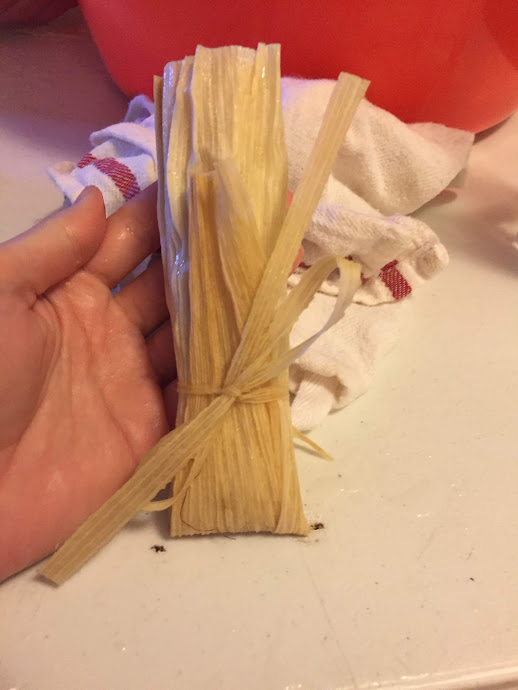
Tamales don’t have to just be a winter food. However, the labor-intensive process means that if you’re going to make them at home, they’re a special-occasion food . . . and a dish best made as a group. The last Christmas before COVID, John and I hosted a tamale-making party, and it remains one of my happiest holiday memories. I’m still sad I never had one more opportunity to host a Christmas tamale gathering in Texas. I associate tamales with winter holidays more than any other, and they are a gift that can last for months. With the filling wrapped in corn husks, they can be frozen and easily re-steamed (or microwaved) for a delicious meal in those last days of winter and earliest days of spring, when the holidays are long gone but things feel a little bleak.
The fruits of our labor, Christmas 2019
Cheshire cat grin between bare pecan branches— the waxing moon
Sandra Cobb, Lifting the Sky: Southwestern Haiku and Haiga, ed. Scott Wiggerman and Constance Campbell. Dos Gatos Press, 2013.
Note: In Lifting the Sky, this haiku appears in the Spring section. However, I interpret bare branches as a winter kigo, and thus have placed it as such.
Although I encountered a number of challenges while working on this post, I feel inspired to keep going with the regional theme. However, I can’t possibly be an expert on all geography-specific foods, even in my own country! If you’re interested in putting together a guest post similar to what I’ve done here, please contact me. I’ll also put up a post with formal guidelines sometime in the next week or so.
Before reading your haiku, please say your name or pen name and, if comfortable, where you’re writing from
Please read each haiku twice
Haiku should mention food, and connect to the transitional aspect of seasons, with an emphasis on autumn
Submissions that do not follow these guidelines will be disqualified
In Gratitude Thanks to the anonymous doner who bought me three coffees this weekend! They donated after I sent the podcast to be mixed and edited, so I couldn’t thank them at the top of the episode, but I will for the next one!
I forgot to mention in the intro, but this month, project supporters will get a recipe for Christine’s Mango Trio Pie.
On the blog Visit https://culinarysaijiki.com/ for long-form essays and commentary on food haiku. The most recent post is about debatable food season words. Please join the conversation and offer your insight!
Join the conversation I’m excited about the requests coming in to join the podcast! If you want to record a conversation, go to the form on the website: https://culinarysaijiki.com/join-the-conversation/
Just as there isn’t always a clear distinction between one season and the next, sometimes a haiku feels seasonal without having a clear seasonal referent. I’m not talking about haiku that completely lack a kigo. Rather, I’m thinking about haiku that seem to have a kigo, yet are not clearly grounded in an identifiable season.
There are a few reasons why a seasonal referent might not be clear:
The word that is ostensibly a kigo could plausibly fit into more than one season;
The reader’s interpretation of the potential kigo might be influenced by where they have lived;
As a whole, the haiku suggests a different season than a single word might imply
Below, I have some haiku that are currently in my summer collection, but that I’m not entirely sure about. Some of them might belong to spring or autumn, or might be better placed in the All Year category. I welcome your thoughts in the comments!
farmers’ market the queen bee makes her appearance
Victor Ortiz, bottle rockets #46
I initially placed Victor Ortiz’s haiku in the summer category because summer is peak time for farmer’s markets and fresh produce. However, markets can easily last well into the fall, with root vegetables and cruciferous greens making an appearance. When I lived in Austin, farmer’s markets would last year-round, only skipping weekends from the most inclement weather. In addition, some cities in more temperate climates have covered markets year-round.
I’m also not sure how to treat the phrase “queen bee” as a kigo. In Haiku World, “bee” is listed as a spring kigo. Jane Reichold also listed “bee” as a spring kigo in A Dictionary of Haiku Classified by Season Words with Traditional and Modern Methods. I cannot find a reference to bees in Yamamoto Kenkichi’s The Five Hundred Essential Japanese Season Words. Honeybee mating season also begins in the spring. In Ortiz’s haiku, I interpret “queen bee” metaphorically, referring to a particular type of woman making an appearance, but taking the word more literally, it could refer to spring. As a result, I’m not 100% certain whether I should keep this poem in summer or move it to spring.
a month of Sundays . . . berries rotting on the vine
Julie Schrein, First Frost #1
While berries are a summer kigo, in Julie Schrein’s haiku, we see them rotting. In addition, the opening line illustrates the passage of time. That the berries are rotting does not inherently mean that autumn has arrived. Berries that are ready earlier in the summer can rot before autumn arrives. However, autumn is the season of decay, and the clear passage of time suggests that even if autumn hasn’t fully arrived, we’re in a transitional state. I’m tempted to move this haiku to autumn, but the word “berries” is such a classic kigo that I still have it in the summer.
When I think of lavender ready for harvest, I think of Blanco, Texas, which hosts an annual festival where visitors can travel to farms to harvest their own lavender. The festival takes place in May, which is early summer in the Lunar calendar, and late spring in the Gregorian calendar (however, in Texas, it’s definitely feeling like summer already). In addition, different varieties of lavender bloom throughout the year, with some in early spring, and others late in the summer (Gregorian)/early fall (Lunar). I haven’t moved this haiku out of the summer category yet, but I wonder if lavender isn’t best specified by the type it is (True/Common, Spanish/Butterfly, Fringed/French) in order to best place it in a specific season. That being said, given the minimalist tendencies in English-language haiku, poets might not want to add an additional modifying word . . . though if they’re aiming to be as specific as possible, that might be the most pragmatic choice.
“Sunset” is listed as an all-year kigo in Haiku World, but appears as a summer kigo in A Dictionary of Haiku Classified by Season Words with Traditional and Modern Methods. (I can’t find reference to it in The Five Hundred Essential Japanese Season Words.) By that logic, I should move Tony Williams’ haiku to the spring section. However, dining outdoors reminds me more of summer than of spring, when the late nights and dry weather are more conducive to outdoor dining. I think this is an example in which the whole of the haiku creates the season, rather than a specific word.
As mentioned above, in the established saijiki I’m working with, “sunset” is either an all-year kigo or a spring kigo. However, I associate rose wine with summer, especially because frose (frozen rose) was a trendy summer millennial drink a few years ago. While “sunset” as a kigo might be ambiguous, to me, “rose” is not . . . However, that might be my own biases and preferences talking.
I look forward to your thoughts and suggestions! Even if you disagree with me, I hope the explanation of my thought process has been interesting.
Note: The theme music and transitions have changed because the ones I was using from my hosting service are suddenly no longer available. I discovered this at the proverbial 11th hour, so had to make do with new stock sounds. Hopefully that didn’t cause too much confusion. If you know of anyone who enjoys writing music and cues for podcasts, please let me know!
Before diving in, I’d like to thank Geoff M. Pope for being the first supporter of this new project. I’m now officially making progress on my goal of covering website costs for the year. If you would like to support the Culinary Saijiki project, you can visit the Buy Me a Coffee page here: https://www.buymeacoffee.com/culinarysaijiki.
Second, don’t forget that tonight is the deadline to send your haiku and senryu for the May 31st bonus post. Note that although the deadline is 11:59 p.m. CST, I will be asleep when that passes, so if you slip your haiku in during the wee hours, I’ll still take them! You can find the submission form here: https://forms.gle/wamaaMmoYS88AjXz6
Notes on All-Year Food
In my May 10th post, I noted that I have observed three broad categories of food words in haiku:
Food words that are a definite seasonal referent;
Food words that are not a part of any specific season;
Food words that become seasonal with an additional modifying word.
This week, I’m focused on the second category.
As of this writing, I’ve collected 125 haiku for the project. Of those, the greatest proportion are all-year words, making up 36% of the current total. Although I haven’t collected statistical data every time I add a haiku to my Scrivener file, I know that when I first started collecting, the all-year food words were an even higher percentage. As I’ve added to the collection, the proportions have evened out somewhat, though the all-year words still come up more frequently. As yet, I don’t have a hypothesis as to why that might be.
In Haiku World, William J. Higginson identifies the following food-related words in the All Year section of his saijiki:
Meal
Cooking
Beverage
Coffee
Pots and Pans
Although I have collected a range of all-season words beyond these five, as a nod to his work, in this post, I’ll discuss the haiku I’ve collected that relate to his original list. None of these appear in Haiku World; they’ve all been published recently.
Meal
Breakfast is a common meal that shows up in haiku. Morning and evening seem to be inspiring times of day for haiku poets, and if you have the luck of enjoying peaceful, leisurely breakfasts, I can see how the first meal of the day would lead to inspiration.
morning meditation; thinking about not-thinking . . . and breakfast
Shir Haberman, bottle rockets #46
rising early . . . a half-finished haiku for breakfast
Tony Williams, Failed Haiku #70
I debated whether classifying Johnette Downing’s lunch haiku as all-year or not. On the one hand, there isn’t a clear seasonal referent. On the other hand, a lunch box implies school. As school runs most of the calendar year, though, I didn’t feel right assigning this haiku to the autumn category. A lunch box could also imply summer camp. Therefore, I designated this one as all-year. If you disagree, let me know in the comments. I’d love to hear your thoughts! (Johnette, if you happen to see this, please do chime in about what you intended!)
lunch box her doll a stowaway
Johnette Downing, bottle rockets #46
The act of setting the table can be a meditative experience that can yield haiku moments. It doesn’t have to be a formal dinner arrangement; a simple home arrangement for a small family brings new moments of awareness.
table setting for three bun in the oven
Brittney Ritoff, Failed Haiku #70
Cooking
At present, I haven’t found much in the way of cooking-related haiku, senryu, or zappai that don’t have an additional seasonal modifier. Ronald K. Craig’s humorous poem reminds me of the pitfalls of having to cook for oneself: not wanting anything you have in the fridge, hoping dinner will cook itself, and trying to talk yourself out of takeout.
often the fridge door of opportunity opens
Ronald K. Craig, Failed Haiku #70
Beverage
Tea is the most common all-year beverage I’ve collected so far, and ultimately, deserves to be a topic of its own, on par with coffee. That being said, varieties of tea can become season-specific words; a colleague of mine talked about how green tea makes her think of spring. I’m certain that tea will get a post of it’s own in the future!
Sunday morning head bowed, hands clasped around my tea
Kristen Lindquist, Kristen Lindquist, Haiku Pea Podcast, Series 5, Episode 8
In Gary Hotham’s poem below, the cup could refer to tea, coffee, or something else entirely. The presumably empty beverage vessel connects to rich memory, nostalgia, and perhaps grief. I’m also intrigued by the extent to which mothers come up in the haiku and senryu in this section.
Mom’s home the last cup she drank from
Gary Hotham, Rightsizing the Universe: Haiku Theory, Yiquralo Press, 2019
Coffee
Coffee is one of the most popular all-season food words I’ve collected so far. I’m certain that if I went through the list of all the haiku I’ve written, coffee would be the food/beverage word that features most frequently. While coffee can be modified to reflect the season (more about that in June), a hot cup of coffee seems appropriate just about any time of the year. (And if you’re not sensitive to caffeine, it’s appropriate to any time of day!)
coffee shop date jitters
Marsh Muirhead, Failed Haiku issue 70
waiting for your call the coffee percolator welling up
David Gale, First Frost #1
coffee milk cloud another day to figure out the finances
Crystal Simone Smith, First Frost #1
hot black coffee ad-just-ing my eye-sight between sips
As with most of the cooking-specific haiku I’ve collected so far, most of my pots-and-pans haiku have a seasonal modifier, taking them out of the all-year category. However, left to their own devices, this is definitely an all-year word. We have to cook regardless of season!
our first saucepan cooking for one
Maurice Nevile, Failed Haiku #70
silence . . . water comes to a boil in a silver pot
Do let me know your thoughts in the comments, and don’t forget to send me your bonus post submissions by tonight! I’m already putting it together with the work that has come in so far, and I’m looking forward to sharing it with you.
I’m about seven weeks into my yearlong study of saijiki. While my personal writing practice isn’t centered around food, working with Higginson’s Haiku World, as well as the companion volume The Haiku Seasons, have been invaluable as I also explore the ways in which food and the seasons work in haiku.
As of this writing, I have collected 93 haiku that incorporate food in some way. Taking a cue from Haiku World, I am organizing them by season, as well as maintaining an All-Year category. Based on what I have collected so far, I have observed three broad categories:
Food words that are a definite seasonal referent;
Food words that are not a part of any specific season;
Food words that become seasonal with an additional modifying word
I will focus on the first category in this post, the second category in my May 24th post, and the third category in my June 14th post.
Some Observations
At this point in the project, inherently seasonal food words make up the smallest proportion of haiku that I have collected. Most of the poems in my Scrivener file involve all-year food words, or foods that become seasonal through additional modifiers. The greatest proportion of inherently seasonal food words falls into the summer category. Spring and winter have the lowest proportions. However, I have nothing close to a statistically significant sample size, so I won’t be surprised if the proportions change as I go.
As I’m still early in my journey of collecting haiku, I’m only giving 2-3 examples for each season of food kigo.
Spring
As spring is the planting season, seeds are a specific kigo. Even if there is another food referent that might indicate a later season, as in Cherie Hunter Day’s haiku below, the presence of seeds grounds the poem in spring. Seeds speak to the potential food we will eat in the future.
hidden in the seed packet star songs
Stuart Barrow, bottle rockets #46
lockdown starting a lemon tree from seed
Cherie Hunter Day, First Frost #1
The sugar maple is another image of food that is not yet ready for consumption. It also illustrates the challenge of working in two traditions. Sap harvesting season runs 4-6 weeks, and can start as early as February. While that’s still deep winter for those of us working with the Gregorian calendar, in the haiku calendar, it’s spring. There’s also no accounting for climate. You can be well past the spring equinox and still get snow in areas where sugar maples thrive!
sugar maple pressing my tongue against the wood
Genevieve Wynand, Kingfisher #3
Summer
The best iced tea is that which has been brewed slowly. Sun tea is a perfect summer beverage, and therefore a summer kigo. The heat of the sun allows for a long, slow infusion of tea leaves. Then, you can pour the tea over ice for a refreshing beverage.
my writing slow as that snail sun tea
John S. Green, First Frost #2
Tomatoes are one of the quintessential summer foods in the Western hemisphere. I remember that some years, my parents struggled to get theirs to thrive, and other years, we had more tomatoes than we could handle!
heirloom tomato the want ads rustle
Aidan Castle, Kingfisher #3
Ice cream is a treat best enjoyed in the summer. It’s cold, rich, and a delightful treat during hot weather. I still remember the ice cream socials held in June and July in the town where I grew up.
maternity dress a scoop of homemade ice cream
Deborah P. Kolodji, Kingfisher #3
Autumn
Apples are a quintessential autumn fruit. Cultural motifs might include apple picking, pressing cider, making apple pies a Thanksgiving, and bringing an apple for the teacher at the start of the school year.
cut apple slices the star in all of us
Gillen Cox, Haikuniverse, March 27th, 2022
in the old orchard sad apple trees concede their mortality
Phil Huffy, Haikuniverse, April 1st, 2022
apple blushed and ripe I close my eyes with the taste yes, Eve, yes
Ellen Rowland, Kingfisher #3
Kale is one of the last greens to be harvested in the year. One of the hardiest cruciferous vegetables, it grows late into the season, which makes it a fitting fall vegetable.
picking kale— the darkened veins in grandma’s hands
Jacob Salzer, Kingfisher #3
Winter
At first I was undecided about whether to consider sweet potatoes a fall kigo or a winter kigo. While they are harvested just when it’s starting to get cold, they’re stored in root cellars, and eaten during the coldest months. I see sweet potatoes as providing nourishment when the gardens and fields are fallow.
sweet potato the peeling away of intimacy
Joanna Ashwell, First Frost #1
Even without a seasonal word such as wind chill, like in Lenard D. Moore’s haiku below, the idea of rich, warm hot chocolate as an antidote to the cold makes it a winter kigo.
wind chill the hot chocolate still too hot
Lenard D. Moore, Kingfisher #3
Tthe gingerbread house, along with other variations of gingerbread, is a winter image, associated with Christmas. (I’m partial to the Kemp’s gingerbread men ice cream sandwiches . . . it’s definitely weird to be eating ice cream in winter, but they are also delicious.)
a gingerbread house in this economy
Aaron Barry, Kingfisher #3
I’d love to hear your thoughts on these first observations in the comments. Also, don’t forget to send me your haiku for the special themed bonus post at the end of May!
In my April 12th post, I talked about how I came to saijiki study, and how I incorporate both the Gregorian seasons and the lunar seasons into my haiku practice. Through my decision to work with a saijiki for a year, I got inspired to think about how we approach food in haiku. Like many of my ideas, it had probably been building for a while, but it seemed to come in a flash. I to create a large-scale project related to haiku, but didn’t feel I had anything specific to talk about over the long haul.
I decide my saijiki topic or word for the day first thing in the morning. After I brush my teeth, I sit down at my kitchen table with Haiku World and my notebook, skim through the list, and settle on a focal point. Exploring the saijiki right when I get up primes me to pay attention to the world around me as I walk Astrid every morning. Our first stroll of the day lasts around 30 minutes, and usually, I’m able to get at least one haiku related to the theme of the day by the time we come home. I don’t carry a notebook and pen when I write; I have to hold the haiku in my head as we walk, and take care not to let it slip away. Not only does this allow for a fair amount of mental revision before I even sit down at the notebook, but it serves as a sort of meditation. Since I started my saijiki practice over a month ago, I’ve discovered that the amount of time I spend ruminating on the walk has gone down dramatically. My mind is too occupied with haiku to be able to focus on my worries about the day ahead!
I started my saki study on March 20th, 2022. The idea for the Culinary Saijiki project came to me 24 hours later, as I was taking my dog, Astrid, for her morning walk. The topic I’d chosen for March 21st was the word “March,” and the Haiku World example was a poem from Allan Curry:
middle of March the first lemonade stand has a slow day
Alan Curry, Haiku World (ed. Higginson), p. 45
In the “March” entry, Higginson notes that the topic of “lemonade stand” is really a summer kigo in the northern hemisphere (p. 45). Allan Curry creates juxtaposition by contrasting the defined spring season with a summer image. (Even in Austin, March is often not ideal lemonade stand weather!)
Astrid and I had just stepped off the apartment grounds and into Houston Street. I was pondering the concept of “March,” as well as Allen Curry’s poem. Suddenly, I was reminded of the fact that food is seasonal. Yes, in the United States, we are able to get produce year-round, regardless of whether or not it’s actually in season. But fundamentally, food is connected to the changes of spring (planting), summer (growing), autumn (harvesting), and winter (resting). The agricultural year has a rhythm, and food follows it. I wondered what it would be like to create a saijiki entirely around the concept of food.
My mind was so captivated by the idea that I barely managed to find a haiku on that dog walk. By the end of the day, I decided to structure the project as a blog, in hopes of fostering discussion and collaboration with other haiku poets. I had also decided a podcast would be a fun complement. I wanted to be able to not just write about my own perceptions of food and haiku, but have direct discussions with others as well. Before I went to bed, I’d bought the website URL and made a to-do list.
I’ve been slowly building this project for about 5 weeks now. As of this writing, I’ve collected and tagged 65 food-related haiku, just from the print journals I have on-hand, as well as PDF publications in my hard drive. After just one day of struggling to find an organizational system in Microsoft Word that I liked, I jumped ship and bought a copy of Scrivener. I’d attempted to use Scrivener as a budding fiction writer about 12 years ago, but it didn’t resonate with my process. However, I plan to work on the Culinary Saijiki for a while, and the thought of a folder filled with hundreds of Word documents, or one giant Word file of doom, made me feel overwhelmed. I realized that Scrivener’s binder approach would make it easy for me to organize and tag the haiku I collected.
My current Culinary Saijiki project has a folder for each season, plus an All-Year category. I have a template for typing out the entries, and I tag each one with relevant keywords. I can sort by season, by type of food, or some other aspect. Being able to do so will help me structure future commentary on food-related haiku, and eventually compile a print book (though I don’t plan on that happening for at least two years). At the moment, I’m only adding haiku that I find myself, but stay tuned on the blog. Every now and then, I’ll post calls for themed submissions for special bonus posts, and those will end up in my database as well. (Don’t worry, I’ll be sure to get permission if I want to include them in the book, but that’s still far in the future.)
A screen shot of my Scrivener project
As for the podcast, I’m launching that in June. I’ve had several blogs over the years, so I was able to get started on that right away. Plus, I consider the blog the foundation of the project, so it made sense to start that first. Finally, since I’ve never produced a podcast before, I needed to give myself time to set up an infrastructure and learn the basics.
While I’ll be soliciting a few podcast guests, especially as I try to get things up and running, all haiku poets who want to talk about food are welcome to join in. Please fill out the form at the “Join the Conversation” page so I can get to know you and your work a little more.
In my May 10th post, I’ll be talking about the preliminary ideas I’ve developed in my study of food and haiku so far. If there are other topics you’d like me to cover in the future, please leave a comment!