I’m thrilled to announce that next month, I’m launching a quarterly ginko (haiku walk) series around the Soulard neighborhood. The first event takes place on Saturday, October 26th at 9:30 a.m. It’s free, family-friendly, and open to anyone in the St. Louis area.
I’ve wanted to start hosting ginkos in St. Louis for over a year now, but with everything else I have going on, it kept getting pushed to the back burner. Finally, though, I realized I could start hosting them in conjunction with the Soulard Restoration Group Community Involvement & Events Committee.
Here are my goals for the series:
Provide free haiku education in a digestible format.
Provide space for people to practice writing haiku without worrying about critique or judgment.
Create a family- and beginner-friendly event.
Explore Soulard and learn about its unique history.
Recognize that haiku can be written in any environment, and that urban spaces are just as legitimate haiku spaces as pastoral ones.
We will meet at the Soulard Community Garden and spend 90 minutes learning about haiku, walking, exploring, and writing. The event concludes at the historic Soulard Market, a great place to explore at the conclusion of events.
If you have any haikurious friends in the St. Louis area, forward this post along to them!
Note: This essay was originally intended to run in the January issue of the Haiku Society of America newsletter. However, it got preempted by an obituary for an HSA member. Given that this piece won’t be timely in February, I figured I might as well share it here, so it doesn’t just linger on my hard drive. (Because if I save it for 2025, I will probably forget that it exists.)
As someone who takes on a shocking number of projects, you probably aren’t surprised that I love the reflection and goal-setting aspect of the new year. I’m also wary of absolutes like, “You should write every day.” As we go through the different seasons of life, our relationship to our poetry evolves. I wanted to start out 2024 with a list of practices you can use to support your haiku practice. Whether you’re a new practitioner, or more seasoned and looking for fresh inspiration, I hope some of these ideas resonate with you.
1. Sign up for a time-bound daily writing challenge such as National Haiku Writing Month (https://www.nahaiwrimo.com/) or Poetry Postcard Fest (https://cascadiapoeticslab.org/poetrypostcards/). Daily writing is a fantastic discipline, and committing to a one-month period can make it seem like a more manageable task. (Note that Poetry Postcard Fest is not specific to haiku/senryu, but the postcard format is a perfect fit!)
2. If you feel extra ambitious about daily writing, try the Buson Challenge: 10 haiku a day for 100 days. (I confess I have attempted this challenge at least four times and haven’t yet succeeded.) You can listen to Mike Rehling talk about the challenge here: 3 Michael Rehling.
3. Make a calendar of submission deadlines for the coming year. Most publications have their deadlines established already, and you can set up recurring deadlines easily using Google Calendar or iCal. Don’t forget to turn on email or push notifications so you always get a reminder! (I like to set notifications for both the opening date and closing date.)
4. If you don’t have a system yet for tracking your haiku submissions, this is the year to set one up! Most of us (myself included) have accidentally submitted something that’s out for consideration elsewhere. A solid submission system helps! There are many services out there, such as Duotrope, that help you track your submissions (usually for a fee). However, you can use a spreadsheet or Word document as well. I’ve been using a color-coded Excel spreadsheet for three years, and it works great!
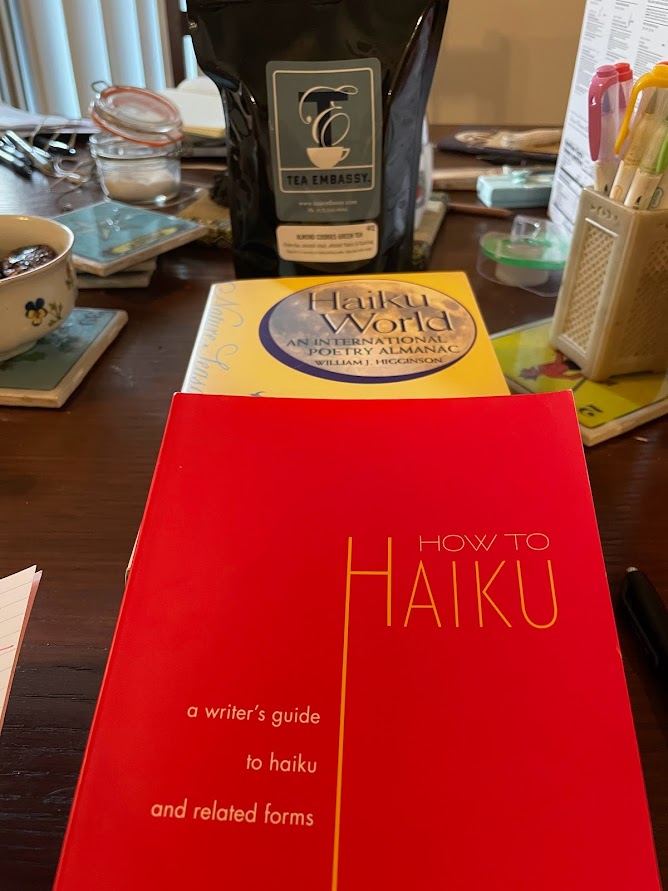
5. Work with a saijiki (a compendium of kigo), picking one word a day to start as a jumping-off point. My favorite is William J. Higginson’s Haiku World: An International Poetry Almanac. However, it’s out of print and copies can be expensive. I am also a fan of Jane Reichhold’s A Dictionary of Haiku, available as a free PDF from the Haiku Foundation.
6. Commit to a revision streak. Often, we get focused on generating new work and don’t devote as much time to revision. Consider taking a few weeks off from writing new poems (unless you get struck with divine inspiration, of course!) and focus on daily revision of existing work.
7. Spend a chunk of time every day observing your environment: sunrise and sunset, traffic patterns (they can be seasonal!), the emergence of plants, the clothes that people wear. Start to develop your own personal saijiki related to the area where you live.
8. We often overlook the sense of smell in our writing. Try spending a week writing down every scent you encounter as you go about daily life. Use your scent list as a springboard for your haiku, senryu, and other forms.
9. Join forces with a haiku friend or a small group and write some renku, rengay, or split sequences. If you don’t have a writing buddy in your area, you can write via email, online chat, text message, or Zoom.
10. Participate in a ginkgo (haiku walk). If you don’t have a group in your area to walk with, you can have a solitary ginkgo. (Or maybe start a ginkgo group in your area!) You can learn more about ginkgo practice in the article “Haiku as a Nature Connection Practice” from seasonwords.com.
11. Make a small chapbook as a birthday or holiday gift for a loved one, especially if you have a number of haiku/senryu written about them and experiences you have shared.
12. Take a poetic risk this year: submit to a journal or contest that feels out of reach, self-publish a collection, give a public reading, or start a podcast. Maybe launch a print-on-demand store of postcards featuring your haiga. Whatever is calling to you but seems scary, give it a shot.
Which of these ideas will you try this year? Let me know! And be sure to check back in to tell me about your experience.
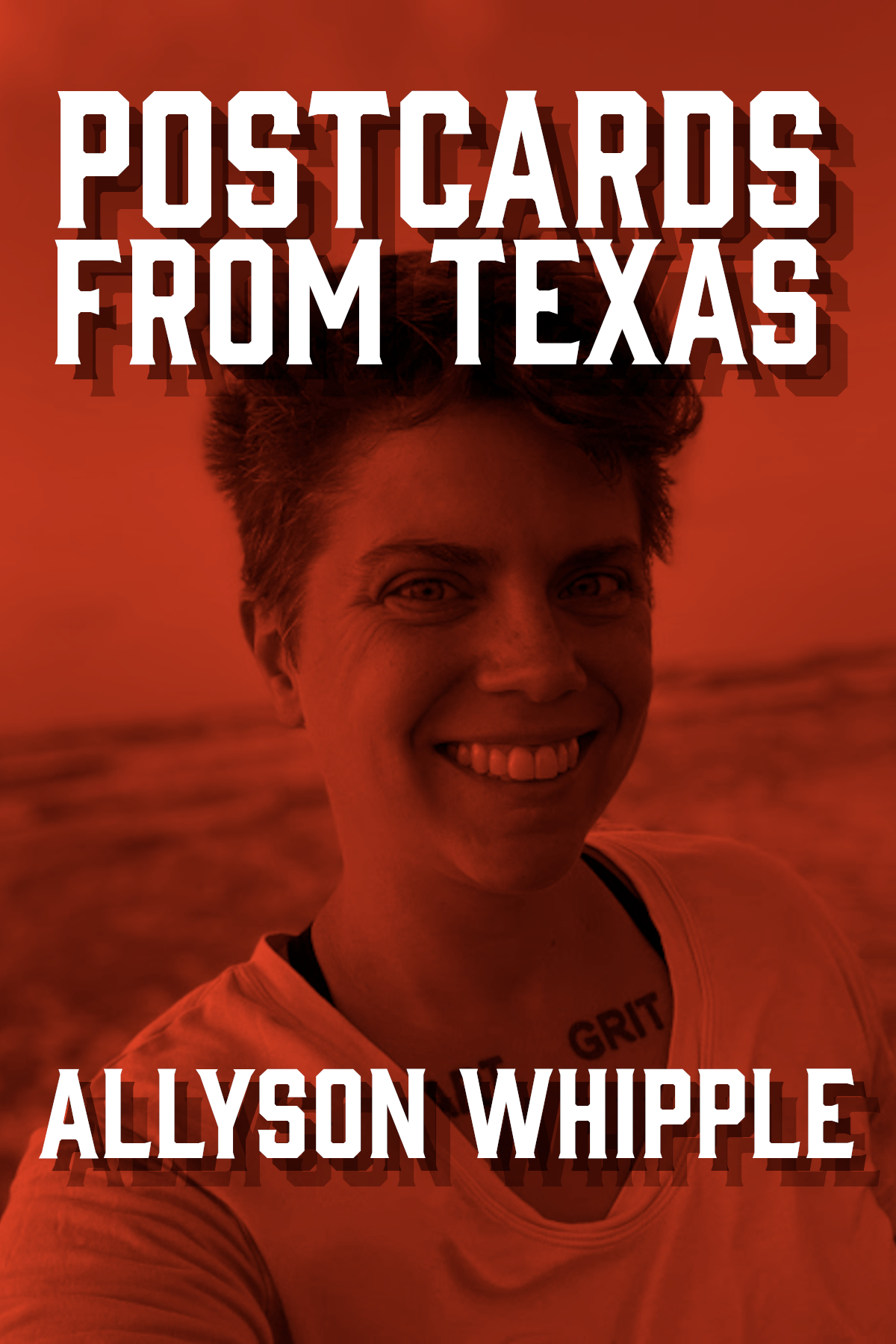
I’m thrilled to announce the forthcoming publication of my third poetry chapbook, Postcards from Texas, now available for preorder from Cuttlefish Books. This chapbook is my first that is devoted exclusively to haiku, and represents the shift in my creative focus since 2020. You can find the preorder link here: https://cuttlefishbooks.wixsite.com/home/2023-summer-book-launch.
The haiku in Postcards from Texas were mostly written in the second half of 2021 and the first half of 2022, the last 12 months I spent living in Austin. A few are older, going as far back as 2018. They were composed on hikes and camping trips, as well as dog walks around the city and picnics in local parks. My haiku address the changing political and physical landscape of a place I lived in, and deeply loved, for 15 years.
I’ve now lived in Missouri for just over a year. I adore the city of St. Louis, I finally found a job I could enjoy, and there are gorgeous landscapes throughout the state. The past year has also been one of grief for a place I still adore with all my heart, a place I thought I’d live until I died. Putting this chapbook together this past spring was a way to find some resolution of those emotions surrounding my move.
Postcards from Texas contains another form of grief as well. In 2015, I reconnected with my maternal grandfather for the first time in 20 years. (The reasons for that separation are complicated, and I have become wary of making family history public.) John and I are avid hikers, and I began sending my grandfather postcards from our hikes and camping trips all over Texas. He loved seeing the places we went. Four and a half years after my grandfather came back into my life, the universe took him from me again. He didn’t die of COVID, but I believe that he was a secondary casualty of the havoc the virus created around the world. There is no way to know fore sure, but I believe that if COVID hadn’t cause so many other problems, he’d still be here. I still feel sad that we didn’t get more time, and heartbroken that COVID protocols kept me from seeing him or even attending his funeral.
Postcards from Texas is dedicated to my maternal grandfather, as well as all the other people I lost my last few years in Texas (all but one of them died before COVID). Putting this book together was a way to continue writing postcards could no longer go to their intended recipient. It’s not just a farewell to a place I loved; it’s a reckoning of the loss that I feel should never have happened when it did.
Not only am I excited to be publishing a book, but I’m thrilled to be in the company of Lenard D. Moore and Julie Bloss Kelsey, the other two Cuttlefish authors included in the summer catalog. While you can preorder my book individually, I encourage you to get the bundle of all three authors. Lenard D. Moore is someone I consider a contemporary haiku master, with an incredible attention to detail. Julie Bloss Kelsey presents a compelling and humorous look at adolescence and the transition into adulthood, all in the short haiku form.
(Note: As of this writing, the preorder site is having some issues on mobile browsers. It’s easier to order from the desktop version of the site. If you are trying to order from a mobile browser and running into issues, email me or send me a DM on Instagram, and I’ll help you out.)
As they say in the current parlance, it’s been a minute. Last summer, after the writing intensive I was part of wrapped up, I just felt a need to stop. Stop pushing, stop trying so hard. Just be quiet and see what happens.
And quite a bit happened. I earned my Level 1 comprehensive teacher certification from Peak Pilates. In the interest of diversifying my skill set, I also got a certification from POP Pilates. (So much for doing less . . .) In February, I started teaching Pilates part-time on the regular. And the biggest change is that my partner and I decided to leave Austin and move to St. Louis, Missouri. As of this writing, I’ll only be in town for about six more weeks, and I’m doing my best to soak up everything I love about Texas.
While I was excited to focus on my movement practice after spending so much time on writing, and while I am also looking forward to a new city, my poetry life had gotten a little stagnant. I was still writing, submitting, and publishing haiku, and became an active member of the Austin Haiku Study Group. But I was looking for more.
About a month ago, my waiting paid off. I got the idea for a new project: The Culinary Saijiki. As most people who read this blog probably know, I’m a big fan of food (eating more so than cooking). I’m also interested in the ways in which English-language haiku practitioners approach the seasons in their haiku practice. I realized that food is one way in which people can connect to the seasons, and decided I wanted to go deeper into exploring that connection. I launched the first blog post earlier in April. (I planned to announce it here that same week, but hey . . . I’m moving and wrapping up the semester. Things are a bit hectic.)
In addition to the blog, I’ve also decided to start a companion podcast, where I talk to haiku practitioners about the ways in which food shows up in their work. I’m already in the process of sorting out my first guests, but I’d love to hear from the rest of the haiku community. If you are a haiku poet, or know a haiku poet, who might like to have a conversation with me, the Join the Conversation page has the information you need to get started. The podcast launches in June, and I’d love to have a few conversations recorded in advance so I can sustain momentum in the midst of my big move.
I’m excited for this new facet of my creative life. I still prefer to keep this site more general, so I’ll only crosspost when I have major announcements. If you want to stay updated, head over to The Culinary Saijikiand subscribe!
“Do you always watch for the longest day of the year and then miss it? I always watch for the longest day of the year and then miss it.”
Daisy Buchanan, The Great Gatsby by F. Scott Fitzgerald
Let’s try not to miss the summer solstice this year! In honor of the official transition into summer, write a poem on the theme of daylight. Let your poem span at least one entire page.
Email your poem to allyson@allysonwhipple.com by 11:59 pm on June 20th (the summer solstice!). The winner will receive a gift certificate to the independent bookstore of their choice, or I will make a donation in their honor to a nonprofit.
My poetry contest continues to bring amazing poetry entries from an international audience! I truly never thought I’d be getting responses from other continents.
This month, the winning poem comes from Medha Goel, a poet living in India. Medha posts short poems under the instagram handle of @whyj_st.
Even with pandemic restrictions loosening, I’m still inclined to take precautions regarding large events. Most of the poets I know are still hosting readings online, and I’m not about to be the first one to push the status quo. But now that the spring semester is over, I’m getting that usual burst of creative energy, and I wanted to host an event. It’s definitely been a while.
I also wanted to collaborate with Zoe Fay-Stindt again. We edited the 2020 Texas Poetry Calendar together, and since then she’s spent time in Europe, and then returned to the USA to pursue her MFA at Iowa State University. When the idea for a virtual poetry road trip between Texas and Iowa popped into my head, I immediately messaged her, and then, it was on!
The Virtual Poetry Road Trip takes place on Friday, May 21st from 6:00-7:30 pm CST. This event is by donation, and you can still join even if you can’t contribute financially. We’re asking all attendees to register via Eventbrite. If you are unable to make a donation and have trouble registering, please contact me directly! We will work it out!
If you want to know more about our featured poets, read on! Otherwise, head over to our Eventbrite page to attend. And bring your own road trip snacks! (I’ll have two kinds of potato chips.)
Featured Poets Cindy Huyser’s (TX) poems have received Best of the Net and Pushcart Prize nominations, and appear in many journals and anthologies. Her chapbook, Burning Number Five: Power Plant Poems, was co-winner of the 2014 Blue Horse Press Poetry Chapbook Contest, and her first full-length collection, Cartography, is forthcoming from 3: A Taos Press. She has edited or co-edited a number of anthologies, including Bearing the Mask: Southwestern Persona Poems (Dos Gatos Press, 2016) and several editions of the Texas Poetry Calendar. Cindy has been a juried performer for the Houston Poetry Fest, Houston’s Public Poetry series, and the Scissortail Creative Writing Festival, and lives in Austin, Texas, where she hosts the monthly BookWoman 2nd Thursday Poetry Reading and Open Mic series.
Ken Hada (OK) lives in rural Pottawatomie County in Oklahoma. He has published eight volumes of poetry, including his latest, Sunlight & Cedar (VACPoetry, 2020). Ken’s poems have been featured on The Writer’s Almanac, and his work has been awarded by The Western Writers of America, The National Western Heritage Museum, SCMLA and The Oklahoma Center for the Book. Information available at kenhada.org.
Dottie Joslyn (MO) is a writer and poet living in Southwest Missouri. She is a retired Certified Applied Poetry Facilitator in the field of Poetry Therapy, Certified Journal Facilitator, and Journal to the Self® Instructor. Her poems have appeared in: American Tanka, Buffalo Bones, Poetry from the Trail Ridge Writers, Wellness & Writing Connections Newsletter, Beginning Again: Creative Responses to Poetry of Presence, and Gyroscope Review. She also has a poetry book, Just Show Up, published in late 2018. Her website, http://www.joslynpoems.com has more information and includes an interactive blog.
Jennifer L. Knox’s (IA) sixth book of poems, Crushing It, was published by Copper Canyon Press in 2020. Publisher’s Weekly’s review called Crushing It, “Darkly inventive…This is a careful, thoughtful book about the complexities of identity and the difficulty of words.” Knox’s poems have been published in The New Yorker, The American Poetry Review, Granta, McSweeney’s,five times in the Best American Poetry series, and the 2022 Pushcart Prize: Best of the Small Presses anthology. Her nonfiction writing has appeared in The New York Times and The Washington Post. She received an Iowa Arts Council Fellowship for her crowdsourced poetry project, Iowa Bird of Mouth. Over 750 people from around the world contributed to the project; the code is open source and free to use in noncommercial projects.
Laura Van Prooyen’s new collection, Frances of the Wider Field
I met Laura Van Prooyen at Poetry at Round Top when she was promoting Our House Was on Fire. I still remember seeing her cast in the warm stage lights of the Round Top concert hall, reading these poems about uncertainty, illness, and motherhood. Her new collection, Frances of the Wider Field, was released in March. While I was sad that we couldn’t celebrate her new release in person at Round Top this year, I did enjoy the online workshop I took with her in the online version of the festival. I’m excited to share this interview that we conducted via email over the past few months, while dealing with the Texas freeze, teaching duties, family responsibilities, and the work that goes into a book launch. That we wrote our questions and responses amidst the hustle and bustle of daily life reflects something that I admire about Laura’s poetry: our other work, our obligations, do not take us away from poetry. They are the stuff of which poetry is made.
[AW] My favorite lines in “Against Nostalgia” are “What defines me is constancy of place, / and my urge against it.” Like you, I’m from the Midwest, and have made a life in Texas. I find that the longer I am away from Ohio, the more the tension of being a native of one place but choosing to live in another comes through with more intensity in my poems. Has being of a particular place but then making your life in another place influenced your poetry in a particular way?
[LVP] Thanks for this question. It is hard to be away from home, but when I visit my parents it is also hard. So, yes, that inherent paradox informs my poems. I grew up in a house my grandfather literally built. I never met him, but I have a picture of him with a crew digging the basement. My grandmother lived next door to us, and my great-grandmother next to her. My mom has never moved in her life. She’s still there now, at 81 years old and with dementia. Our roots are deep. I opted for sun, warmth, and new experiences, a choice I don’t regret but wrestle with all the same. I feel torn a lot, wishing to be in multiple locations at once. That tension fuels a lot of the poems in Frances of the Wider Field.
As I read through Frances of the Wider Field, I think of my own grandmothers, one who died suddenly 30 years ago, and one who died 17 years ago from Parkinson’s. I often feel that I never really got to know them, and that is its own kind of grief. I see your poems as a way to stay in conversation with people you cannot converse with anymore, at least not in the way you once did. Do you feel there is something special about poetry as a genre that allows for these conversations to happen?
I hadn’t really thought about it like this before, but yes. Poetry allows for all kinds of unexpected turns as opposed to, say, a mode that has some expectation of linearity. It seems to me that poems are not only a way to stay in conversation with people we can no longer access, but that writing into the unknown allows us to converse with mysteries. The Frances poems originated with that energy, of being open to conversations with people I never met, with places that existed before me, with lineage, with ghosts, with concepts of god. The energy was at first an impulse to write toward a very specific absence, but the poems turned into presence–Frances began permeating the landscape, the dailiness of past, present and maybe even future. I’m interested in the continuum of time and memory and how we move long through different planes of experience, sometimes all at once.
Speaking of lineage, I love the ways in which that theme shows up in this collection. One of my fascinations is with the idea of a writer’s lineage, and the ways in which creative lineage can be expansive. We have our family lineage, and we also have the poets/writers we read over and over. We have the teachers that have taught us about craft, or form, or topics that had nothing to do with writing, but nonetheless had a profound influence. Anne Sexton and Natalie Goldberg are part of my creative lineage; so are the Austin poets who have been both mentors and friends over the past 13 years. Finally, that list includes my 9th grade geography teacher (who taught kindness as much as she taught geography), my aunt, and my grandmothers. How do you trace your own creative lineage? What are the different threads or spokes that have come together to help make you the poet that you are today?
One pivotal moment in my life was my first semester at the university. I was a first generation college student. My first semester I took a seminar called “Creating Selves.” I have no idea if we had choices for these seminars, but somehow I lucked into this class taught by a professor who had us read Rainer Maria Rilke’s Letters to a Young Poet, Maxine Hong Kingston’s The Woman Warrior, Dag Hammarskjöld’s Markings, and Helen Hanff’s 84 Charing Cross Road. She required that we keep a journal, a mix of personal insights mixed with responses to the texts. I have been keeping a journal since that class, since I was 18 years old. I still have my marked up copy of Letters to a Young Poet, and I’m actually still in touch with that professor. She came to my virtual book release just last week. I hold close poems from Louise Gluck, Larry Levis, Brigit Pegeen Kelly, Vievee Francis, John Donne, Adelia Prado and Olena Kalytiak Davis among many others, too. I’m also a fan of Lynda Barry. I wanted to be a visual artist before I ever thought about being a writer. I suppose there’s still time.
I love the way you depict work in these poems, specifically, the work Frances performs. “Avenue F” is the most striking example: the work of wringing and hanging laundry, of polishing the baby’s shoes. In “Lilacs Full of Bees,” Frances has cleaned gutters, polished the car, and soaked her feet after a long day. I’d love to hear more about your approach to depicting those daily tasks. Did you have a specific approach to incorporating them? I think some poets are hesitant to bring dailiness into their poems because they worry it comes across as boring. How did you incorporate Frances’ daily, domestic work in a way that made the poems come alive?
It’s wonderful to hear that for you the poems came alive. Dailiness is life. I’m interested in specificity, and if I had a particular approach, I suppose it was to write toward the specifics. I also had to make choices. I had ideas and things popping up, like polishing the car and cleaning the white walled tires with a toothbrush. Not every daily task made the final cut. When I really get into revision, I read my work aloud. What stays is what sounds right. As in, sonically. I ask myself (consciously or intuitively) how the sounds of words play off each other, how can the poem create a sonic landscape that works in relation to the details.
Finally, is there anything you never get asked about your work that you’ve always wanted to talk about?
I love your final question, but I cannot think of anything in particular that I’ve never been asked. I love talking about the creative process and hearing from other makers what they do, what they’re reading, what art they’ve seen or music they’d listened to. I like to talk to people who are curious, because staying curious feels right to me. Learning new things. Being open. That’s part of the work.
Laura Van Prooyen
Thanks to Laura for participating in this interview. I hope you enjoyed learning more about this engaging collection. You can buy Frances of the Wider Field from Laura’s website (the most direct way to help a poet get paid!), Lily Poetry Review Books, Bookshop.org, major book retailers, or your local independent bookstore.