In Gratitude Thank you to our anonymous donor who bought me a total of six coffees in August! I’m now 20% of the way toward my goal of covering website costs for the year. Those who want to support the podcast financially can do so at: https://www.buymeacoffee.com/culinarysaijiki/.
Join the Conversation I’m seeking guests for October, November, and December! If you’d like to be on the podcast, visit https://culinarysaijiki.com/join-the-conversation/ and fill out the form. My life is a little hectic right now, so if I don’t follow up in a timely manner, send me a reminder.
Theme Music “J’attendrai” by Django Reinhardt, performing at Cleveland Music Hall, 1939. This recording is in the public domain. Hear the whole song at https://clevelandhistorical.org/files/show/6045.
In Gratitude Thank you to our anonymous donor who bought me three coffees this month! I’m now 20% of the way toward my goal of covering website costs for the year. Those who want to support the podcast financially can do so at: https://www.buymeacoffee.com/culinarysaijiki/.
Join the Conversation If you’d like to be on the podcast, visit https://culinarysaijiki.com/join-the-conversation/ and fill out the form. My life is a little hectic right now, so if I don’t follow up in a timely manner, send me a reminder.
Theme Music “J’attendrai” by Django Reinhardt, performing at Cleveland Music Hall, 1939. This recording is in the public domain. Hear the whole song at https://clevelandhistorical.org/files/show/6045.
In Gratitude Thank you to our anonymous donor who bought me three coffees this month! I’m now 13% of the way toward my goal of covering website costs for the year. Those who want to support the podcast financially can do so at: https://www.buymeacoffee.com/culinarysaijiki/.
August Open Mic Bonus Episode To participate in the August 30th open mic bonus episode, click this link: https://anchor.fm/culinarysaijiki/message. Recordings must be received by Friday, August 28th at 11:59 pm CST.
Guidelines:
Each poet is limited to two haiku
Before reading your haiku, please say your name or pen name and, if comfortable, where you’re writing from
Please read each haiku twice
Haiku should mention food, and connect to the transitional aspect of seasons, with an emphasis on autumn
Submissions that do not follow these guidelines will be disqualified
Join the Conversation If you’d like to be on the podcast, visit https://culinarysaijiki.com/join-the-conversation/ and fill out the form. My life is a little hectic right now, so if I don’t follow up in a timely manner, send me a reminder.
Theme Music “J’attendrai” by Django Reinhardt, performing at Cleveland Music Hall, 1939. This recording is in the public domain. Hear the whole song at https://clevelandhistorical.org/files/show/6045.
When planning this project, I decided that I would publish posts and podcast episodes on Tuesdays. Since there’s a fifth Tuesday in August, that means an extra week for content. When there was a bonus Tuesday back in May, I did a blog post in which I published community submissions around a theme. For August, I want to do a bonus podcast, again featuring community recordings.
To participate in the open mic, click the link to my Anchor voicemail box: https://anchor.fm/culinarysaijiki/message. Record your haiku according to the guidelines below. If you run into any trouble, please contact me! I want to help you record your haiku and be part of the episode. The submission deadline is Saturday, August 28th at 11:59 pm CST.
Guidelines:
Each poet is limited to two haiku
Before reading your haiku, please say your name or pen name and, if comfortable, where you’re writing from
Please read each haiku twice
Haiku should mention food, and connect to the transitional aspect of seasons, with an emphasis on autumn
Submissions that do not follow these guidelines will be disqualified
Before reading your haiku, please say your name or pen name and, if comfortable, where you’re writing from
Please read each haiku twice
Haiku should mention food, and connect to the transitional aspect of seasons, with an emphasis on autumn
Submissions that do not follow these guidelines will be disqualified
In Gratitude Thanks to the anonymous doner who bought me three coffees this weekend! They donated after I sent the podcast to be mixed and edited, so I couldn’t thank them at the top of the episode, but I will for the next one!
I forgot to mention in the intro, but this month, project supporters will get a recipe for Christine’s Mango Trio Pie.
On the blog Visit https://culinarysaijiki.com/ for long-form essays and commentary on food haiku. The most recent post is about debatable food season words. Please join the conversation and offer your insight!
Join the conversation I’m excited about the requests coming in to join the podcast! If you want to record a conversation, go to the form on the website: https://culinarysaijiki.com/join-the-conversation/
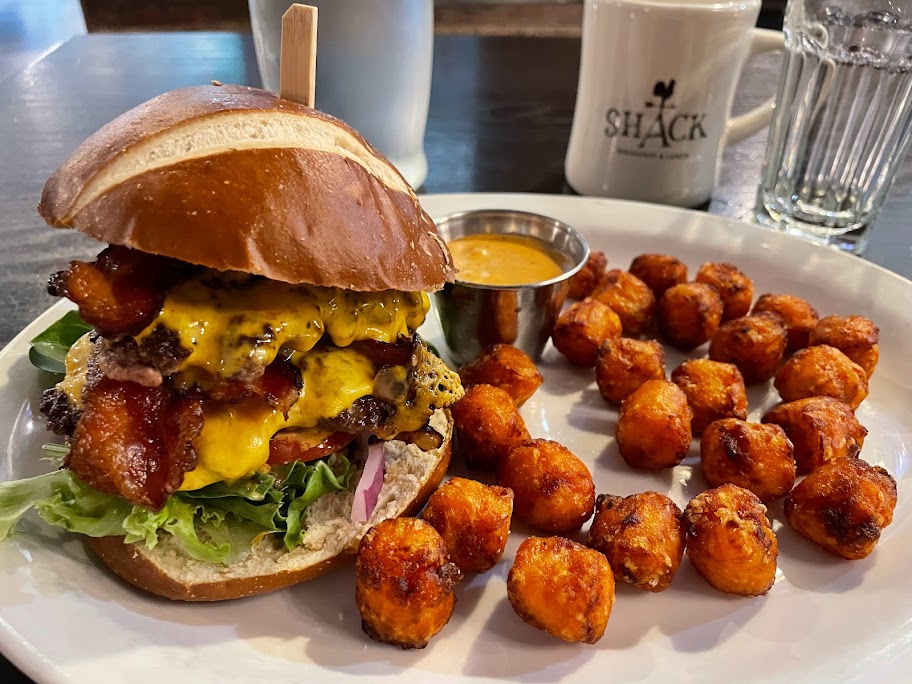
A burger and sweet potato tater tots from The Shack restaurant
In my penultimate Austin recording, I sat down with Claire Vogel Camargo at her home in Austin, Texas. We met after my final meeting with the Austin Haiku Study group. Claire and I talked at length about how food connects us to family, and her haiku brought up memories that led to fund stories and digressions. I hope you enjoy our rambling, free-form conversation.
I need help with sound editing for episode 4! If you know of any sound editors who have room in their schedules, please send them my way!
I would like a dedicated theme song and transition sound for the podcast. If you know of anyone who would like to compose, please let me know. Or, if you know how to navigate the overwhelming amount of public domain content and want to help, reach out!
Note: The theme music and transitions have changed because the ones I was using from my hosting service are suddenly no longer available. I discovered this at the proverbial 11th hour, so had to make do with new stock sounds. Hopefully that didn’t cause too much confusion. If you know of anyone who enjoys writing music and cues for podcasts, please let me know!
Welcome to the first episode of The Culinary Saijiki podcast! I talk with Agnes Eva Savich, leader of the Austin Haiku Study Group (among other things) about eight of her haiku. Along the way, we discuss holidays, motherhood, fruit, and the fun of Haiku North America conferences.
First, thanks to Pamela Pfautsch for buying me a coffee and supporting The Culinary Saijiki. I appreciate that people I haven’t (yet) met in person are as excited about the project as I am.
This bonus post features haiku and related forms from community readers. Thanks to everyone who sent me their work. I had fun reading it, and I plan to do more of these in the future. Look for announcements of future bonus posts in August and November.
I was also excited to have poems from across the world! I love to eat cuisines from all over (I think Korean food is my favorite . . . but it’s a tough call!), and am glad to be able to represent different traditions here.
Oche Akor brings us two spring haiku. While I admit that they didn’t quite touch on the holiday aspect of the prompt, I still wanted to include these two in the post because I loved them so much. (I’ve been known to be a stickler as an editor, but a poem that surprises or intrigues me can override that tendency.)
This first haiku resonated with me because I’ve had weevils infest flour and rice . . . but also am in a position where, though the waste is lamentable, I can toss out the tainted food. This haiku is a compelling reminder that not everyone has that option.
spring breeze the taste of weevils in my beans . . .
Oche Akor, Lokoja, Kogi State, Nigeria
While the spring planting season isn’t specifically a holiday, there are traditions and cultures where it’s a festive time. Planting of crops is an investment in the future, a hope for a bountiful harvest in the fall. I feel the poem below contains a sense of wariness, which, given the state of agriculture around the world, certainly makes sense. These days, it seems natural to temper optimism with something else.
corn planting . . . footprints in the sand Going nowhere
Hwaro gives us two haiku that celebrate sharing food. During COVID, my partner and I have gotten into the habit of going on picnics. It’s a way to enjoy good food outdoors, and at a distance. Hwaro’s first haiku reminded me of our picnic dates. (Also, tteokbokki is one of my most favorite foods. As I type, I’m wishing I had some!)
Gimbap roll for each Tteokbokki to pique the tongue and enjoy the spring breeze
Hwaro, Coquitlam, British Columbia, Canada
While the haiku below doesn’t explicitly mention Father’s Day, I felt a strong connection with that particular holiday. Sometimes, it feels like there’s no way to fully honor your parents and all they have done for you. Yet the act of sharing a meal together, and being totally present, can sometimes be enough.
Father, I’ve got nothing to offer you shall we share jjajangmeyon?
Pamela Pfautsch brings us a tanka-style poem that made me think of all the delightful treats that emerge in summer. Whether enjoying a cold ice cream on a hot day, or the natural sweetness of fresh berries, cherries, and peaches, summer is a season full of sweetness. Haiku Haven captures the lushness of a berry bush, or the dessert spread at a picnic.
A breezy wisp Of honeycomb sighs Whoosh of treats Flutter on honeybee wings Summer’s sweet begins.
I admit that I can’t resist a good pun, and Peter Schmidt made me laugh with this haiku. Peter packs a great deal of imagery into this small poem, and the picture of fudge and melting ice cream merging makes me think about the ways in which long, hot summer days can melt into each other, with time slowing down in the heat.
Chocolate Sunday Hot fudge sun melts ice cream breeze Scoop of May in June
Geoff Pope offers this haiku with a bit of mystical quality to it. I love coconut soup, and there are many variations; they can range from creamy white to orange or green, depending on the other ingredients. In Geoff’s poem, I picture a moon-white bowl of soup, enjoyed at night at a solstice festival. The bowl has a bit of glow to it, maybe from outdoor lights, or maybe from something a little more magical. I like the idea of being able to eat moonlight, and Geoff’s poem makes that feel like a possibility.
Robert Epstein was the first person to send haiku for this bonus post! These haiku invoke the delights of family. In fact, in my acceptance letter to Robert, I noted that the child in the monoku below could easily be my nephew! The word “river” invokes water, so I picture a blue-raspberry Popsicle running in rivulets, dripping onto the lawn below.
that river of popsicle down the bare-chested toddler
Robert Epstein, El Cerrito, CA, USA
While the she in this poem isn’t necessarily a child, I picture a young girl here, someone young enough to not care what someone might think about her spitting watermelon seeds on the ground. I think a child would also find it amusing to time their spitting with the show. When I read the following haiku, I can’t help but think of a girl making extra fun for herself on a summer night.
watermelon seeds— she spits them out in concert with the fireworks
Robert Epstein, El Cerrito, CA, USA
While Robert’s last haiku is based in memory and written from the perspective of adulthood, the wonder of childhood runs through in this haiku. Maybe the children didn’t appreciate the efforts at the time, but as an adult, you could feel a sense of reverence for the way in which your mother took the time to cut small pieces of cool melon on a hot day.
the simple way she cut into small pieces the cantaloupe for us
~ in memory of my mother
Robert Epstein, El Cerrito, CA, USA Originally published in The Helping Hand Haiku Anthology, ed. Robert Epstein, 2020
Mary Stevens brings multisensory haiku that to me capture the quotidian essence of summer. In her first haiku, I picture someone sitting out on a porch in the evening, as the air cools down. Maybe the neighbors are cooking, maybe they’re eating, maybe they’re even arguing. You can probably hear them because the windows are open. This haiku makes me think about how everything seems open and permeable in summer (at least when it’s not so hot you have to lock yourself in with the air conditioner).
summer evening the neighbors’ kitchen sounds
Mary Stevens, Hurley, NY, USA Originally published in Upstate Dim Sum, 2021
Even though this poem also doesn’t name a specific holiday, the way the middle line serves as a linchpin for the first and second lines makes me want to read it over and over. This haiku not only makes me think of eating an antipasto platter on a warm evening (one of my favorite summer dinners), but it’s packed with sensuality despite being only eight words long.
pitting an olive in my mouth his name
Mary Stevens, Hurley, NY, USA Original published in Modern Haiku 50.3, 2019
Mary’s final haiku incorporates music. This poem reminds me of the ways in which ice cream truck music can be jarring. Sometimes it’s one consistent tune, but other trucks will cycle through a variety of tinny renditions of old songs. The music gets stronger as the truck approaches, but then after the ice cream is purchased, the music fades away, just as summer fades into fall.
summer’s end the counterpoint melody of the ice cream truck
Mary Stevens, Hurley, NY, USA Originally published in The Heron’s Nest XXII, Number 4, 2020
Thanks again to everyone who sent work for this bonus issue! In June, I’ll wrap up my series on initial observations about food and haiku. Also, be on the lookout for the podcast launch on June 21st!
All members of the haiku community are invited to submit poems for an upcoming Culinary Saijiki bonus post. I want to showcase haiku that incorporate food and are also focused on the topic of late spring or early summer holidays. Examples of holidays include Labour Day (International), Mother’s Day (International), Memorial Day (United States), or religious holidays. There are plenty of others to pick from as well!
While my writing on this blog is designed to be more analytical, as someone who has worked as an editor for a variety of literary publications, I love providing venues for poets to showcase their work. Since we have an extra Tuesday in May, I thought that would be a good time to do a themed community showcase.