Category: community

  • The Best of It: Late May Edition

    The Best of It: Late May Edition

    1. Being honored with a 2025 Soulard Star award at this year’s membership party.
    2. The success of this year’s rummage sale.
    3. It’s iced tea season.
    4. The Roaring exhibition currently running at the St. Louis Art Museum.
    5. Getting to show Texas friends around the neighborhood.
  • Haiku Girl Summer is taking submissions!

    Haiku Girl Summer is taking submissions!

    Haiku Girl Summer is officially open for submissions! The window is a little shorter this year; submissions are now only open until August 15th. However, that’s still 3 solid months to get work in, and you can submit up to 3 times during the cycle.

    Please submit 3-5 haiku or senryu using the form here: https://forms.gle/foXpvuaS19jHcyaR8

    I’m also excited to have the following guest editors lined up:

    • Jessica Allyson
    • Kathryn Haydon
    • Jennifer Gurney
    • Lakshmi Iyer
    • Kimberly Kuchar
    • Lorraine A Padden
    • Kelly Sargent
    • Vidya Shankar
    • C.X. Turner
    • Caroline Wermuth
    • Katherine E. Winnick

    2025 guidelines are available here: https://haikugirlsummer.substack.com/p/submission-information. I’ve just made a few changes, mostly on the housekeeping side. Please note the definition of “previously published” for this journal, and also note the AI statement.

    The biggest reminder: poems should not contain the word “summer.” The goal is to convey the season using descriptive language rather than naming it directly.

    I look forward to seeing your 2025 poems!

  • Soulard Haiku Hike on January 25th!

    Soulard Haiku Hike on January 25th!

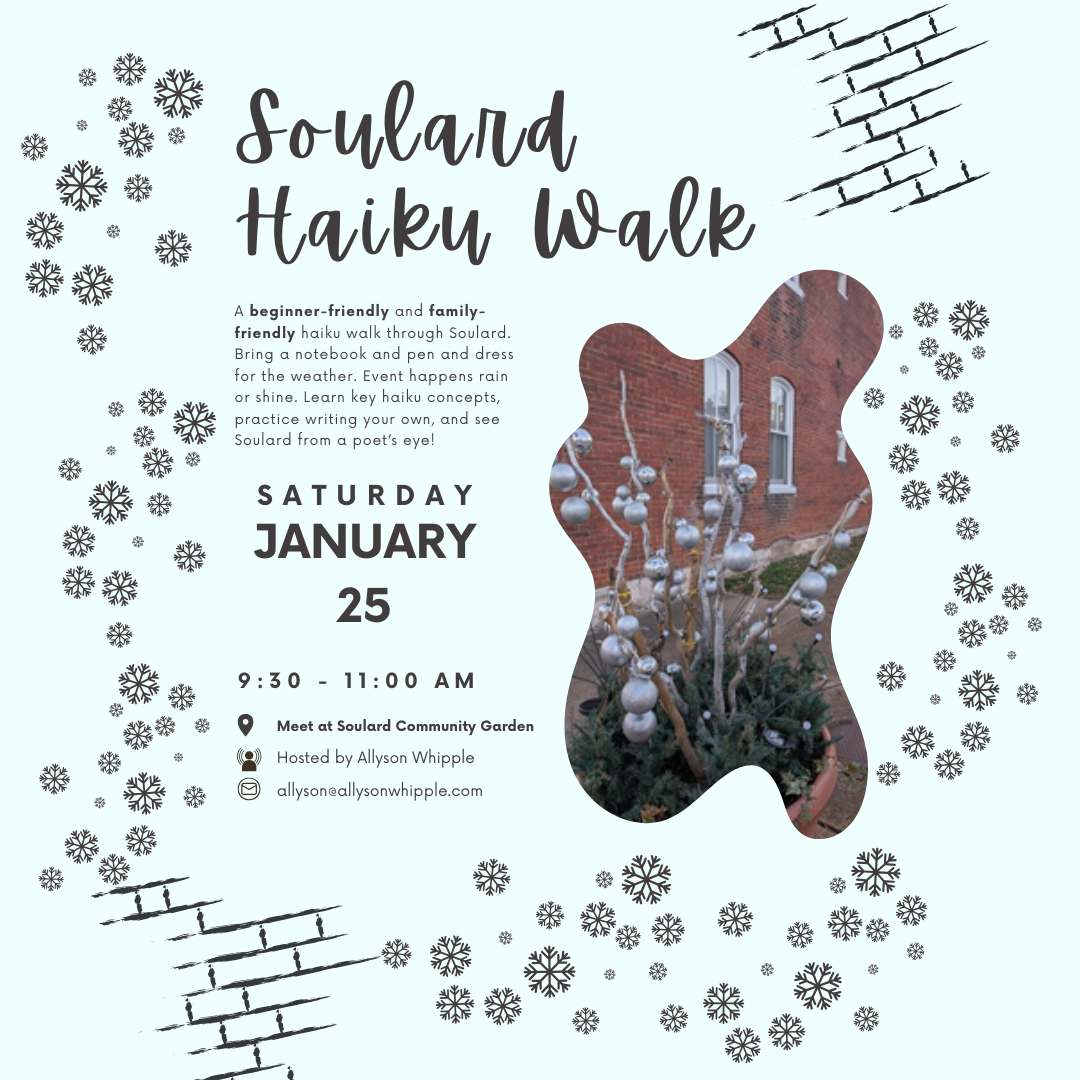
    I’m excited to be hosting another Soulard Haiku Walk this Saturday, January 25th at 9:30 a.m. I know that many of the people who read this blog are not local to St. Louis, but if you know someone in the area who might be interested, feel free to forward them this post.

    The Soulard Haiku Walk is a quarterly series that is beginner- and family-friendly. The aim is to introduce haiku to people who have limited to no knowledge, though experienced haijin are still welcome to attend.

    The walk begins at the Soulard Garden Co-Op, progresses to Pontiac Square Park, and ends at Soulard Market Park. Attendees are free to enjoy the Soulard Market and surrounding restaurants after the event. At each stop on the walk, I’ll give some instruction on haiku as well as a bit of local history. You’ll have plenty of time to write, and the event will end with a Q&A period as well as an optional chance to share your work. (No critique involved.)

    The January hike will provide a review of syllables in English-language haiku and give an introduction to season words (kigo). You can get more details via the Soulard website. If you have any questions, the fastest way to get in touch is email me at allyson[at]allysonwhipple[dot][com].

    I look forward to sharing my love of haiku with you!

  • Midwinter Day Renku: First Notes on a New Form

    Midwinter Day Renku: First Notes on a New Form

    For the past two years, I’ve collaborated with haiku friends on what I call the Midwinter Day Renku. I created this renku variation in response to one of my all-time favorite works of literature, Bernadette Mayer’s epic poem Midwinter Day

    The story behind Midwinter Day is that Mayer composed the entire thing on Friday, December 22nd, 1978, the date of the winter solstice. The title refers to the fact that many older, lunar-based calendars consider the solstice the midpoint of the season rather than the beginning, which is the designation of the astronomical calendar we use today. 

    Midwinter Day is a 100-ish page poem about the day in the life of a young family (Mayer, her husband, and their two children) living in Lenox, Massachusetts. Largely free verse, this poem is highly allusive, contains numerous lists, and frequently incorporates poetic devices such as rhyme. In Midwinter Day, poetry is not separate from parenthood and grocery shopping; it’s intertwined. There is no distinction between art and the rest of life; they are one and the same. 

    Since first reading this poem in 2015, I wanted to create some sort of homage to it. But my attempts to truly imitate Bernadette Mayer fell flat, and didn’t feel true to the way I like to approach my own poetry. Once I went deeper into studying haiku and learned about the various forms of linked verse, I began experimenting with a linked form that I wrote solo throughout the day. But while you can certainly write a renku or other linked form alone, I found I didn’t really enjoy that. I wanted to collaborate. Midwinter Day might have been written by a sole author, and yet she is anything but alone. 

    After a couple of years of noodling around ideas, I finally settled on a shorter version of the renku. I wrote the first one with my friend Claire, a poetry friend from my Austin days. Last year, I tried with a larger group: six people in three time zones emailing back and forth. Tomorrow, I will write the third-ever Midwinter Day renku with my friend Dan, who lives in another country. It’s the first international Midwinter Day renku! I’ve kept it just the two of us because juggling such disparate time zones is going to be a bit of a challenge, and I decided a smaller size would help navigate that. 

    This approach to the form is still a work in progress. Not only do I keep learning more about renku, but I keep wanting to adjust the specifics of the structure itself. I’m already thinking of adjustments I want to make for next year, but I didn’t want to make more changes at the last minute and throw off this year’s game. The parameters for 2024 and 2025 will be different, but that’s just fine. I’m excited to see how this form evolves over the next few years, and look forward to the eventual feeling that I’ve gotten it just right. 

    Poem Structure

    A traditional kasen renku has 36 verses, though shorter variations exist as well. My first renku was an 18-line version because my in-person group didn’t have enough time to do a full 36. 

    The Midwinter Day Renku has only 24 verses. Since the lore behind Midwinter Day is that it was written in the span of a single day, the 24 verses stand for each hour of the day in which it is written. 

    The writing process does not have to span 24 hours (unless you have a lot of energy and ambition), and each verse does not literally have to correspond to a specific hour, either. Just as Midwinter Day is not a literal accounting of hour by hour, this poem should not be a ponderous notation that happened in each block of time. Rather, the decision to use 24 verses is a nod to the time span of the original Midwinter Day epic poem.

    The Season

    A traditional renku incorporates all four seasons, with certain verses assigned a seasonal designation. The Midwinter Day Renku, however, focuses on one season: winter. It’s written on a winter day and influenced by a different winter poem, so invoking additional seasons didn’t feel right. I wanted the whole poem to be fully grounded in the time of year.

    That being said, 2024 is only the third year I’ve tried out this form, and I’m still refining the details. I’m not opposed to potentially putting other seasons in if I get to a point where it feels like the correct choice.

    Topics

    Most renku verses have a designated topic, and that topic is usually a specific season. The only other topic we occasionally see is love. 

    For the first two years, I tried this form, I did not use any topics. Since I’m not changing the season, I just kept every verse open. However, the original Midwinter Day poem is rife with topics that could be fun to use. Not only does the poem detail the events of a young family throughout the day, but it’s rife with cultural and historical allusions, as well as details of the current events at the time it was written.

    This year, I decided to try assigning one topic for each verse. While in a renku some verses have no topic, Midwinter Day is so full of potential topics that I decided to try 24 topics. Again, this is only the third year of working with this form, so that might change in 2025. Right now I’m having fun and seeing what happens with each year’s iteration. 

    Verse Topics (2024 Edition)

    Verse 1: Dreams

    Verse 2: People you know

    Verse 3: Love

    Verse 4: Children

    Verse 5: Cultural allusion

    Verse 6: Memory

    Verse 7: Food

    Verse 8: Current events

    Verse 9: A discovery

    Verse 10: Art

    Verse 11: Incorporate rhyme

    Verse 12: A book title

    Verse 13: A store of some kind

    Verse 14: Walking

    Verse 15: Friendship

    Verse 16: Cooking a meal

    Verse 17: Religion

    Verse 18: Music

    Verse 19: Philosophy

    Verse 20: Reference another poet

    Verse 21: A list

    Verse 22: Science

    Verse 23: Love

    Verse 24: The sun / light  

    Writing Strategies

    While renku were traditionally written in-person at gatherings specifically designed for writing this type of poetry, long-distance renku have been written for a long time. Poets have written them slowly via postal mail, and in the internet era, people compose them via email or messaging apps.

    I think that the Midwinter Day renku is well-suited to writing at a distance. The past two years, I’ve composed via email. This year, I’ll be composing via direct message in the Station of the Metro Haiku Discord. Just as the original Midwinter Day was written throughout the day, in between childcare and errands and the other facets of life, writing long-distance via email or another system allows you to go about your various activities and allow those to drift into the poem. If a verse comes in while you’re in the middle of wrapping gifts or feeding your kids, you can finish what you’re doing before writing the next verse. The things you do throughout your day have the potential to enrich the entire writing process.

    If you want to write in person and you live with people or have friends/family visiting for the holidays, consider leaving a sheet of paper out on a table and come back to it throughout the day. Let the rhythms of your life guide the writing. Let the renku composition take place in those brief moments of pause throughout the day. (But if your life has a tendency to get hectic, maybe set yourself a few phone reminders to go work on it.)

    Of course, if you want to sit down and write with another person in one session, that’s totally fine as well. And you can certainly compose by yourself, either throughout the day or in one shot. My goal in devising this form was to honor the Winter Solstice through one of my favorite poetic forms. 

    Beyond that, the only thing I would recommend is that you create an outline of the verse, topic, and the person who will be writing it. I think that’s especially important when you’re writing long-distance. Although this form is shorter than a standard renku, it’s still possible to get confused or lose your place. Having an outline and plan will help. 

    2022 Poem: The Hidden Sun

    I posted the first-ever Midwinter Day Renku as a Haiku Girl Summer bonus post. If you would like to read what I first wrote with my friend Claire, you can view it here: https://haikugirlsummer.substack.com/p/midwinter-interlude-the-hidden-sun

    Not only was this the first attempt at the form, but I also knew less about renku than I do now. So I hope that those of you who know the form well can overlook the stylistic issues of this novice attempt.

    2023 Poem: Wassailing Within

    Wassailing Within

    A Midwinter Day Renku written by Allyson Whipple (St. Louis, MO), Peter H. Schmidt (Lexington, MA), Eavonka Ettinger (Long Beach, CA), and Claire Vogel Camargo (Austin, TX)

    Thursday, December 21st, 2023

    iceless river
    one prolonged blast
    of a salvage barge                           (AW)

    sideways sleet
    maple javelins spear the earth         (PHS)

    the yearly
    arrival of homemade
    family stollen                                  (EE)

    how the time feels shorter
    between holidays                            (CVC)

    smell of snow due soon
    silent slate blue clouds hover
    soothe my solo heart                       (PHS

    picking oranges from
    the roadside farm stand                  (EE) 

    bare tree branches
    reveal empty nests waiting
    signals of green sprigs                     (CVC)

    finding the long way
    back to the office                            (AW)

    wild parrots
    flying against
    el nino rains                                    (EE) 

    the soup he makes
    for me this cold day                        (CVC) 

    spotted tabby tum
    smiling cat face sleeping
    sun patch on blanket                       (PHS) 

    one last cigarette
    at nightfall                                       (AW)

    moon frost
    the chill in her words
    after the smile                                  (CVC) 

    crunching bubbles
    fists deep in my pockets                 (PHS)

    city walk
    another fruitless
    search for stars                                (AW)

    lightning flashes
    on the darkest night                        (EE)

    dream waked
    slip from bed unnoticed
    drink in Christmas tree glow          (PHS)

    another cup of tea
    to warm me from the inside            (AW)

    all the gifts
    yet to be wrapped
    or bought                                         (EE)                

    the two weeks it takes
    to heal from surgery                        (CVC) 

    one year in
    a stack of moving boxes
    still unpacked                                  (AW)

    glitter spangled envelopes
    piled on the kitchen counter           (PHS)

    magnolia trees
    rethinking landscapes and scents
    to wake to                                       (CVC) 

    wassailing within
    as sirens wail outside                      (EE)

  • Soulard Haiku Walks Launch in October

    Soulard Haiku Walks Launch in October

    I’m thrilled to announce that next month, I’m launching a quarterly ginko (haiku walk) series around the Soulard neighborhood. The first event takes place on Saturday, October 26th at 9:30 a.m. It’s free, family-friendly, and open to anyone in the St. Louis area.

    I’ve wanted to start hosting ginkos in St. Louis for over a year now, but with everything else I have going on, it kept getting pushed to the back burner. Finally, though, I realized I could start hosting them in conjunction with the Soulard Restoration Group Community Involvement & Events Committee.

    Here are my goals for the series:

    1. Provide free haiku education in a digestible format.
    2. Provide space for people to practice writing haiku without worrying about critique or judgment.
    3. Create a family- and beginner-friendly event.
    4. Explore Soulard and learn about its unique history.
    5. Recognize that haiku can be written in any environment, and that urban spaces are just as legitimate haiku spaces as pastoral ones.

    We will meet at the Soulard Community Garden and spend 90 minutes learning about haiku, walking, exploring, and writing. The event concludes at the historic Soulard Market, a great place to explore at the conclusion of events.

    If you have any haikurious friends in the St. Louis area, forward this post along to them!

  • S209: Where I’ve Been and Where I’m Going

    S209: Where I’ve Been and Where I’m Going

    When you perpetually avoid something on your to-do list for months, at some point, you have to take a hard look at why.

    In the case of this podcast and blog, I realized two things:

    1. I have learned so much from podcasting, and had a great time doing it, but at the end of the day, when I have limited time to pursue my creative endeavors, that just wasn’t what I wanted to work on.
    2. Putting out regular blog and podcast content was preventing me from moving forward with putting together a Culinary Saijiki book manuscript.

    Yet while I was always finding reasons to postpone work on this aspect of the project, the fact that it was left unresolved was also keeping me from moving forward.

    While I always struggle to leave things behind (even though I know it’s time), I’ve recorded this short episode today to formally wrap up this phase of the project. In doing so, I make public my commitment to have a draft by the end of the year, and free myself of the unfinished business that was keeping me from delving into the book phase of this project.

    I will always be grateful for the conversations I got to have, for the opportunity to present on this subject at Haiku North America, and for the ways in which the podcast and blog work helped me developed my editorial and aesthetic foci for the book. I can’t wait to see what’s next, and I hope you’re as excited as I am.

    Thank You to all of my podcast guests, including open mic participants. I enjoyed talking about haiku and sharing your work. Our conversations brought fresh insights to this project and propelled me forward.

    Thank You to everyone who bought me a tea (I recently change my Buy Me a Coffee purchase to reflect my love of tea). Your support made a difference in terms of being able to keep this running.

    Keep an eye on this space, the Buy Me a Coffee page, and my personal website for book progress updates. Keeping you in the loop is how I’ll stay accountable to getting a draft done by the end of the year.

  • S2E8: Buson, Translation, and Food Part 2

    S2E8: Buson, Translation, and Food Part 2

    Highlights from Poetry Pea

    I’ve learned a great deal from Patricia’s two-part conversation with Janice Doppler about the concept of zoka in haiku. I think it’s her best workshop yet! Be sure to check it out, so you’ll be ready to submit your haiku when the submission period opens.

    Part 1 link: ⁠https://poetrypea.com/s6e31-zoka-how-to-use-it-in-your-writing-part-1-featuring-janice-doppler/⁠

    Part 2 link: ⁠https://poetrypea.com/s6e32-zoka-part-2-a-tool-for-all-writers-featuring-janice-doppler/⁠

    Postcards from Texas is available now!
    You can buy my new chapbook, Postcards from Texas, one of two ways:

    1. Purchase from Cuttlefish Books at this link: ⁠https://cuttlefishbooks.wixsite.com/home/poetry-series⁠

    2. Email me at allyson@allysonwhipple.com to order a signed copy.

    On the Blog
    A long-form essay about the challenges of reading haiku in translation. Read it here: ⁠⁠https://culinarysaijiki.com/2023/09/06/accepting-the-challenges-of-translation/⁠⁠

    Buy Me a Coffee
    If you would like to make a donation to cover production costs, visit ⁠⁠https://www.buymeacoffee.com/culinarysaijiki⁠⁠

    Join the Conversation
    This season, I am welcoming both podcast guests and guest bloggers. If you’re interested in joining one or both, visit ⁠⁠⁠⁠⁠⁠https://culinarysaijiki.com/join-the-conversation/ ⁠⁠⁠⁠⁠⁠for details.

    Looking Ahead to Season 3
    I’m already preparing for Season 3 of The Culinary Saijiki. I want to create a full 52 weeks of blog posts and podcasts episodes centered around the theme of “Feasts and Festivals.” My goal is to curate a global celebration of food and haiku in 2024, focusing on everything from bombastic national holidays to sacred religious traditions. To do that, I need your help! Start thinking about blog posts or podcast episodes you’d like to create, and be on the looking for full details soon.

    Theme Music
    “J’attendrai” by Django Reinhardt, performing at Cleveland Music Hall, 1939. This recording is in the public domain. Hear the whole song at ⁠⁠⁠⁠⁠https://clevelandhistorical.org/files/show/6045⁠⁠⁠⁠⁠.

  • S2E7: Buson, Translation, and Food Part 1

    S2E7: Buson, Translation, and Food Part 1

    More About Patricia

    Visit the Poetry Pea website to learn more about the podcast and journal: ⁠https://poetrypea.com/⁠

    View Patricia’s contributions to re:Virals and Per Diem for the Haiku Foundation:⁠ https://thehaikufoundation.org/tag/patricia-mcguire/⁠

    Watch Patricia’s 2020 presentation at the Haiku Society of America Conference: ⁠https://youtu.be/QzPHybySDgw?si=IQOf8EtF2DczSbU_⁠

    In Gratitude

    Thanks to Kimberly Kuchar for buying three coffees to support the project. If you want to make a contribution, you can do so here: ⁠https://www.buymeacoffee.com/culinarysaijiki⁠

    On the Blog

    A long-form essay about the challenges of reading haiku in translation. Read it here: ⁠https://culinarysaijiki.com/2023/09/06/accepting-the-challenges-of-translation/⁠

    Join the Conversation

    This season, I am welcoming both podcast guests and guest bloggers. If you’re interested in joining one or both, visit ⁠⁠⁠⁠⁠https://culinarysaijiki.com/join-the-conversation/ ⁠⁠⁠⁠⁠for details.

    Theme Music

    “J’attendrai” by Django Reinhardt, performing at Cleveland Music Hall, 1939. This recording is in the public domain. Hear the whole song at ⁠⁠⁠⁠https://clevelandhistorical.org/files/show/6045⁠⁠⁠⁠.

  • S2E6: Community Open Mic

    S2E6: Community Open Mic

    Thank You, Contributors!

    Not all of this episode’s contributors have a dedicated online presence, so in the interest of fairness, I am not including supplemental links in these show notes. However, I encourage you to seek out these poets in the various print and online haiku journals:

    • Phillip Woodruff
    • Adele Evershed
    • Vandana Parashar
    • Eavonka Ettinger
    • Peter Larsen
    • Kimberly Kuchar

    Thank you again for being willing to share your work, as well as having patience with the technological issues!

    In Gratitude

    Thanks to Pamela P. for buying me a coffee! I appreciate the support. If you want to support this project financially, you can do so at at ⁠⁠⁠⁠https://www.buymeacoffee.com/culinarysaijiki⁠⁠⁠⁠. You can also help by sharing this podcast with anyone who you think might enjoy it.

    Postcards from Texas is available for preorder

    Preorder one, or all three, of the Cuttlefish chapbooks for summer 2023: ⁠⁠⁠https://cuttlefishbooks.wixsite.com/home/2023-summer-book-launch⁠⁠⁠

    If you preorder my book or the entire bundle, send me your address and I’ll mail you a thank-you postcard!

    You can also read my interview with fellow Cuttlefish author Julie Bloss Kelsey at my personal blog: ⁠https://allysonwhipple.com/2023/08/29/chapbook-interview-julie-bloss-kelsey/⁠

    On the Blog

    An overview of Full Moon is Rising: The Lost Haiku of Matsuo Basho and Travel Haiku of Matsuo Basho, a New Rendering, by James David Andrews. Read it here: ⁠https://culinarysaijiki.com/2023/08/23/lost-haiku-authorship-and-translation/⁠

    Join the Conversation

    This season, I am welcoming both podcast guests and guest bloggers. If you’re interested in joining one or both, visit ⁠⁠⁠⁠https://culinarysaijiki.com/join-the-conversation/ ⁠⁠⁠⁠for details.

    Theme Music

    “J’attendrai” by Django Reinhardt, performing at Cleveland Music Hall, 1939. This recording is in the public domain. Hear the whole song at ⁠⁠⁠https://clevelandhistorical.org/files/show/6045⁠⁠⁠.

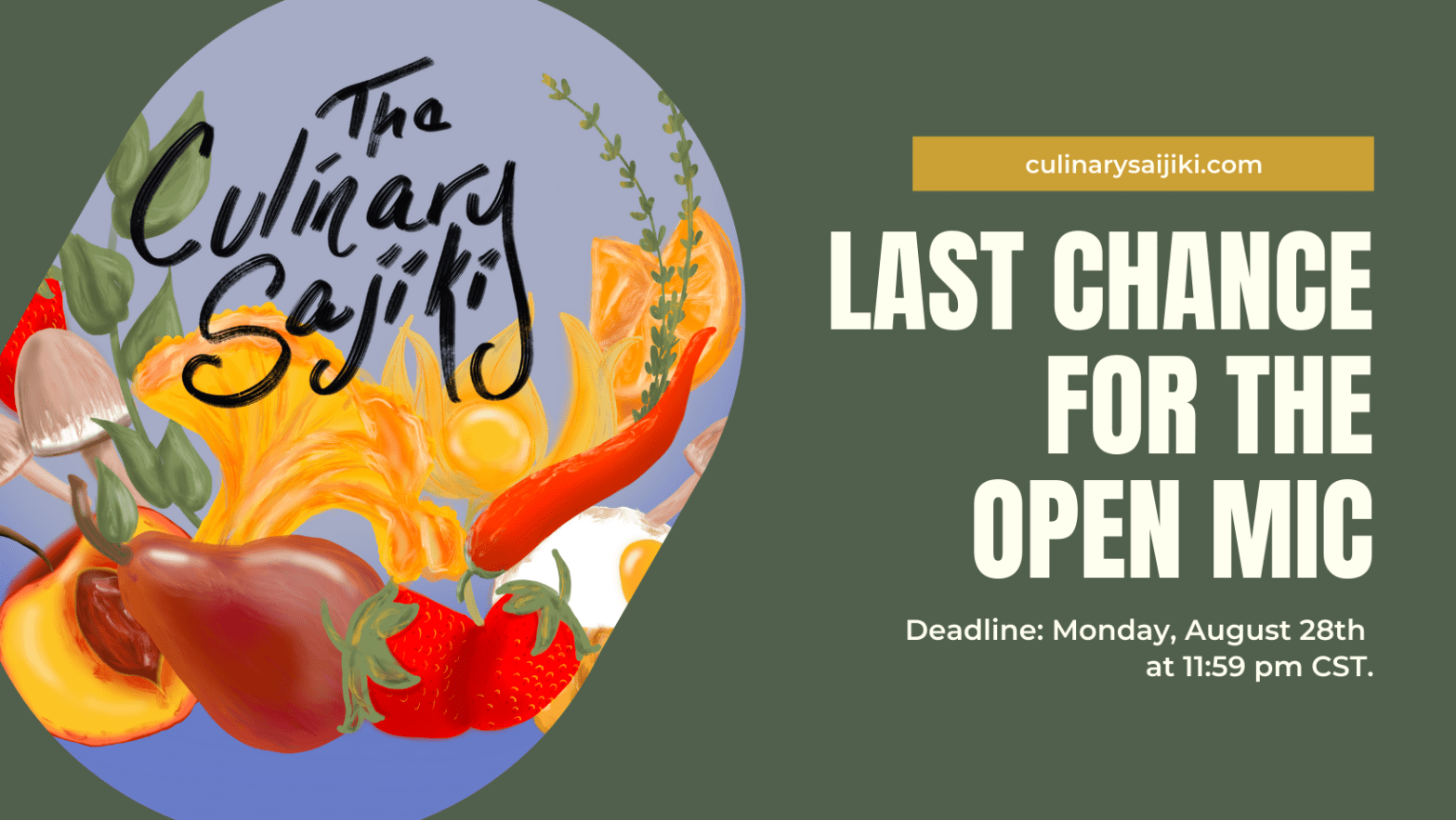
  • Reminder: Last Chance for the Podcast Open Mic!

    Reminder: Last Chance for the Podcast Open Mic!

    There is just one week left to submit some food haiku for the community open mic! This is the only open mic of season 2, so don’t wait around for next time. Otherwise, you’ll be waiting until 2024! Read on for full submission details.

    First, a reminder that if you run into any issues submitting your work, please email me at the address below. I’m happy to help!

    Due to changes in the Spotify for Podcasters interface, there are now two options for sending your work:

    1. Record your haiku and email the file to me at allyson@allysonwhipple.com. You can use your voice memo app and attach it to an email. It’s the simplest option this season.
    2. Send a voice message through Spotify (requires a free Spotify for Podcasters account): ⁠⁠⁠https://podcasters.spotify.com/pod/show/culinarysaijiki/message⁠⁠⁠

    You only need to choose one of the above options.

    New Deadline: Monday, August 28th at 11:59 pm CST.

    Theme: Transitions

    Details:

    • Remember to mention food in some way
    • You are welcome to record up to three (3) haiku
    • Please say your name before your haiku
    • Please read each haiku twice
    • Please keep your haiku family-friendly