I’ve decided to shake up the structure a bit for this post. In the abundant set of samples that royal_teacups sent me, she included four from Kusmi Tea. When I was looking through my spreadsheet to consider which tastings to write about for this entry, I noticed how nice and stacked the four of them were in my spreadsheet, and decided it would be a nice change of pace to devote one update to a single company’s samples.
I found Kusmi Tea to be a true delight all around, so these reviews are going to be positive across the board. However, while all the teas were good, I enjoyed some more than others, and you’ll see those preferences reflected below. All in all, no matter what your Earl Grey preferences are, you will probably find something to love from Kusmi.
Earl Grey (Classic Earl)
In my opinion, there are two true classic types of blended teas: Earl Grey and Chai. (Should I repeat this project next year with chai? Let me know in the comments!) And any tea company that sells blends (rather than exclusively plain tea) is going to include at least one Earl Grey and one Chai on their blend roster. And I also recognize that if a company has one or more fantastic Earl Grey variations, they probably feel compelled to offer a traditional Earl Grey for the customers who want the simple, classic blend.
However, when a company’s Earl Grey variations are so unique and of such high quality, I find that the traditional Earl Grey pales a bit in comparison. That’s not to say that the Kusmi Earl Grey is bad; it’s a lovely, straight-up Earl Grey. The tea smells lovely in the sachet, has a nice body and aroma, and has a quintessential Earl Grey flavor.
Ultimately, I have no real complaints about this blend, except that it just doesn’t stand out when Ksumi is already offering three other exceptional Earl Grey variations, one of which I found to be truly exceptional. I understand why they need to offer a standard Earl Grey, and they certainly blend it impeccably. If you’re an Earl Grey fan, you won’t be disappointed by this blend. However, the variations Kusmi offers are the true stars of the show.
Earl Grey Intense (Special Variation)
On the Kusmi website, Earl Grey Intense is described as, “an even bolder bergamot oil and particularly tangy lemon peel.” The addition of lemon peel puts this in the Special Variation category.
The steeped liquor is a nice amber color. Although the blend was billed as having a heavy citrus presence, the tea scent came through first when I smelled the liquor. On taste, I tasted tea first, then the lemon came through, with bergamot at the finish. In addition, as the tea cooled down, both citrus flavors became more prominent.
All in all, this was a brisk, fresh tea that made for an enjoyable cup. I imagine that this would be lovely prepared as a cold-brewed iced tea; you wouldn’t need to add any lemon to it. In addition, the flavors are balanced enough that I don’t think it requires any sweetener, whether prepared hot or iced. Between the quality of the tea leaves and the brightness of the citrus, this tea doesn’t have any bitterness. Although it’s called Intense, I think this would be a lovely blend for any tea drinker who likes Earl Grey in general.
Prince Vladimir (Special Variation)
The website describes the Prince Vladimir blend as containing grapefruit, orange, and lime in addition to the standard bergamot. This tea blend is also topped off with a bit of vanilla. Kusmi also notes cloves in the ingredient list. Obviously, with the number of additions, I consider this a Special Variation.
The steeped liquor has a nice body and an incredible scent. The clove and citrus really come through as the steam rises from my cup. When I drink this brew, I note the vanilla first, then the various citrus components, then the clove.
Although not heavily spiced, this tea reminds me a bit of Christmas. Crates of oranges were a Christmas staple when I was growing up, and of course cloves invoke the holiday season. While not overtly a holiday tea, I could see this right at home at a Christmas or Thanksgiving table.
Anastasia (Special Variation)
The Anastasia blend is my clear favorite of the Kusmi lineup. According to the Kusmi website, this blend includes lemon and orange blossom in addition to bergamot and black tea. The dry leaf is the most fragrant of these four blends, and is absolutely gorgeous, filling my whole kitchen with the scent of citrus.
The steeped liquor has a medium body, and when I smell it, I get the scent of tea first, followed by citrus. That order was consistent when tasting the tea as well. I think the inclusion of orange blossom was what made this taste extra-refreshing. It’s perfect for spring and summer, and like the Earl Grey Intense, this would be lovely as a cold-brew iced tea. I also don’t think it requires any sweetener, though if you like your tea sweet, I think honey would complement the orange blossom oil quite well.
When I finished my sample of the Anastasia blend, I immediately wished that I had more. This is the kind of tea that I could definitely drink all day long. It’s extremely sippable, with mellow black tea and bright citrus. This one is going on my best-of list, and definitely will have a regular place in my tea cabinet.
By the Numbers
I’ve officially reached the minimum number of teas I need to sample in the month of June, once again keeping comfortably ahead of schedule. And I’m now more than halfway through the tasting portion of this project!
Since I’ve only had four more teas since my last update, the proportions haven’t changed much. For reference, though I have many teas in my queue, I don’t classify them ahead of time; their category doesn’t get noted in the spreadsheet until I drink it. I prefer to update the teas as I go so the classification pie chart reflects my real-time tea drinking as closely as possible.
I’ve also now tasted nearly everything in my queue so far. I’ll have to buy a few more teas in order to meet my quota for July. I’ve enjoyed working my way through this long list of tea, and I’m also excited to add some new blends to my lineup. I have a long wishlist, and I haven’t decided what to purchase next. There are so many options for fantastic tea!
Enjoying this series? You can support my tea wishlist here, or contact me if you have samples you want to share!
For more tea content, check out my tea pairings playlist on YouTube.
Project References
Note: This is an ongoing list of all the reading I have done so far for this project. The bibliographic entries here are not necessarily cited in this specific post.
American Chemical Society. (1965). “Bergamot Joins Lineup Of Synthetic Oils: Glidden process breaks down ß-pinene, back-blends components.” Chemical & Engineering News Archive 43 (33), 24-25. DOI: 10.1021/cen-v043n033.p024a
Avila-Sosa, Raúl et. al. “Bergamot (Citrus bergamia) Oils.” Essential Oils in Food Preservation, Flavor and Safety. Ed. Preedy, V.R. (2015). Elsevier Science & Technology. pp. 247-252. http://dx.doi.org/10.1016/B978-0-12-416641-7.00027-4
Di Giacomi, Angelo and Giovanni Dugo. “Origin, History, and Diffusion.” Citrus bergamia: Bergamot and Its Derivatives. Ed. Dugo, Giovanni and Ivana Bonaccorsi. Boca Raton: CRC Press, 2013. pp. 1-8. https://doi.org/10.1201/b15375
Dugo, Giovanni and Ivana Bonaccorsi. “Composition of Leaf Oils.” Citrus bergamia: Bergamot and Its Derivatives. Ed. Dugo, Giovanni and Ivana Bonaccorsi. Boca Raton: CRC Press, 2013. pp. 227-236. https://doi.org/10.1201/b15375
Lo Curto, Rosario. “Uses of Juice and By-Products.” Citrus bergamia: Bergamot and Its Derivatives. Ed. Dugo, Giovanni and Ivana Bonaccorsi. Boca Raton: CRC Press, 2013. pp. 531-542. https://doi.org/10.1201/b15375
Note: This essay was originally intended to run in the January issue of the Haiku Society of America newsletter. However, it got preempted by an obituary for an HSA member. Given that this piece won’t be timely in February, I figured I might as well share it here, so it doesn’t just linger on my hard drive. (Because if I save it for 2025, I will probably forget that it exists.)
As someone who takes on a shocking number of projects, you probably aren’t surprised that I love the reflection and goal-setting aspect of the new year. I’m also wary of absolutes like, “You should write every day.” As we go through the different seasons of life, our relationship to our poetry evolves. I wanted to start out 2024 with a list of practices you can use to support your haiku practice. Whether you’re a new practitioner, or more seasoned and looking for fresh inspiration, I hope some of these ideas resonate with you.
1. Sign up for a time-bound daily writing challenge such as National Haiku Writing Month (https://www.nahaiwrimo.com/) or Poetry Postcard Fest (https://cascadiapoeticslab.org/poetrypostcards/). Daily writing is a fantastic discipline, and committing to a one-month period can make it seem like a more manageable task. (Note that Poetry Postcard Fest is not specific to haiku/senryu, but the postcard format is a perfect fit!)
2. If you feel extra ambitious about daily writing, try the Buson Challenge: 10 haiku a day for 100 days. (I confess I have attempted this challenge at least four times and haven’t yet succeeded.) You can listen to Mike Rehling talk about the challenge here: 3 Michael Rehling.
3. Make a calendar of submission deadlines for the coming year. Most publications have their deadlines established already, and you can set up recurring deadlines easily using Google Calendar or iCal. Don’t forget to turn on email or push notifications so you always get a reminder! (I like to set notifications for both the opening date and closing date.)
4. If you don’t have a system yet for tracking your haiku submissions, this is the year to set one up! Most of us (myself included) have accidentally submitted something that’s out for consideration elsewhere. A solid submission system helps! There are many services out there, such as Duotrope, that help you track your submissions (usually for a fee). However, you can use a spreadsheet or Word document as well. I’ve been using a color-coded Excel spreadsheet for three years, and it works great!
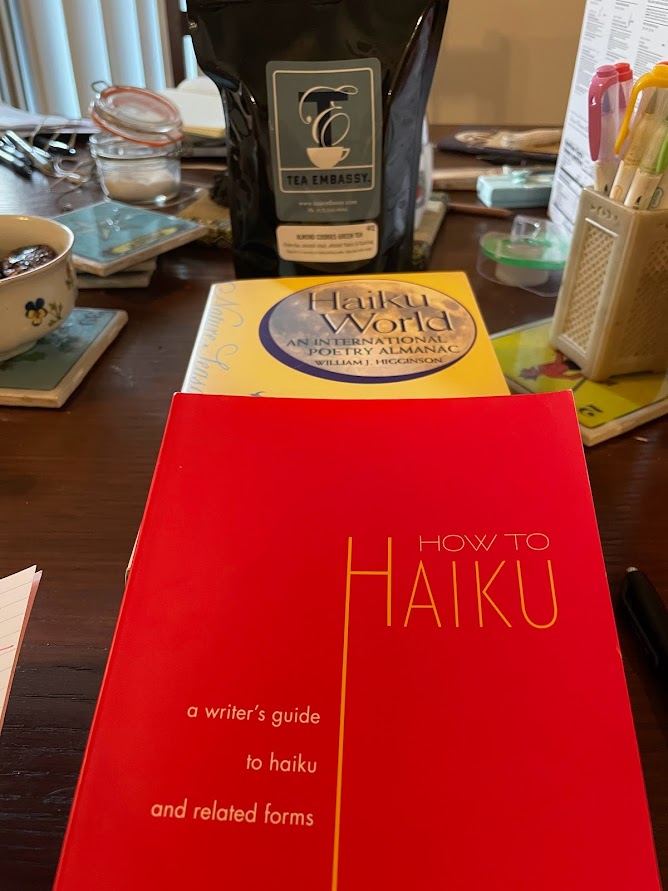
5. Work with a saijiki (a compendium of kigo), picking one word a day to start as a jumping-off point. My favorite is William J. Higginson’s Haiku World: An International Poetry Almanac. However, it’s out of print and copies can be expensive. I am also a fan of Jane Reichhold’s A Dictionary of Haiku, available as a free PDF from the Haiku Foundation.
6. Commit to a revision streak. Often, we get focused on generating new work and don’t devote as much time to revision. Consider taking a few weeks off from writing new poems (unless you get struck with divine inspiration, of course!) and focus on daily revision of existing work.
7. Spend a chunk of time every day observing your environment: sunrise and sunset, traffic patterns (they can be seasonal!), the emergence of plants, the clothes that people wear. Start to develop your own personal saijiki related to the area where you live.
8. We often overlook the sense of smell in our writing. Try spending a week writing down every scent you encounter as you go about daily life. Use your scent list as a springboard for your haiku, senryu, and other forms.
9. Join forces with a haiku friend or a small group and write some renku, rengay, or split sequences. If you don’t have a writing buddy in your area, you can write via email, online chat, text message, or Zoom.
10. Participate in a ginkgo (haiku walk). If you don’t have a group in your area to walk with, you can have a solitary ginkgo. (Or maybe start a ginkgo group in your area!) You can learn more about ginkgo practice in the article “Haiku as a Nature Connection Practice” from seasonwords.com.
11. Make a small chapbook as a birthday or holiday gift for a loved one, especially if you have a number of haiku/senryu written about them and experiences you have shared.
12. Take a poetic risk this year: submit to a journal or contest that feels out of reach, self-publish a collection, give a public reading, or start a podcast. Maybe launch a print-on-demand store of postcards featuring your haiga. Whatever is calling to you but seems scary, give it a shot.
Which of these ideas will you try this year? Let me know! And be sure to check back in to tell me about your experience.