Haiku and a Cup of Tea

  • The Earl Grey Year Part 4: Greens and Tisanes

    The Earl Grey Year Part 4: Greens and Tisanes

    Before diving into Part 4 of this series, I want to take a moment to thank Mark of seasonwords.com for making a contribution to my project wish list! The Winter White Earl Grey he funded has been ordered and should arrive by the end of the week! 

    While I had initially planned to only write a blog post when I had consumed four teas in each category, last month taught me how things like shipping issues could throw a wrench in those plans. In addition, looking at my current queue, it’s clear that certain types of Earl Grey are simply far more prevalent than others. In order to prevent the tasting rate and the blogging rate somewhat proportional, I decided to feature two smaller categories in this week’s update.

    Two Green Earls

    I classify a Green Earl Grey as any blend that consists of green tea and bergamot. (While there are some blends that combine green and black tea, I have placed those in a separate category.) Since green tea ranges from grassy to smoky, and has a flavor quite distinct from black tea, I think that Green Earl blends are worth exploring, even if you haven’t enjoyed standard Earl Grey in the past. Hopefully you’re inspired to try one of these!

    Earl Grey Green, Adagio

    This Adagio Teas blend contains green tea (variety unspecified, though I’m guessing sencha), orange peels, natural bergamot flavor,and cornflowers. The leaves, citrus, and flower petals look lovely in the infuser basket. The dry leaves and the wet leaves both have a nice scent, with the citrus coming forward. 

    The stepped tea itself is very bergamot- and citrus-forward. I actually don’t get much green tea flavor at all. However, the bergamot/citrus is not overwhelming, which suggests to me that the tea is doing some subtle work to keep everything in balance. This would probably be lovely as a cold-brew iced tea.

    Since green teas can usually be resteeped 2-3 times, I factored that into my analysis of this category as well. Unfortunately, most of the bergamot and citrus did not come through on a second infusion. The green tea is still nice, but if you’re looking for sustained bergamot across multiple infusions, you’re not likely to find that here.

    Duke of Earl, Cove Tea Company

    At last, the chance to sample my long-delayed Cove Tea Company package. I’m happy to say it was worth the wait. This blend contains green tea and specifies that it uses Italian bergamot. It’s a truly straightforward, no-fuss variation on this classic tea. 

    The dry leaves smell lovely; the bergamot comes through quite well. The taste has a nice progression: a hit of green tea at the front, with the bergamot blossoming at the back. It’s a light blend, but also complex. In my reading this week, I learned that “Bergamot essential oil produced in Italy is ranked as of the highest quality at the international trading market” (Avila-Sosa et. al, 2015, p. 247). In the course of this project, I had already started to notice that bergamot marked with its country of origin tends to contribute to a better-tasting tea. While I’m finding things to like about bergamot from all regions, the biggest takeaway so far is that when a blender uses bergamot with a named location, I am probably going to have a more pleasurable tasting experience. 

    In terms of resteeping the tea, the bergamot is still present on a second infusion, but considerably weaker, but still quite enjoyable. The bergamot doesn’t really survive a third infusion, but you’re still getting a nice cup of green with a whisper of citrus. This is a lovely blend perfect for the onset of spring.

    Two Tisane Earls

    A Tisane Earl is any blend that does not use actual tea, but rather an herb such as rooibos or honeybush as the base. Of course, bergamot is a nonnegotiable part of the mixture. Tisane Earls are generally a good option for people who love the taste of bergamot but can’t have caffeine. (However, be sure to check with your doctor to ensure that the herbs in question don’t interfere with any medications you may be on or worsen any medical conditions you might have.) So far, rooibos is the most common herb I’ve found as the base of an Earl Grey tisane.

    Earl Grey Rooibos, Artful Tea

    Rooibos seems to be the kind of herb that people either love or hate, with little in-between. For me, it was love at first sip, but even with my general enthusiasm, I know that some types of herbs, oils, and flowers work better with rooibos than others. While I’ve been a fan of rooibos as an Earl Grey base for most of my adult life, I also know it can be difficult to pull off well. Rooibos is assertive and strong; bergamot is much lighter. 

    Fortunately, the blenders at Artful Tea understand how to balance out bergamot oil with the rooibos to ensure a pleasurable drinking experience. What’s especially impressive is that they make this work while sticking to the basics. The blend consists only of rooibos and bergamot oil. There is no extra citrus, no flowers, no other herbs to balance things out. When you stick to just the two ingredients, they have to be just right. There’s no room to hide, and the team at Artful Tea pulls this off masterfully. A common refrain on internet memes is, “10/10, no notes,” and really, I can’t think of a better way to describe this tisane. 

    If you don’t like rooibos at all, you probably want to skip this one. I think bergamot is a delightful addition, but it certainly doesn’t make the rooibos disappear. But rooibos fans should give this a try, especially if you haven’t had any sort of rooibos-based Earl Grey yet.

    Rooibos Earl Grey, Adagio

    For many years, the only Earl Grey blend I would drink was the Rooibos Earl Grey. Adagio was the first brand I tried, but I’ve enjoyed plenty of others as well. Based on my earlier bad experience with regular Earl Grey (discussed in Part 3 of this series), I refused for the better part of a decade to drink any sort of real tea with bergamot. 

    For their Rooibos Earl Grey, Adagio combines rooibos orange, blue cornflowers, and natural bergamot flavor. Although I haven’t had this particular blend in quite some time, I’m happy to report that it’s as enjoyable as I remember.

    Like most Adagio teas and tisanes, the dry blend is quite pretty. The rooibos smell dominates, but once the hot water is added, the bergamot and orange peel come through. Drinking the infused tea, I find a well-balanced cup where the rooibos and bergamot both come through. I think that’s impressive, because rooibos can be heavy-handed. I think the orange peel helps to keep things well-balanced and keep the rooibos from overpowering everything else. 

    If you don’t like rooibos, you should avoid this blend, because the bergamot and orange peel don’t make it go away. However, if you’re a rooibos fan, give this a try. It certainly has a special place on my tea shelf.

    By the Numbers

    As of this writing, I’ve tasted 23 different Earl Grey blends. It’s hard to believe that at the end of the month, I’ll be more than 25% of the way through the tasting portion of this challenge! I’m pretty sure I’ve already had more Earl Grey this year than I have in the rest of my adult life, which I find amusing. The good thing is that I’m not tired of it yet!

    While classic versions of Earl Grey are still the best represented, other categories are beginning to stand out. I’m close to having enough of both Creme Earl Grey and Special Variations to give each of those a post of their own, though honestly, based on this post, maybe I should do another half and half in order to keep the blogging momentum going. 

    I have close to 50 teas in my tasting queue, which is exciting. It’s a good feeling to not feel like I have to hurry up and buy more tea. That being said, there are still 50 teas to add. If you have any suggestions, leave a comment! If it already happens to be on my list, I’ll consider that a sign to make it a priority tea.

    Support the Project

    Read previous installments here:
    The Earl Grey Year Part 1: Four Classics
    The Earl Grey Year Part 2: Four Florals
    The Earl Grey Year Part 3: Four More Classics

    Enjoying this series? You can support my tea wishlist here, or contact me if you have samples you want to share! 

    For more tea content, check out my tea pairings playlist on YouTube.

    Project References

    Note: This is an ongoing list of all the reading I have done so far for this project. The bibliographic entries here are not necessarily cited in this specific post.

    Avila-Sosa, Raúl et. al.  “Bergamot (Citrus bergamia) Oils.” Essential Oils in Food Preservation, Flavor and Safety. Ed. Preedy, V.R. (2015). Elsevier Science & Technology. pp. 247-252. http://dx.doi.org/10.1016/B978-0-12-416641-7.00027-4

    Heale, Christopher. (n.d.) “A Guide to the Tea Grading System.” Herbs & Kettles. https://www.herbsandkettles.com/blogs/blog/a-guide-to-the-tea-grading-system 

    Twinings. (n.d.) “What is Bergamot?” https://twinings.co.uk/blogs/news/what-is-bergamot

  • The Best of It: February 2024 Edition

    The Best of It: February 2024 Edition

    1. I managed to complete the Run for Your Beads 5k in roller skates!
    2. The pot stickers and crab rangoon at Stew’s Place.
    3. Hosting a pre-parade Mardi Gras breakfast taco party for my neighbors.
    4. Getting to meet up with my friend Heather for dinner.
    5. Finally nailing my French Onion Soup recipe
  • The Earl Grey Year Part 3: Four More Classics

    The Earl Grey Year Part 3: Four More Classics

    Between winter weather and the foibles of the United States Postal Service, I was worried that I was going to completely lose momentum on this project in February. Although I had plenty of tea on hand to stay on track with the tasting schedule (I only need to sample 9 blends a month to stay on track), I didn’t have enough variety to get four teas in the same category, which meant I couldn’t keep up with blog posts. 

    The short version of the story is that January’s winter storms meant that my samples from Cove Tea Company went out about two weeks later than planned. Obviously that couldn’t be helped. But the parcel got shipped as soon as the weather cleared, and was supposed to be delivered by February 6th. After it cleared customs on the West Coast, it was at a distribution center in St. Louis . . . and then for some reason sent to Chicago to go through customs again. After that, it bypassed St. Louis and ended up in Dallas, then Louisiana, and then went through another round of customs in Miami before finally making it to my house on February 26th. And at no point was anyone at USPS able to offer me an explanation for what happened. But I have to say, nothing creates a business/customer bond like the shared experience of constantly tracking the adventures of a tea package that seems to be having a great road trip.

    Fortunately, my friend @royal_teacups on Instagram sent me an abundance of Earl Grey samples. Although the package had to make its way across the ocean, somehow it arrived in just over a week, while my Canada package was meandering all over the place! I really appreciate Inessa’s generosity because a number of the samples she sent me would be difficult to get in the United States. Plus I get to try some brands I might have never encountered otherwise! This bumper crop of tea samples meant I finally had enough classic blends to do another post on that category.

    Four More Classics

    As a reminder, I define a classic Earl Grey as containing black tea and bergamot. No more, no less. The tea can be single-source or it can be a blend, and the bergamot could be from any of the various regions, but a standard Earl Grey should only contain these two things. 
    In this post, I cover some Earl Grey teas from companies large and small, including a revisit of the first Earl Grey I ever tried. The final two teas are part of the package that @royal_teacups sent me.

    Earl Grey, Bigelow

    Back in my first post for this project, I alluded to the fact that a certain Earl Grey tea making me ill caused me to avoid the blend for years. For the sake of being polite, I chose not to reveal the name of that brand. After all, I was still new to tea; perhaps an error in my preparation had made it that unpalatable. But since I ended up drinking the Bigelow Earl Grey for this project, I think the context is important.

    I didn’t set out to revisit the Bigelow Earl Grey. I have not consumed a cup of it since that day in my dorm 18 years ago, when I could make it only halfway through the cup. However, one day I was eating lunch at work and noticed that, among the assortment of bagged teas in the breakroom, were several boxes of Bigelow Earl Grey. And I figured it would be foolish to not make a cup of it for this project, especially when it was freely available and only required a walk across the office to acquire. Acquiring 100 different Earl Grey teas requires a bit of effort, so once in a while, it’s worth going for the low-hanging fruit.
    I’m happy to report that this time around, the Bigelow Earl Grey did not produce any ill effects! In fact, I was surprised to find myself loving the first sip! The bergamot was more toward the lemon end of the spectrum (as opposed to orange), and the blend was smooth. Unfortunately, as the tea cooled the bergamot flavor seemed to weaken. I suspect that this tea being in a standard commercial tea bag (as opposed to a sachet or loose leaf) is part of the problem. The leaves in commercial tea bags tend to be fannings (or sometimes dust, but I imagine a company like Bigelow uses fannings), and while those can produce a highly concentrated tea flavor, sometimes that can overwhelm other aspects of a blend. (For more information on fanning and other tea grading terms, check out this great blog post from Herbs & Kettles: A Guide to the Tea Grading System.”)
    Earl Grey Français, Artful Tea

    Although the name might suggest otherwise, this blend from Artful Tea is a straight-up classic. The tea base is a blend of Ceylon and Yunnan teas, and the Français in the name refers to the French bergamot that is used for flavoring.  

    In my quest to understand the differences between Italian, Turkish, and now French bergamot (which so far have been largely unsuccessful), I did learn that bergamot became fashionable in France in the 16th century, when aristocrats wore it in perfume. (For more information on the history of bergamot, check out “What is Bergamot?” from the Twinings blog.)

    This is an absolutely beautiful blend, and is my favorite of the teas I tried for this post. I think there’s something about French bergamot that really resonates with my palate, because I tried this tea on January 26th (over a month before I was able to write this post), and I am still thinking about what an excellent tea it is. This blend uses Yunnan tea as the base, and something about that particular tea with the right amount of French bergamot is magical.  

    It’s on par with my known favorite, the Eastside Earl Grey (EEG) from The Steeping Room. Once I’m done collecting samples of Earl Grey from far and wide, this is a tea that I can see living alongside the EEG as a permanent part of my tea stash.

    Earl Grey, Magasin du Nord

    Magasin du Nord is a famous department store in Copenhagen, so I’m grateful to @royal_teacups for the teamail, since I don’t imagine I’d have had a chance to try this otherwise! I did have to run the website description of the tea through Google Translate, but thanks to translation software, I was able to find out that this Earl Grey uses a blend of black teas, though it doesn’t specify which ones.

    Whatever teas they use, the black tea flavor is delightful. The bergamot tends toward the subtle side. As I sampled it, the main word that came to mind was “refreshing.” Even though I was drinking this tea hot on an unseasonably warm day (80 degrees Fahrenheit in February!), I truly felt refreshed after drinking it. There’s no bitterness to the tea; everything is bright and delicious. This is an easy tea to drink. Between the smoothness of the tea and the lightness of the bergamot, I don’t think this particular tea would be enhanced by milk or cream. If you like sweetener, though, I think honey would be a marvelous addition to this blend.

    Decaf Earl Grey, Lupicia

    This tea really fell flat for me. The leaves looked nice; this tea was packaged in a pyramid sachet so the leaves had room to expand. However, after steeping this tea from Lupicia, the best adjective I could come up with was bland. It wasn’t a terrible tea; the Keemun they used had a strong, earthy flavor. But I could barely detect any bergamot. I tasted the black tea almost exclusively, and had to really seek out traces of citrus.

    I admit to having a bias against decaffeinated tea, but I did my level best to go into this tasting with an open mind. When I was really having trouble picking up the bergamot flavor, I even took a break and drank some sparkling water to cleanse my palate and try again. Ultimately, though, I didn’t particularly enjoy this as an Earl Grey.

    By the Numbers

    I’m closing out February slightly ahead of schedule, with a total of 20 teas sampled since the start of the year. With all the tea mail I got at the end of the month, I don’t need to worry about acquiring more samples for a while, which is a good feeling. The volume of Earl Grey in my tea collection also means that I’m going to be able to write these blog posts more frequently. 

    A pie chart showing that my tea tasting project is 20% complete

    Traditional Earl Grey blends still dominate the tasting list (no surprise, considering this is the second post devoted to them). However, in February I also drank more special variations, and also added some Earl Greys made with green tea, as well as some Earl Grey tisanes (herbal teas). 

    A pie chart indicating the proportions of each type of tea I've consumed so far.

    With the new samples that have come in, I expect to be able to write about special variations and tisane Earl Greys in the near future. I’m also excited to finally be able to delve into the variety of samples I got from Cove Tea Company!

    Support the Project

    Read previous installments here:
    The Earl Grey Year Part 1: Four Classics
    The Earl Grey Year Part 2: Four Florals

    Enjoying this series? You can support my tea wishlist here, or contact me if you have samples you want to share! 

    For more tea content, check out my tea pairings playlist on YouTube.

  • The Best of It: January 2024 Edition

    The Best of It: January 2024 Edition

    1. Attending my first Mardi Gras ball
    2. Beginning my Tea Sommelier training
    3. Returning to writing practice
    4. Making butternut squash and leek risotto
    5. My nephew’s 4th birthday party
  • The Earl Grey Year Part 2: Four Florals

    The Earl Grey Year Part 2: Four Florals

    This was supposed to be a blog post about four Lady Grey teas. Because until this past Tuesday, I was living under the belief that Lady Grey tea was Earl Grey with lavender. I was living under this impression because the only tea named Lady Grey that I drink regularly is from The Steeping Room, and that contains lavender. But after seeing a number of Earl Grey and lavender teas that weren’t called Lady Grey, and also noticing that the Edith Grey from Big Heart Tea Company contained rose, I began to question whether or not I actually knew what the Lady Grey blend was supposed to include. 

    I ended up creating polls on Threads and my Instagram Stories soliciting input on what Lady Grey tea actually is. Some people shared helpful articles or left comments and voice notes. I learned two things from my polls:

    1. Lady Grey tea was in fact developed by Twinings in the 1990s. It’s a trademarked blend that includes lemon and orange peel in addition to bergamot. 
    2. I’m not the only one who was confused about Lady Grey tea.

    My Threads poll showed the greatest Lady Grey literacy; most people identified the blend as Earl Grey plus citrus, but over a third of respondents thought that Lady Grey contained lavender. (One commenter said they thought that Lady Grey simply contained less bergamot than regular Earl Grey, which is also a thing I have heard, but can’t remember seeing.)

    A screenshot of my Threads poll about Lady Grey tea.

    On my Instagram stories, on the other hand, 75% of respondents said they believed that Lady Grey contained lavender, while only 25% correctly identified it as Earl Grey with citrus peel. 

    A screenshot of my Instagram poll about Lady Grey tea

    I had initially been tracking every floral Earl Grey as a Lady Grey tea, but now that I know otherwise, I have changed the category to Floral Grey. Rather than just have a category for Earl Grey with lavender, I created a more expansive title to focus on any sort of floral inclusion. I think Earl Grey is a fantastic base for any number of flowers, and I don’t want to pigeonhole too many blends in a miscellaneous category, so Floral Grey is the new category from here on out.

    Four Floral Grey Teas

    This week’s entry doesn’t just introduce the category of Floral Greys. I also get to write about two local companies! All of these companies have online ordering, allowing you to sample their teas even if you live far away.

    Organic Lady Grey Black Tea, The Steeping Room, Austin, TX

    Although billed as a Lady Grey, this is a lavender-based blend. The ingredient list includes black tea, lavender flowers, bergamot oil, and lavender extract. The dry leaves look absolutely gorgeous with a fragrance to match.

    This blend has a mellow sweetness to it, almost like honey. I’m not sure what specific black tea is used in the blend, but it’s a nice, well-rolled full leaf, and I’m guessing it’s the characteristics of the tea bringing out that particular flavor. The ratios of bergamot and lavender also work well together. I find bergamot to be a little delicate, and because of that it can be overpowered by other flavors. But the folks at The Steeping Room have struck a solid balance. While their Eastside Earl Grey remains my favorite, this is an excellent tea for lavender-lovers.

    Edith Grey, Big Heart Tea Co., St. Louis, MO

    This is the only blend in this week’s update that does not include lavender. Per the Big Heart Tea Company website, Edith Grey tea contains single-origin Malawi tea, bergamot oil, and rose. I got this blend as part of the 12 Days of Cozy Tea calendar I bought back in December. (Since I was already doing a standard advent calendar, I saved the 12 days for the actual Christmas period, though I actually ended up saving this blend so I could drink it as part of the project.)

    I really wanted to love this tea. Rose is an iffy flavor for me, but I always want to be able to champion my local businesses. While many of the teas in the Cozy Tea Calendar were fantastic, I’m sorry to say that the Edith Grey blend wasn’t one of them. Neither the bergamot nor the rose came through enough for me, and considering I often find rose overwhelming, that’s really saying something. The black tea base was excellent, but unfortunately, it dominated the rest of the inclusions.

    I will say that among existing Big Heart customers, the Edith Grey is a popular blend, with 4.7 stars (out of a possible 5); the blend is also often sold out. Perhaps the amount that ended up in my Cozy Calendar teabag was not a representative sample; perhaps the physical proportions were unbalanced. 

    (Because I just can’t bring myself to be totally negative about a small, local business, I will say that there were other teas in the Cozy Calendar that I loved. The Winter Chai and Royal Treatmint were my favorites.)

    Earl Grey with Lavender, Cornucopia Kitchen, Kirkwood, MO

    I received a sample of Cornucopia’s Earl Grey with Lavender blend from a coworker when she saw me drinking a cup of Earl Grey at the office. She didn’t even know I was doing this project, just gave me a bit of her purchase in order to share the joy of tea! I can’t speak much to the specifics of this blend, because Cornucopia has a minimalist website, but on the whole, I enjoyed it.

    In this cup, I found the lavender to outshine the bergamot in both the smell and the initial taste. That being said, as the tea cooled, the bergamot flavor was able to come through a bit more. Of the lavender Earl’s I’ve tasted so far, this one had perhaps the weakest bergamot taste, but it was nonetheless enjoyable. (It’s also worth remembering that everyone’s palate is different, and while I crave a hearty bergamot taste, that’s not everyone’s preference.)I think someone who is iffy about the taste of bergamot but wants to explore more Earl Grey teas would enjoy this very much. 

    While I don’t get out to Kirkwood very often, the next time I find myself in the neighborhood, I will make sure to pay Cornucopia a visit, and I would probably purchase this blend again.

    Earl Grey Lavender, Artful Tea, Santa Fe, NM

    Artful Tea’s take on a floral Earl Grey is my favorite of this category so far. While the aesthetics of the dry leaf aren’t everything (a dry tea can be visually stunning but taste terrible . . . we’ve all been there), the addition of cornflower petals alongside the lavender creates a blend that is gorgeous to look at both before and after steeping. 

    While the lavender is the star of the show, it manages to shine without overwhelming the bergamot. I think that the addition of the cornflower petals helps balance things out. While cornflowers are often considered to have a neutral flavor, I know many people (myself included) detect a faint sweetness from them. I’m not a supertaster, but whenever I taste cornflower in a blend, it brings with it a sort of light, creamy sweetness. 

    This is a tea I will definitely add to my Earl Grey rotation. The only reason I wouldn’t recommend this to someone is if they didn’t like lavender, because that particular flavor is unmistakable. Other than that, though, I think this is an excellent blend.

    By the Numbers

    As of this writing, I’ve tasted 11 different Earl Grey teas, putting me slightly ahead for February. I have 8 more untasted teas in my spreadsheet, plus my Instagram friend royal_teacups is going to mail me some Earl Grey from Denmark! When February starts I’ll finish my Artful Tea samples, as well as dive into the Cove Tea Company samples that got delayed two weeks due to the wild winter weather.  

    A pie chart illustrating project completion.

    Classic Earl Grey teas are still the dominant style I’ve had, with Floral Greys in a close second. While I haven’t tasted an Earl Grey tisanes yet, I have a few in the queue, as well as some more special blends. I’m not sure yet whether I’ll return to Classic Earls in the next post, or branch out. We’ll see where the tasting menu takes me! 

    A pie chart illustrating which categories of tea I have tasted so far.

    Support the Project

    Read previous installments here:
    The Earl Grey Year Part 1: Four Classics

    Enjoying this series? You can support my tea wishlist here, or contact me if you have samples you want to share! 

    For more tea content, check out my tea pairings playlist on YouTube.

  • S209: Where I’ve Been and Where I’m Going

    S209: Where I’ve Been and Where I’m Going

    When you perpetually avoid something on your to-do list for months, at some point, you have to take a hard look at why.

    In the case of this podcast and blog, I realized two things:

    1. I have learned so much from podcasting, and had a great time doing it, but at the end of the day, when I have limited time to pursue my creative endeavors, that just wasn’t what I wanted to work on.
    2. Putting out regular blog and podcast content was preventing me from moving forward with putting together a Culinary Saijiki book manuscript.

    Yet while I was always finding reasons to postpone work on this aspect of the project, the fact that it was left unresolved was also keeping me from moving forward.

    While I always struggle to leave things behind (even though I know it’s time), I’ve recorded this short episode today to formally wrap up this phase of the project. In doing so, I make public my commitment to have a draft by the end of the year, and free myself of the unfinished business that was keeping me from delving into the book phase of this project.

    I will always be grateful for the conversations I got to have, for the opportunity to present on this subject at Haiku North America, and for the ways in which the podcast and blog work helped me developed my editorial and aesthetic foci for the book. I can’t wait to see what’s next, and I hope you’re as excited as I am.

    Thank You to all of my podcast guests, including open mic participants. I enjoyed talking about haiku and sharing your work. Our conversations brought fresh insights to this project and propelled me forward.

    Thank You to everyone who bought me a tea (I recently change my Buy Me a Coffee purchase to reflect my love of tea). Your support made a difference in terms of being able to keep this running.

    Keep an eye on this space, the Buy Me a Coffee page, and my personal website for book progress updates. Keeping you in the loop is how I’ll stay accountable to getting a draft done by the end of the year.

  • The Best of It: Astrid’s Best Life Edition

    The Best of It: Astrid’s Best Life Edition

    Note: On January 5th, our dog Astrid unexpectedly suffered a grand mal seizure. Despite imaging, testing, and medical interventions from our vet, her health continued to decline rapidly. On January 15th, the good folks at Lap of Love helped her cross the rainbow bridge at home, wrapped in blankets, and with us holding her. I am grateful that she was able to have a good life and a good death.

    1. Little Debbie Oatmeal Cream Pies, Arby’s sliders, and canned tuna.
    2. Zoomies around the yard, at the farm, or at the cabin.
    3. Rolling in dirt, mud, and raccoon poop. (Even if the humans were unhappy about it.)
    4. Blankets and stuffed animals.
    5. Sunbeams.
  • The Earl Grey Year Part 1: Four Classics

    The Earl Grey Year Part 1: Four Classics

    Welcome to a 25-part blog series in which I review (kind of) 100 different Earl Grey teas over the course of 2024. I wanted to do a big tea-based project, and ultimately, drinking a range of Earl Greys seemed like the best bet. 100 different Earl Grey teas is a lot, but really, I have to drink less than 10 a month, and if you knew how much tea I drank on the regular, you would realize that’s a perfectly reasonable challenge. Earl Grey is also a tea that doesn’t necessarily need milk or sweetener. It’s versatile, bright, and honestly, was a tea that took me a while to like. So challenging myself to really go deep into this style of tea seems like a fun way to develop my palate.

    Each post will consist of four sections: a discussion of four teas I’ve tried, grouped by category, and then a breakdown of my progress on the tasting journey, including charts that show what I’ve drank across categories. I hope you enjoy this tea journey as much as I do!

    Four Classics Earl Grey Teas


    I define Classic Earl Grey as containing only two things: black tea and bergamot. Of course, there are a number of Earl Grey variations, and I have set up categories for those. For this initial post, though, I want to focus on four versions of the standard blend.

    Eastside Earl Grey – The Steeping Room, Austin, TX

    Eastside Earl Grey is at a distinct advantage, as it’s a long-established favorite. In fact, when I first tried Earl Grey back in 2006, I hated it. It actually made me throw up! It wasn’t until 2022, when I made an Earl Grey ice cream pie, that I tried the tea again. I went to The Steeping Room to buy their Eastside Earl Grey because I wanted to use quality tea as part of my pie. The pie was delicious, but with all the cream and sugar in the pie, I wasn’t sure I really loved the tea, or if the parts I disliked were mitigated. Of course, there was plenty left over, so rather than waste it, I started brewing it. To my surprise, I couldn’t get enough. I was finally an Earl Grey convert.

    The Eastside Earl Grey uses real Italian bergamot, and I think both the real and the Italian make a difference. I understand why some tea companies make the decision to use artificial bergamot. But the way mashed potatoes from scratch are more satisfying than mashed potatoes from a box, real bergamot makes a better impression than artificial. Sure, there is a time and place for boxed mashed potatoes; in fact, they might scratch a sentimental itch. And there is a time and place to use artificial bergamot. But tasting an Earl Grey that uses a real bergamot was a game–changer.

    Ultimately, this tea holds such a special place in my heart that it will be tough for any other Earl Grey to compare. This was the first tea I drank in 2024, and though it’s a familiar cup for my palate, it always tastes fresh.

    Earl Grey Classic – Fortnum & Mason, London

    It feels sacreligious to say that I didn’t like this blend. Fortnum & Mason is a legend. The bergamot smell was strong on the dry leaves, but I wrote in my tea journal, “It feels like as soon as the water hits the leaves, the bergamot washes away.” Of course, that’s not literally true. Otherwise there would be at least one cup with an overwhelming hit of bergamot. Certainly, though, that was how it felt over the course of drinking six cups of it, hoping that I would find something to like. But infusion after infusion, I couldn’t taste the bergamot once it was steeped. 

    Fortnum & Mason doesn’t specify on their website what kind of bergamot. The ingredients for this blend are “Tea, Flavouring.” (I admit that I love the simplicity.) Since it’s not specific, it’s tough for me to point to a specific reason why this tea didn’t work for me. I did also note how small the leaves were. Compared to the Eastside Earl Grey, which has big, full leaves (see, I told you this was the standard), these were tiny, and just didn’t look visually appealing either dry or wet. Again, there are no specifics about the tea, so it’s tough for me to make a definitive statement, but it certainly didn’t help things. 

    (Don’t worry, I had a much better experience with Fortnum’s Smoky Earl Grey, but that’s a topic for another post.)

    Earl Grey Organic – Tea Market, Kansas City, MO

    I appreciate that Tea Market includes the specific teas included in this blend. There are three black teas in this Earl Grey: Assam, Ceylon, and Nilgiri. In addition, they use Turkish bergamot instead of Italian. I tried to do some research on the differences between Turkish and Italian bergamot. Reading some scientific abstracts online, there are definitely some differences in the various chemical compounds. Unfortunately, I couldn’t get access to the full articles, so all I could discern is that Turkish and Italian bergamot are not exactly the same. But this is only the first post of the year, and I am confident that eventually, I can probably get access to some quality scientific information. 

    Like the Eastside Earl Grey, I found this blend to be incredibly well-balanced. I felt that the bergamot was more subtle than the Eastside Earl Grey. I’m not sure if that’s because of the specific chemical components of Turkish bergamot, or something specific to my palate. While I prefer a bolder level of bergamot, ultimately, this was still an enjoyable Earl Grey that I would drink again. 

    I find that there are two types of people who are resistant to traditional Earl Grey: those who do not like black tea, and those who do not like bergamot. For someone who is skeptical of Earl Grey and knows they don’t love bergamot, this might be a good one for them to try. It’s a great example of a bergamot that is flavorful without being aggressive. This could easily be a tea that converts someone to Earl Grey.

    Earl Grey – Artful Tea, Santa Fe, NM

    The kind folks at Artful Tea sent me samples of all four of their Earl Grey blends. Thanks to Karen and the team for supporting this project!

    The classic Earl Grey from Artful Tea is similar in balance to the version from Tea Market, in that the bergamot is subtle, but the black tea is not overpowering. This is another version of Earl Grey that would be great for a skeptic who doesn’t love bergamot. I certainly understand that skepticism. When I first tried an Earl Grey in 2006 and got sick, it was because of the bergamot flavor. (Side note: since I began writing this blog post, I decided to give that brand another try . . . but that’s a post for another day!) In both this blend and the Tea Market blend, you can taste the black tea and bergamot easily; neither overpowers the other.

    The Artful Tea approach to Earl Grey involves straight Yunnan tea rather than a blend of teas. In addition, like most blenders, it uses Italian bergamot. One of the things I noticed in my tasting was that sometimes bergamot tastes more toward the lemon end of the spectrum, and sometimes it tastes more orange. As someone who is more partial to lemon and less partial to orange, this is a blend that will have a regular place on my shelf. One of the things I should consider in future study is whether Italian bergamot has more lemon-related compounds than orange. 

    That being said, there are a number of factors that can influence the molecular structure of bergamot. Soil quality and climate conditions can have an effect on the fruits from year to year. We can’t just say Italian bergamot always tastes one way, Turkish always tastes another, and Greek a third way. There are no absolutes, and honestly, I think that’s lovely.

    By the Numbers

    As of this writing, I’ve tasted 8/100 Earl Grey teas. I need to taste 9 a month to stay on track, and with 10 days left to go in the month, that’s reasonable. I’m taking a little tasting break through the weekend to avoid boredom, and also to focus on the tasting homework for my tea sommelier training. (Yesterday I started sampling the delights from the Lunar New Year box from The Steeping Room, and today I am enjoying some samples from the My New Favorite Tea box.) 

    As far as categories go, I’ve sampled four classic Earl Greys, two Lady Greys, one Creme Earl Grey, and one special variation. I will elaborate more on those categories in future posts. My plan is to sample two more Lady Grey teas and have that be the focus of my next post. I’ll do my best to do four of the same category in each write-up, but I might not be able to do that if I want to stay consistent. We’ll see! If you have any recommendations for Earl Grey teas for me to sample, please leave a comment!

    Support the Project

    Enjoying this series? You can support my tea wish list here, or send me a DM on Instagram if you have samples you want to share! (I’m now realizing I don’t have a proper contact page on this site, but I’ll remedy that for the next post.)

    For more tea content, check out my tea pairings playlist on YouTube.

  • The Best of It: 2023 Edition

    1. My first trip to London
    2. My first time attending Haiku North America
    3. The publication of Postcards from Texas, my first all-haiku chapbook
    4. Editing the 2023 Haiku Society of America members’ anthology
    5. Completing both my comprehensive and national Pilates certifications
  • 12 Haiku Resolutions for the New Year

    12 Haiku Resolutions for the New Year

    Note: This essay was originally intended to run in the January issue of the Haiku Society of America newsletter. However, it got preempted by an obituary for an HSA member. Given that this piece won’t be timely in February, I figured I might as well share it here, so it doesn’t just linger on my hard drive. (Because if I save it for 2025, I will probably forget that it exists.)

    As someone who takes on a shocking number of projects, you probably aren’t surprised that I love the reflection and goal-setting aspect of the new year. I’m also wary of absolutes like, “You should write every day.” As we go through the different seasons of life, our relationship to our poetry evolves. I wanted to start out 2024 with a list of practices you can use to support your haiku practice. Whether you’re a new practitioner, or more seasoned and looking for fresh inspiration, I hope some of these ideas resonate with you.

    1. Sign up for a time-bound daily writing challenge such as National Haiku Writing Month (https://www.nahaiwrimo.com/) or Poetry Postcard Fest (https://cascadiapoeticslab.org/poetrypostcards/). Daily writing is a fantastic discipline, and committing to a one-month period can make it seem like a more manageable task. (Note that Poetry Postcard Fest is not specific to haiku/senryu, but the postcard format is a perfect fit!)

    2. If you feel extra ambitious about daily writing, try the Buson Challenge: 10 haiku a day for 100 days. (I confess I have attempted this challenge at least four times and haven’t yet succeeded.) You can listen to Mike Rehling talk about the challenge here: 3 Michael Rehling.  

    3. Make a calendar of submission deadlines for the coming year. Most publications have their deadlines established already, and you can set up recurring deadlines easily using Google Calendar or iCal. Don’t forget to turn on email or push notifications so you always get a reminder! (I like to set notifications for both the opening date and closing date.)

    4. If you don’t have a system yet for tracking your haiku submissions, this is the year to set one up! Most of us (myself included) have accidentally submitted something that’s out for consideration elsewhere. A solid submission system helps! There are many services out there, such as Duotrope, that help you track your submissions (usually for a fee). However, you can use a spreadsheet or Word document as well. I’ve been using a color-coded Excel spreadsheet for three years, and it works great!

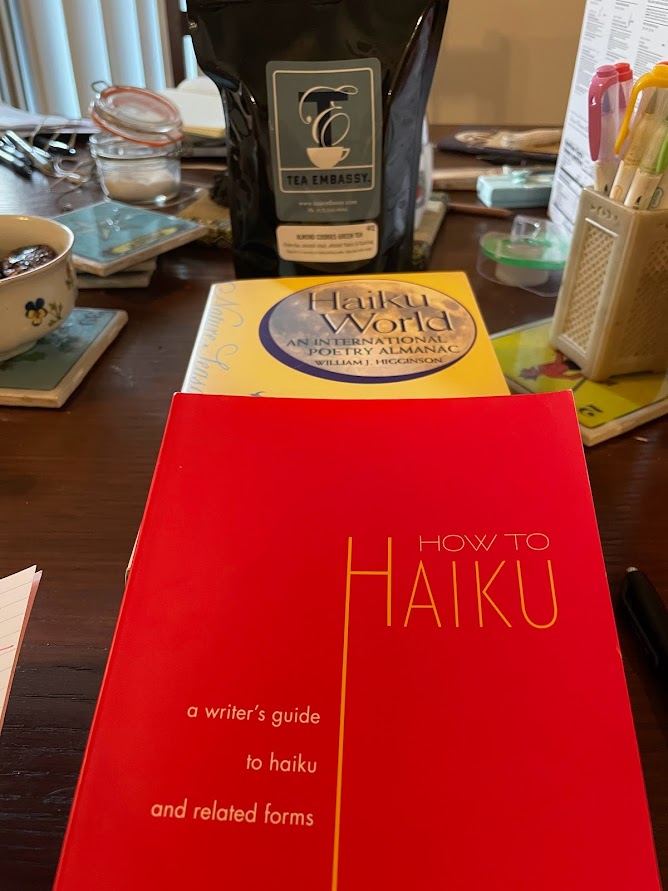
    5. Work with a saijiki (a compendium of kigo), picking one word a day to start as a jumping-off point. My favorite is William J. Higginson’s Haiku World: An International Poetry Almanac. However, it’s out of print and copies can be expensive. I am also a fan of Jane Reichhold’s A Dictionary of Haiku, available as a free PDF from the Haiku Foundation

    6. Commit to a revision streak. Often, we get focused on generating new work and don’t devote as much time to revision. Consider taking a few weeks off from writing new poems (unless you get struck with divine inspiration, of course!) and focus on daily revision of existing work. 

    7. Spend a chunk of time every day observing your environment: sunrise and sunset, traffic patterns (they can be seasonal!), the emergence of plants, the clothes that people wear. Start to develop your own personal saijiki related to the area where you live. 

    8. We often overlook the sense of smell in our writing. Try spending a week writing down every scent you encounter as you go about daily life. Use your scent list as a springboard for your haiku, senryu, and other forms.

    9. Join forces with a haiku friend or a small group and write some renku, rengay, or split sequences. If you don’t have a writing buddy in your area, you can write via email, online chat, text message, or Zoom.

    10. Participate in a ginkgo (haiku walk). If you don’t have a group in your area to walk with, you can have a solitary ginkgo. (Or maybe start a ginkgo group in your area!) You can learn more about ginkgo practice in the article “Haiku as a Nature Connection Practice” from seasonwords.com.

    11. Make a small chapbook as a birthday or holiday gift for a loved one, especially if you have a number of haiku/senryu written about them and experiences you have shared.

    12. Take a poetic risk this year: submit to a journal or contest that feels out of reach, self-publish a collection, give a public reading, or start a podcast. Maybe launch a print-on-demand store of postcards featuring your haiga. Whatever is calling to you but seems scary, give it a shot. 

    Which of these ideas will you try this year? Let me know! And be sure to check back in to tell me about your experience.